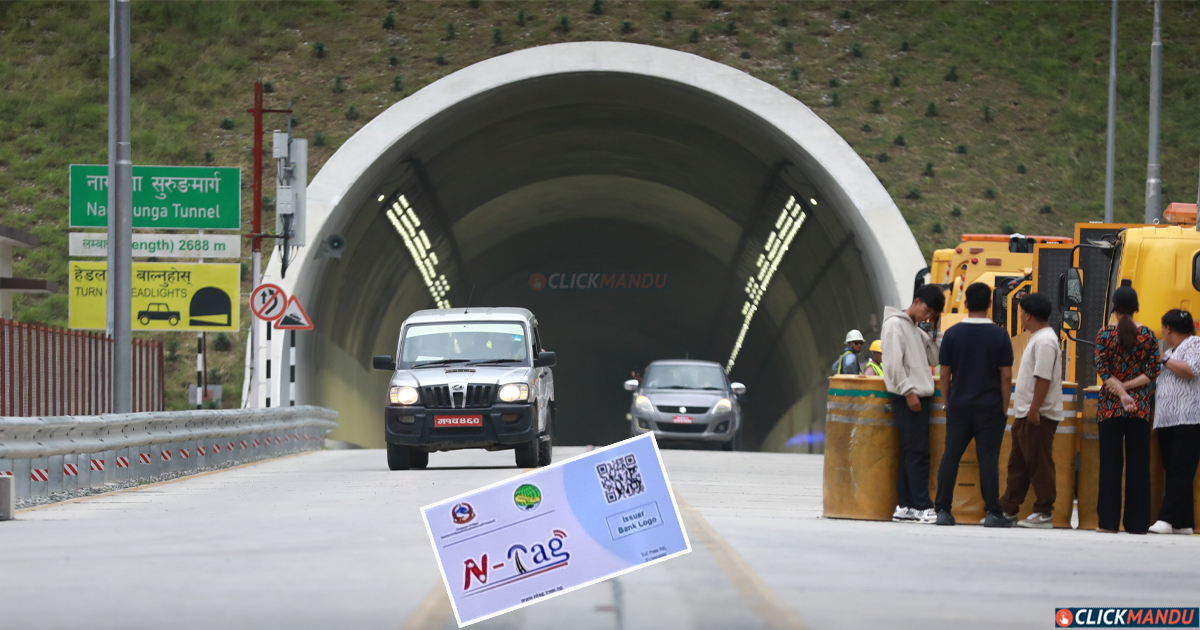

Kathmandu: Authorities in Kathmandu have announced that vehicles travelling through the Nagdhunga Tunnel will no longer be permitted to pay toll fees in cash.
Instead, a mandatory digital payment system has been established, requiring all motorists to settle their road usage fees through an electronic platform. To facilitate this transition, the government has introduced a specialized digital payment card known as the “N-Tag,” designed specifically for seamless transactions at tunnel entry and exit points.
Barring any unforeseen complications, the government is in the final stages of preparation to formally inaugurate and open the tunnel to the public next Monday. This technological shift is being implemented to eliminate the traditional hassles of manual cash transactions and the resulting traffic congestion. Managed by the Road Board under the Ministry of Physical Infrastructure and Transport, the payment infrastructure is designed to ensure a faster and more efficient flow of traffic through this critical transit point.
Ganesh Bahadur KC, the Executive Director of the Road Board, confirmed that the toll collection will utilize a combination of “N-Tag” digital cards and Radio Frequency Identification (RFID) stickers. For regular users—particularly commercial vehicles such as long- and short-haul buses, freight trucks, and tourist transport—the use of these digital tags is now mandatory. Meanwhile, casual travellers and foreign tourists visiting in their own vehicles from India or China will temporarily be allowed to pay the government-mandated fees by scanning QR codes.
The Board initially plans to focus the mandatory rollout on registered transport entrepreneurs and institutional operators who use the route frequently. While private vehicles that use the tunnel occasionally are not yet required to adopt the RFID system, authorities may expand the mandate in the future based on necessity. Rather than enforcing rigid rules immediately, the Board plans to provide counselling and support to vehicle owners during the initial phase to foster a smooth transition toward a fully digital ecosystem.
The RFID technology functions similarly to automated office access systems, where a digital sensor at the toll gate identifies a specialized sticker affixed to the vehicle’s windshield. This sticker is linked to the owner’s information and bank account. Once the system scans the sticker, the driver or authorized staff completes the payment by swiping their N-Tag card at a terminal. Upon a successful transaction, the toll barrier opens automatically and closes once the vehicle has passed through, ensuring a transparent and secure payment process.
This initiative aligns with a 2026 directive from the Nepal Rastra Bank, which authorized only Class ‘A’ commercial banks to issue RFID-based prepaid tags for road toll collection. Beyond facilitating payments, the Department of Transport Management highlights that these stickers will provide the added benefit of vehicle tracking, allowing authorities to monitor the status and movement of vehicles more effectively.
To date, the Road Board has signed agreements with five major commercial banks—Global IME, Nabil, Kumari, Nepal Investment Mega, and Machhapuchhre Bank—to provide these digital services. Kumari Bank alone has already prepared 10,000 N-Tag cards for the launch phase. These tags function as rechargeable units, available in denominations of 1,000, 2,000, and 5,000 rupees, and can be reloaded via bank applications or digital wallets as the balance is depleted.
To obtain the necessary hardware, vehicle owners must first register and create a profile on the Road Board’s official website. After entering their vehicle details, they will receive a submission number, which must be presented along with the vehicle’s registration blue book and national identity documents at a participating bank or authorized agent. Once the RFID sticker is affixed to the windshield and the N-Tag card is purchased, motorists will be fully equipped to use the tunnel’s modern payment infrastructure.

Comment Here