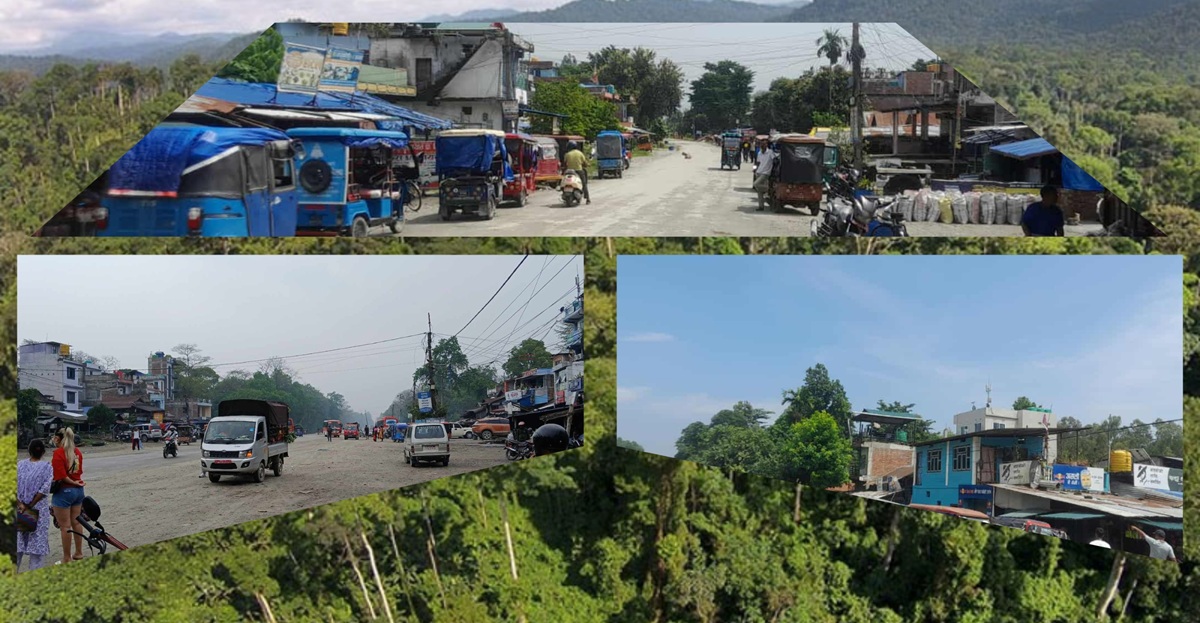

Biratnagar: Once one of Nepal’s most expansive forests, the Char-Koshe jungle in Morang district has shrunk dramatically, with more than 11,000 hectares lost to human encroachment, according to government data supported by a Finnish-funded aerial survey.
Official records show the forest covered 55,500 hectares, but today it has been reduced to 44,500 hectares. Much of the land is now occupied by dense settlements, established in the name of squatters and politically backed settlers.
The National Land Commission is preparing to distribute land ownership certificates to these residents, in a move critics say legitimizes decades of illegal occupation.
For decades, towns and markets have sprung up on what was once dense woodland. Letang, for example, lies entirely on forest land, its origins tracing back to a 1967 flood that forced villagers to relocate into the jungle. Today, nearly 4,000 households live there, though most are not landless but landowners and politically connected settlers.
Other areas such as Pathari, Kanepokhari, Belbari, Sundarharaicha, and Biratchowk also sit on forest land. In Pathari alone, officials count more than 6,000 squatters, though only about 200 families are genuinely landless. Many politicians and landlords have reportedly built large houses by seizing land under the guise of squatter settlements.
Kanepokhari Rural Municipality even used government development funds to construct an agricultural market inside a community forest. Belbari and Sundarharaicha municipalities report more than 2,500 families living on encroached forest areas.
The Division Forest Office in Morang confirmed the loss, acknowledging that attempts to reclaim land have failed due to lack of inter-agency cooperation. “When one state body tries to recover forest land but another legitimizes encroachment, Char-Koshe will remain only on paper,” said office chief Utsav Thapa.
The situation is further complicated by infrastructure projects. The Asian Highway is cutting through remaining forest areas, but the full extent of its impact has not been assessed.
Meanwhile, the government is formalizing encroachment. The Land Commission plans to issue ownership certificates to families settled for decades, charging nominal fees — 5 percent of land value in agricultural areas and 10 percent in residential zones. By October, more than 2,500 families are expected to receive certificates.
On paper, Char-Koshe remains under provincial jurisdiction, spanning 55,500 hectares and divided into 141 community forests, 32 scientific forests, and four collaborative forests. However, “scientific forest management” has already allowed felling of valuable sal trees, drawing criticism for encouraging exploitation.
In response, the provincial government has shifted toward a “Sustainable Forest Management Programme,” aiming to balance conservation with human settlement.
Once dense and unbroken, Char-Koshe is now fragmented by markets, highways, and expanding settlements. Critics argue that government indecision and contradictory policies are accelerating the decline of one of Nepal’s most important forest belts — leaving Char-Koshe in danger of surviving only in official records.

Comment Here