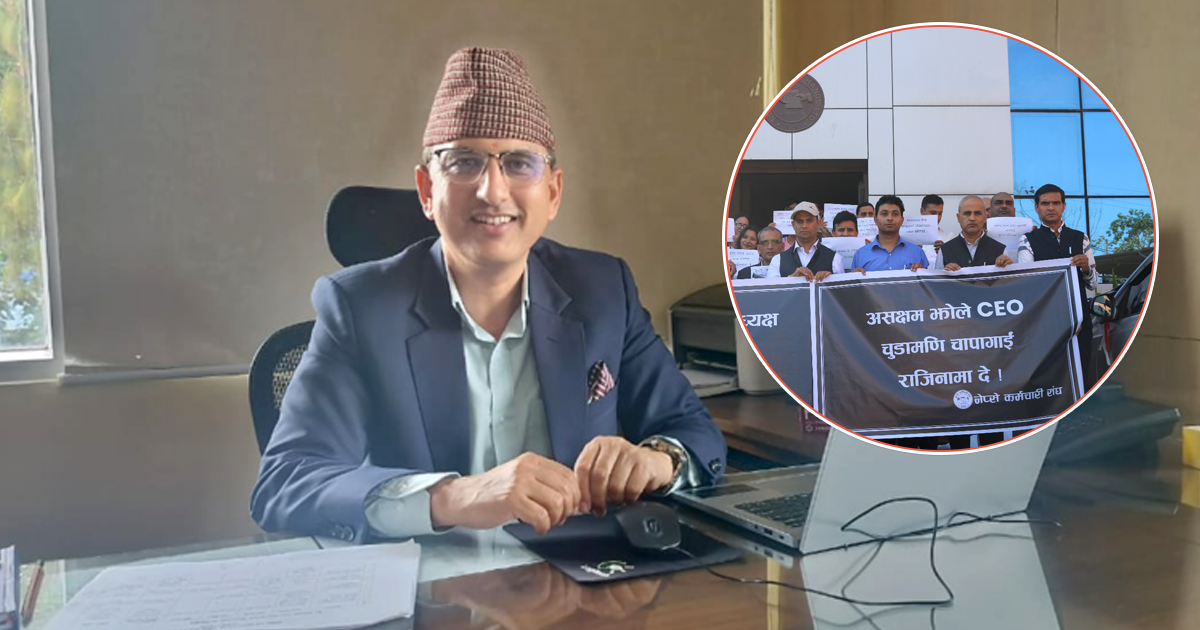

Kathmandu: The writ petition filed by the Nepal Stock Exchange (NEPSE) Board of Directors, demanding that employee bonuses be maintained at 1 percent rather than 5 percent, is currently under consideration in the Supreme Court.
Following the filing of the case by the Board in the Supreme Court, a single bench of Justice Manoj Kumar Sharma issued a show-cause order to the respondents last Wednesday and has summoned both parties for discussion on an interim order on November 8.
Due to the bonus dispute, NEPSE’s Chief Executive Officer (CEO) Chudamani Chapagain left the office at midnight on October 23 after a heated argument with employees and has not reported to work since. Even after 36 days, the CEO has not attended the office, and with the court case pending, NEPSE’s leadership has shown no urgency in building trust with employees, engaging in discussions, or exploring solutions.
Although NEPSE employees won the case in the labour court for a 5 percent bonus from the company’s profits, CEO Chapagain had to leave the office after the decision to file a writ against it.
Furthermore, last Tuesday, the NEPSE Board, authorized by Chapagain, filed a writ in the Supreme Court naming the Bhaktapur Labour Court, the Teku Labour and Employment Office in Kathmandu, and the NEPSE Employees’ Union as respondents, placing him in the crosshairs of the employees. The employees had won the case in the labour court for a 5 percent bonus from the company’s profits.
CEO Chapagain was aware that opposing the employees, who had won the 5 percent bonus case in court, could lead to his boycott from the office. However, he did not seek to avoid it or explore alternatives. As the bonus dispute escalated, he showed no interest in playing a mediating role.
“The CEO could have acted as a bridge between the board and employees, playing a mediating role. He had the option to have the employees present their case to the board to convince them and protect himself,” said one official. “The employees had informed him about this, but he showed no interest.”
After refusing the employees’ request to play a mediating role, the NEPSE CEO became a target for them. By opposing the employees, Chapagain faced boycott not from a few but from all staff. The question now arises as to why the CEO proceeded with that decision, knowing it would lead to opposition from all employees.
After refusing the employees’ request to play a mediating role, the NEPSE CEO became a target for them. By opposing the employees, Chapagain faced boycott not from a few but from all staff.
Typically, it is uncommon for a CEO of any organization to stand against their own employees. Moreover, Chapagain has not even completed a full year as NEPSE CEO. In such a situation, the key question is why he did not hesitate to make a decision that led to his boycott from the office, and what could be the reasons behind it.
According to sources, the Ministry had instilled fear that if the 5 percent bonus was distributed to employees as per the court’s order, the Board itself would have to pay the amount. “In a situation where the court has ordered it, the NEPSE CEO did not need to overthink giving the 5 percent bonus; however, fear was created that the amount would later be recovered from the committee,” the source said. “After this, they decided to file a writ against the employees in the Supreme Court.”
According to him, the CEO reached this decision due to high pressure from the government. Indeed, the NEPSE Board is chaired by Hemant Basnyat, appointed by the Finance Ministry; Churamani Aryal as the Ministry’s representative; Subaschandra Ghimire as the Nepal Rastra Bank’s representative; Arya Joshi; and Pabal Regmi. In addition, NEPSE CEO Chapagain and Tikani Dhi Lohani serve as independent directors. Furthermore, although Murahari Parajuli is the company secretary for NEPSE, the number of government-appointed or government-side individuals on the Board is higher.
This suggests that decisions desired by the government or the Finance Ministry are more likely to prevail on the Board. However, employees are strongly opposing the move, saying there was no need to file a writ in the Supreme Court on the bonus issue, yet the Board proactively did so. The current situation at NEPSE is also being viewed as a step by the current government to revoke previous appointments.
“The government’s intent behind pushing the Board against employees and taking a settled court-decided issue to the Supreme Court can be seen as an attempt to bring in new people by revoking previous appointments,” said a NEPSE official. “Directly removing the current person and appointing a new one would raise questions, so creating problems to oust the previously appointed individual could be the strategy.”
NEPSE employees had been receiving a 5 percent bonus from the company’s net profits up to the fiscal year 2019/20. However, starting from 2020/21, the then Board Chair and CEO proposed reducing the 5 percent bonus that NEPSE had been providing to 1 percent. Although the then Board Chair discussed reducing the 5 percent bonus to 1 percent, the decision at the time was to maintain it at 5 percent.
However, the individual who raised the issue of reducing it to 1 percent brought it up with the Finance Ministry. As a result, the Finance Ministry set a limit, stating that only 1 percent bonus should be given instead of 5 percent. After not providing more than 1 percent bonus, the employees’ trade union went to the Bhaktapur Labour Court against that decision.
Since profit-making companies have the practice of setting aside a portion of their annual profits to distribute as bonuses to employees, and in fiscal year 2019/20 and previous years, the establishment had been distributing 5 percent of net profits as bonuses to employees, but this was halted, leading the employees to approach the court.
NEPSE employees had been receiving a 5 percent bonus from the company’s net profits up to the fiscal year 2019/20. However, starting from 2020/21, the then Board Chair and CEO proposed reducing the 5 percent bonus that NEPSE had been providing to 1 percent.
The union noted that even the bonus distributions before fiscal year 2019/20 were done with the approval of the Finance Ministry, and for fiscal year 2022/23, the Board’s decision to distribute 5 percent bonus had already been approved by the company’s general meeting. However, the Finance Ministry’s correspondence deciding to distribute only 1 percent of net profits as bonus for fiscal year 2022/23 was argued in court as being contrary to employees’ rights, the Bonus Act and Regulations, Labor Act and Regulations, and constitutional protections.
Given that 5 percent bonuses were distributed in previous fiscal years, the Labour and Employment Office’s decision not to distribute 5 percent bonus targeting one fiscal year was not in accordance with the law, so the employees demanded in court that the decision be annulled and their right to receive 5 percent bonus uniformly, as in past years, be protected. On this case, the Bhaktapur Labour Court ruled in favour of the employees on 3 July 2025.
In the dispute’s verdict, the Labour Court stated: “Based on the mentioned grounds and reasons, the decision of the Kathmandu Labour and Employment Office dated 27 November 2024 that employees at Nepal Stock Exchange Limited should not receive bonuses at 5 percent rate under Rule (6)1 of the Bonus Regulations 1982 is not found to be valid, as the respondent company is not a monopoly under Rule (6)2 of the Bonus Regulations 1982, among other reasons. Therefore, it is annulled, and it is determined that the employees of the respondent company shall receive 5 percent amount as bonus. For other matters, proceed as per details.”
Against this verdict, the NEPSE Board has gone to the Supreme Court seeking legal interpretation. Meanwhile, as the case proceeds in the Supreme Court, NEPSE employees continue their protests. After the CEO’s prolonged absence from the office, a notice stating “NEPSE CEO Missing” has been posted in the office. Additionally, papers reading “Our Movement Continues, Entry Prohibited: Chair Hemant Basnyat, CEO Chudamani Chapagain” have been pasted on office walls and the doors of the Chair and CEO’s chambers.

Comment Here