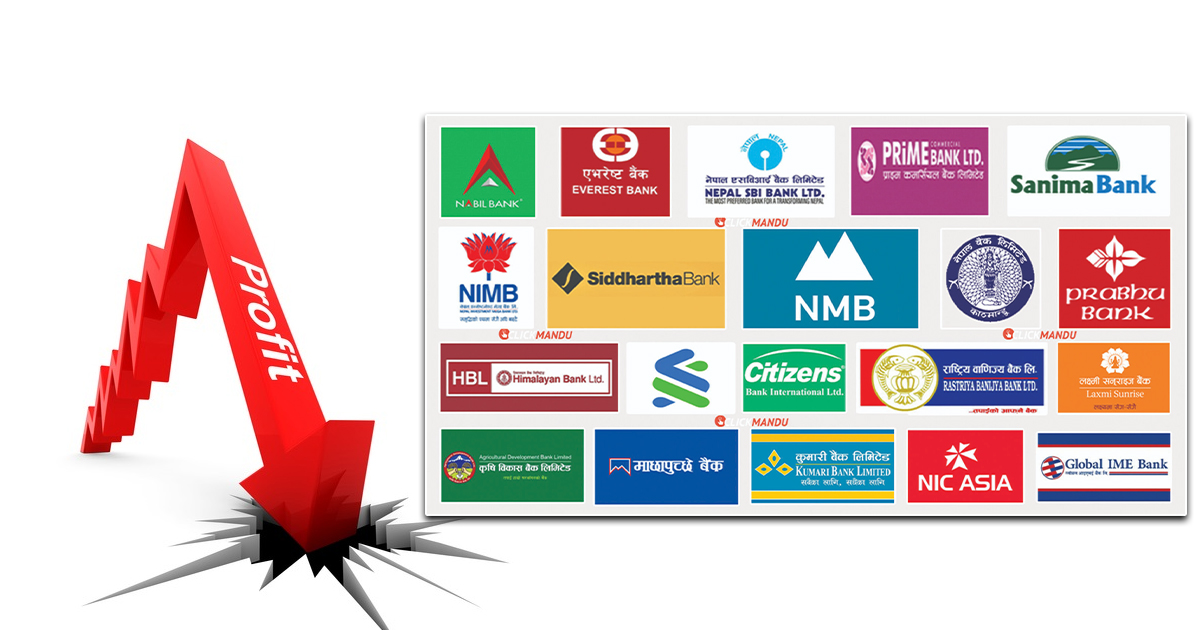

Kathmandu: The increase in non-performing loans, coupled with a rise in provisions for potential loan losses, has led to a decline in profits for most banks in the first quarter of the current fiscal year.
In the first quarter of the current fiscal year 2025/26, commercial banks earned a profit of Rs 13.14 billion.
This represents an 18.78 percent decrease compared to the same period in the previous fiscal year 2024/25. In the first quarter of the last fiscal year, banks had earned a profit of Rs 16.18 billion.
The provisions for potential loan losses by banks have nearly doubled compared to the first quarter of the previous year, resulting in a decline in profits for most banks.
In the first quarter alone, banks have set aside Rs 20.14 billion for potential loan losses.
In contrast, during the same period in the previous fiscal year, they had allocated only Rs 10.44 for potential loan losses. During this time, non-performing loans and overdue interest have also increased, according to Santosh Koirala, Chairman of the Nepal Bankers Association and Chief Executive Officer of Machhapuchhre Bank.
Out of the 20 operational banks, only five saw an increase in profits, while 15 experienced a decline. Citizens Bank has published financial statements showing an operating loss. While Global IME and Rastriya Banijya Bank showed significant improvements in profits, the financial statements of Everest, Nabil, Prime, NMB, and a few others appear balanced.
With non-performing loans rising and inability to collect interest, pressure has been mounting on banks such as Citizens, Nepal Investment Mega, Laxmi Sunrise, Himalayan, Kumari, and NIC Asia.
In the first quarter, Global IME Bank earned the highest profit of Rs 1.85 billion, which is 22.92 percent higher than the same period in the previous fiscal year. The bank’s profit increased significantly due to higher net interest income and a slight reduction in loan loss provisions compared to last year.
Meanwhile, Nabil Bank’s profit decreased by 14.57 percent to Rs 1.75 billion. The decline was due to a slight increase in loan loss provisions and a drop in income.
Although net interest income increased slightly, Prime Commercial Bank’s profit fell by 2.20 percent to Rs 1.28 billion due to higher provisions.
Similarly, Everest Bank’s profit rose by 4.57 percent to Rs 1.17 billion. Despite an increase in loan loss provisions compared to the first quarter of the previous fiscal year, the bank’s net interest income and overall revenue grew, leading to a modest profit increase.
Kumari Bank’s loan loss provisions doubled to Rs 1.26 billion, resulting in a 2.01 percent decline in profit to Rs 1.05 billion.
In the first quarter, Nepal Investment Mega Bank set aside the highest amount for loan loss provisions at Rs 2.80 billion, with a profit of only Rs 40.51 million.
Similarly, Laxmi Sunrise Bank allocated Rs 1.93 billion for loan loss provisions, earning a profit of Rs 330.23 million. Citizens Bank set aside Rs 1.73 billion for provisions and reported a loss of Rs 220 million in its financial statements.
Agriculture Development Bank allocated Rs 1.46 billion for loan loss provisions and earned a profit of Rs 5.7 million. Siddhartha Bank set aside Rs 1.38 for provisions and earned a profit of Rs 320 million.
Kumari Bank allocated Rs 1.26 billion for loan loss provisions and earned a profit of Rs 1.05 billion.
NIC Asia Bank allocated Rs 1.18 billion for loan loss provisions, Global IME Bank Rs 1.01 billion, and Prabhu Bank Rs 1.38 billion.
While Global IME had the highest profit, NIC Asia’s profit was Rs 120 million, and Prabhu Bank’s was Rs 550 million.
Bankers Association Chairman Koirala states that after the Gen-Z Movement, borrowers have shown reluctance to pay interest, leading to an increase in banks’ overdue interest and non-performing loans. He also notes that interest recovery was hindered due to floods and landslides following heavy rains right after Dashain.
Koirala believes that with floods, landslides, the Gen-Z Movement, and festivals like Dashain and Tihar occurring around the same time, there was insufficient time for interest payments or collections.
Bankers have stated that uncertainty has increased because groups like Durga Prasai have warned of intensifying protests, leading borrowers to withhold loan repayments. Bankers claim that due to these four reasons, non-performing loans and loan loss provisions have risen, resulting in profit declines and increased overdue interest. It is also reported that some capable business owners have not paid interest in hopes of receiving concessions.

Comment Here