
Steven Pinker is among the most respected intellectuals of our time. His books are storehouses of fascinating knowledge and are also delightfully stylish reads. However, this book contains some technicalities of linguistics which, for lay readers like me, can appear hard at times. In fact, on two occasions previously, I read about half of the book and then could go no further. This time, though, I pushed myself ahead almost forcefully for a while and found tremendous joy of understanding after some initial hardships.
Speaking and understanding language comes so easily to us that we take it for granted. Even kids as young as three, who cannot carry themselves out well in any other realm and would not survive by themselves, are linguistic geniuses. They are able to understand parents’ speech and form new creative sentences without being taught. We are able to appreciate the complexity and powerful computation that goes into the simple act of language-based communication when we imagine what it would take to install that ability within an artificial system like computer or robot.
How does every normal human mind achieve the stunning engineering feat of language is the main area of concern of this book. The book was published in 1994 before the advancement of AI technology but even after so many years of work by scientists and engineers, voice recognition technology is still not infallible. Yet, recognition is only a small part of what every normal human is able to do. We can imagine a machine that is perfect at recognizing the sound and even repeating it verbatim but not being able to grasp the meaning or implication of it. When I say “I am fine”, my friend not only recognizes the tone made up of syllables and phonemes but knows that I am talking about my wellbeing and not about the fine we pay for infringement of law. Based on the tone of my voice, she can also infer that I actually mean that I am not well or that I am displaying my disappointment towards her in a sarcastic manner. These are the feats which even ChatGPT probably cannot do, at least not yet, I hope.
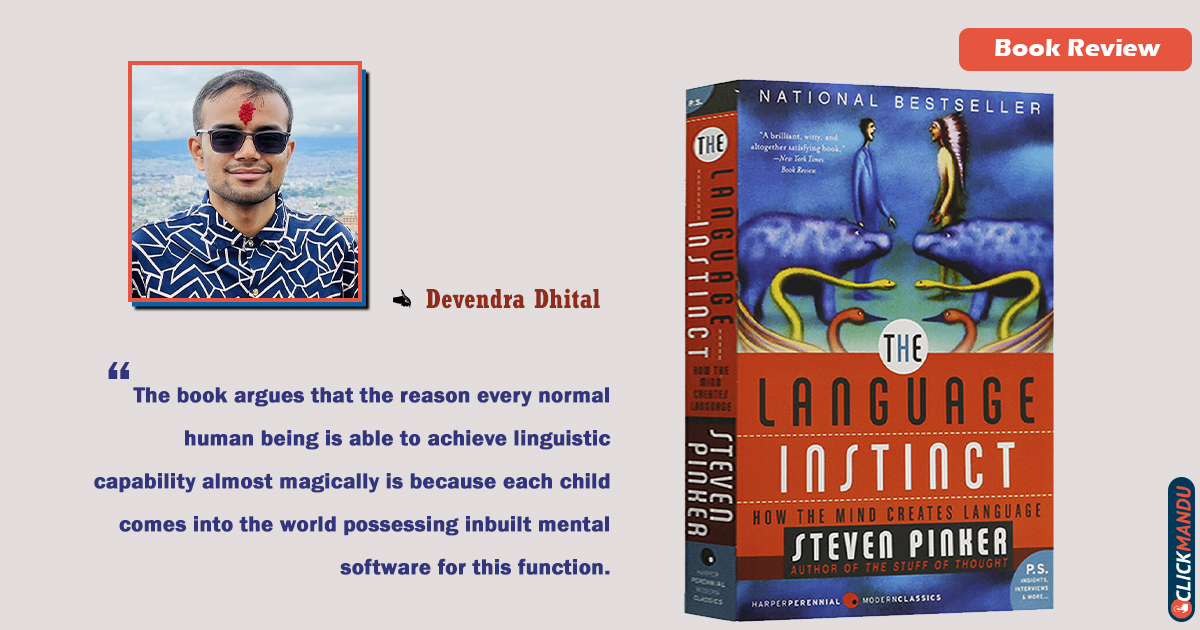
The book argues that the reason every normal human being is able to achieve linguistic capability almost magically is because each child comes into the world possessing inbuilt mental software for this function. That software, which is the language instinct, consists of mental grammar (more about it later), speech formation module, memory ability for vast array of words, ability to combine limited number of symbols (like alphabet, sounds, words, etc) to express unlimited number of ideas or thoughts.
As the book explains in detail, each of these sub-operations within language processing operation is hellishly complicated. As an example, a child hearing the sentence “father eats food” needs to be able to parse that father is the subject carrying the act of eating which the verb eats represent and food is the object being eaten. But nothing in the spoken sentence, when we think about it as just waves of sound, would itself give that hint. Still children are able to not just figure it out by trial and errors but able to generalize from similar such sentences to create brand new sentences in different contexts.
The book argues that the reason every normal human being is able to achieve linguistic capability almost magically is because each child comes into the world possessing inbuilt mental software for this function.
Similarly, nothing about the word rose smells, appears, tastes or sounds like rose. It is just an arbitrary symbol used to represent the concept of the actual flower. As the saying goes, rose by any other name smells just as sweet. Each of the word of any language is similarly an arbitrary combination of sound agreed upon by everyone to represent any entity. And yet, young children are able to store thousands of these combinations in their memory and spontaneously combine the words with one other in communicating their thoughts.
Every language has its own grammar rules defining the construction of sentences. It legislates how different kinds of words can combine with each other to form phrases and how those phrases can be combined to form sentences. Let me present a simple example highlighting the difference of rules in different languages. In English, subject is followed by verb and then object like in “I love you”. However, Nepali construction follows subject-object-verb rule like “Ma timilaai maya garchhu.” We know instinctively that “I you love” is as incorrect as “Ma maya garchhu timilaai” even though we can understand the meaning.
Not even a very anxious person professing his love could make such an error. It seems instinctive because it violates the rules of grammar stored in our mind. When children hear the speech from adults, they are imbibing the rules of construction as much as the meanings of words. Those rules are like the mould through which the material of word can enter in order to create the sentences expressing meanings. These rules are formed and grasped easily by our mind because the mind is equipped and eager to learn these rules. Mental grammar primes us to understand the linguistic grammar of the language of our culture.
How was such a complicated software for language acquisition installed in our mind? The answer is same as that for the emergence of anything complicated in the organic world of living things: Evolution by natural selection. Physical or mental traits that increased the odds of survival and reproduction of organism in the ancient environment in which they evolved get passed on to the offspring, generation after generation and thus appears in the present organism. The information of the traits is carried in the genes of organism like the programming code of software.
It is genes that get copied and passed on through sexual reproduction in case of animals like humans. The copying is not perfect which results in random variation in genes called mutation. Mutation is the material through which natural selection can act. Those minor variations favourable for survival and reproduction get preserved whereas harmful variation gets wiped out. When the minor variations continue to accumulate, complex beneficial traits like human eye with the ability to see or human language with ability to guide, persuade, cajole, court, or threaten can emerge. Thus, the book argues that it is highly likely that, primitive linguistic ability arose in our far ancestors which continued to improve through active selection for marginally better ability over a long time.
The book argues that it is highly likely that, primitive linguistic ability arose in our far ancestors which continued to improve through active selection for marginally better ability over a long time.
The book follows the conceptual framework of mind as a computational organ, in effect a sophisticated form of supercomputer. Language is among the most powerfully sublime outputs of this system. Yet, Pinker busts language-related unscientific myths in the book. Some are as follows: We think our thoughts in the language; some languages are superior to others; when a language lacks a word for certain concept it becomes unthinkable to people speaking it; and the ever-present fear that language is in a state of decline. I cannot recommend the book highly enough despite some technical aspects that require deep focus for the reading pleasure.
The writer is a Chartered Accountant and working as a Chief Finance Officer at Liberty Micro Life Insurance.

Comment Here