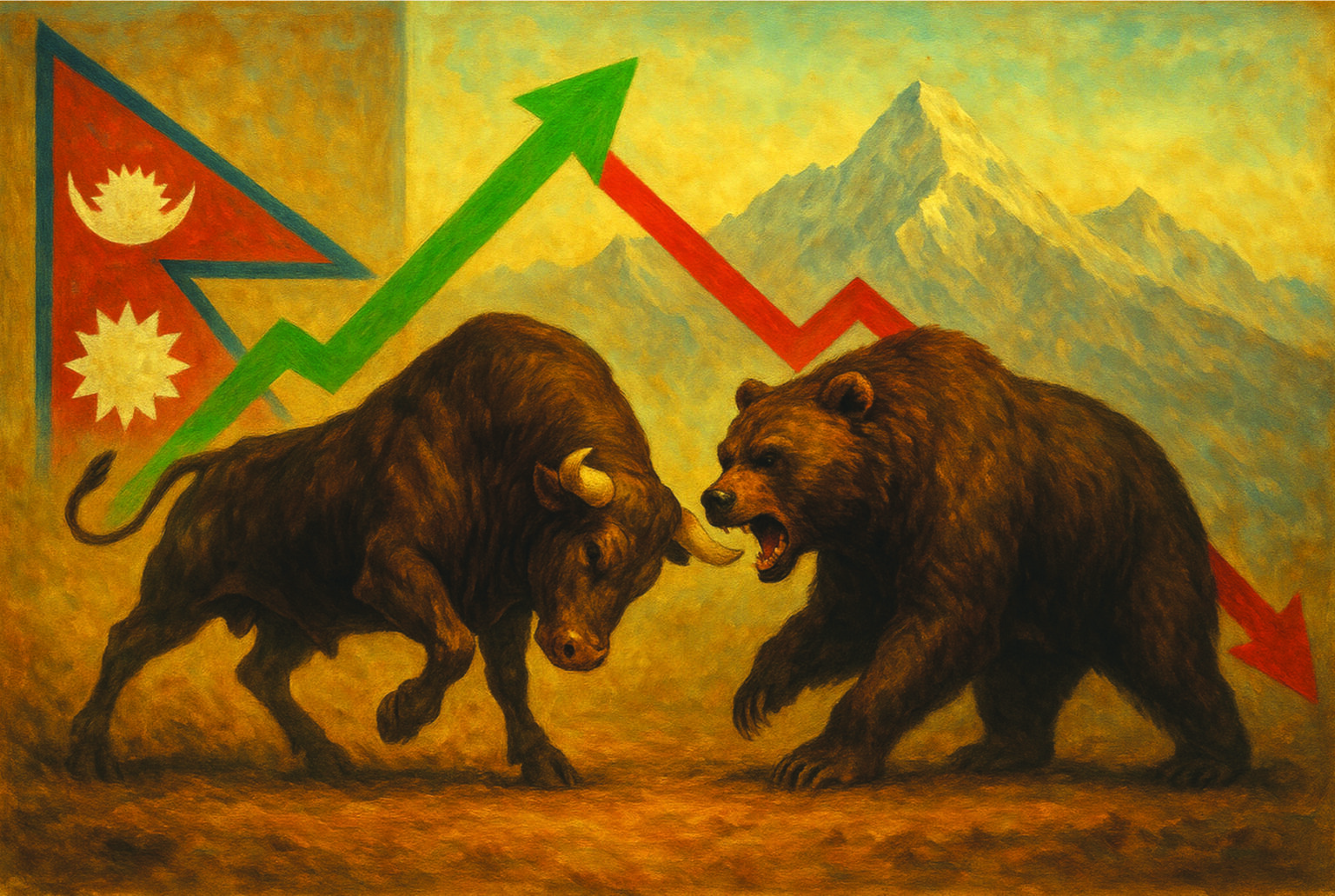

Kathmandu: Nepal’s capital market has rarely had it so good on paper. Regulations are investor-friendly, monetary policy has repeatedly addressed the wishlist of stock-market participants, and both external and domestic economic indicators remain reasonably stable.
Over the past few years, regulators have rolled out one reform after another aimed at making life easier for the market. Yet the Nepal Stock Exchange (Nepse) index continues to move sideways, unable to sustainably cross the psychological peak it set back in 2021.
To understand the disconnect, it helps to revisit how the market first lost its mojo after touching a historic high.
Nearly nine years ago, on 28 July 2016, Nepse stood at 1,881 points. It then entered a prolonged decline, bottoming out at around 1,100 points in early 2019.
The turnaround began with the monetary policy of fiscal year 2020-21, which raised the loan-to-value ratio for margin lending against shares from 65 percent to 70 percent and shortened the share-valuation averaging period from 180 days to 120 days. Confidence returned quickly. From the 1,100-point low, the index recovered to 1,810 by late November 2020 and kept climbing. By early April 2021, in just four months, it had surged roughly 41 percent to an all-time high of 2,735 points.
The euphoria did not last. In mid-2021, the securities regulator published a list of 51 companies with high risk profiles, spooking investors. A few weeks later, the Electricity Regulatory Commission issued a 16-point public appeal that effectively discouraged retail investment in hydropower shares, a darling sector at the time.
Then came the hammer blow: on 25 August 2021, the central bank capped margin loans at Rs 40 million from a single institution and Rs 120 million in total across all institutions (the infamous “4/12 rule”). Banks simultaneously began hiking deposit rates, pulling liquidity out of the market. Between June and early November 2021, Nepse plunged from over 3,000 points to 2,481 which is a drop of more than 22 percent in two months.
A brief recovery followed after the central bank governor publicly promised to rein in interest rates, pushing the index back toward 2,850 by mid-November 2021. But the damage was done. The combination of tight margin-lending caps and high risk weights on share-backed loans kept a lid on leverage and sentiment. For the next two years, Nepse mostly traded between 1,800 and 2,200 points.
Since fiscal year 2022-23, the central bank has steadily reversed course. The Rs 40 million single-institution cap was scrapped, the total exposure limit was raised first to Rs 150 million (individuals) and Rs 200 million (institutions), then completely removed for institutional investors and eventually for individuals as well (the latest directive came on 7 October 2025, scrapping any remaining ceiling of Rs 250 million).
Risk weights on margin loans above Rs 5 million were cut from 150 percent to 125 percent and finally to 100 percent. Banks are now allowed to trade shares in the secondary market if they hold them for at least six months, a rule previously restricted to one-year holdings.
On paper, these are some of the most accommodative policies Nepal’s stock market has ever enjoyed. The index responded: from around 2,025 points at the end of fiscal 2022-23, it climbed to 2,662 by the end of 2024-25 and briefly kissed 3,000 again in July-August 2025, the first time in four years. Yet it has failed to hold those levels or push decisively higher. After touching roughly 3,028 points in mid-August, the market has spent most of the past few months oscillating between 2,600 and 2,700.
Investors and analysts point to one overriding factor: political uncertainty.
The street protests dubbed the Gen-Z movement in September 2025, followed by the formation of an interim government and repeated delays in announcing a firm election date, have left the country in limbo. Every twist in the political drama including coalition reshuffles, leadership changes, and now fears that elections scheduled for early 2026 may be postponed triggers immediate selling. The market, already hypersensitive to headlines, rumours and policy flip-flops, simply cannot build lasting confidence when the broader environment feels unstable.
As Tulsi Ram Dhakal, president of the Nepal Investors Forum, puts it: “Until the path to political stability becomes clear, investor morale will remain low and the market will stay range-bound.”
Recent trading patterns tell the same story. In early December 2025, Nepse gained 116 points over five straight sessions, climbing to 2,676 amid hopes of calmer politics. Within four days it had given nearly all of it back, closing the week at 2,631.
Successive governments and regulators have thrown almost every policy lever available like easier margin lending, lower risk weights, higher institutional participation and still the market refuses to stage a convincing breakout. The missing ingredient, for now, is not more reforms. It is the one thing regulators cannot deliver: political certainty. Until that returns, Nepal’s stock market looks likely to remain stuck in the long shadow of its 2021 peak.

Comment Here