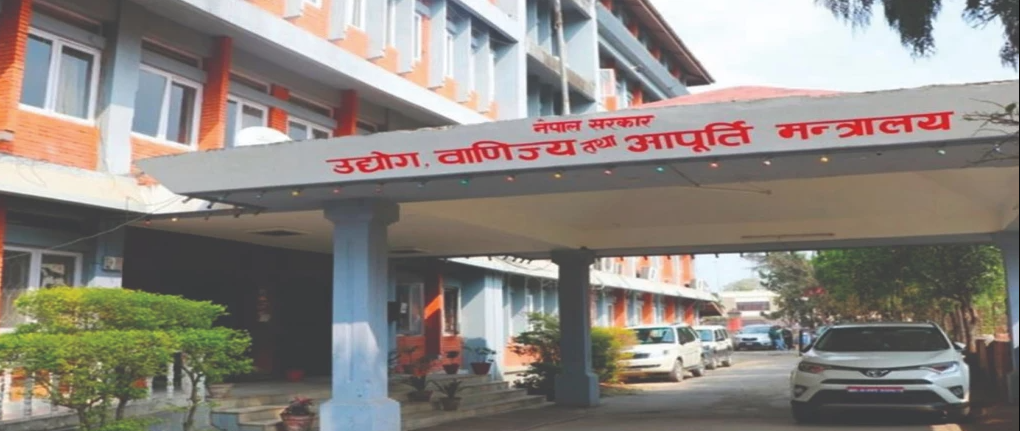

Kathmandu: Due to what industrialists describe as extreme negligence by the Ministry of Industry, Commerce and Supplies, Nepali exporters are on the verge of losing long-overdue cash incentives promised by the government for their exports.
Exporters have yet to receive cash incentives owed for goods shipped abroad up to fiscal year 2023/24. As of that year, the unpaid amount has reached Rs 5.34 billion, leaving many businesses struggling with liquidity pressures and uncertainty.
Interim Finance Minister Rameshore Khanal had publicly stated that clearing exporters’ outstanding incentive payments was among his top priorities. He repeatedly urged the Ministry of Industry, Commerce and Supplies to submit the required documents and files to facilitate the release of funds. Despite multiple reminders, including personal follow-ups, the finance ministry says it has still not received the necessary file.
According to sources at the Ministry of Finance, Minister Khanal was personally committed to resolving the long-pending issue and made several attempts to expedite the process. He even visited the industry ministry himself to inquire about the delay and formally requested that the file be forwarded. However, no documentation has reached the finance ministry to date.
Finance ministry officials say the industry ministry’s prolonged lack of urgency—often citing procedural reasons—has effectively stalled the disbursement process. As a result, funds that were expected to be released are now at serious risk of remaining unpaid.
Quoting Minister Khanal, sources at his secretariat said he was deeply frustrated by the situation. He reportedly questioned senior officials at the industry ministry about why a new production-based subsidy system announced in the budget had not been developed or formally proposed. According to the minister, the ministry failed to coordinate with relevant agencies, failed to follow up, and ultimately failed to complete the required procedures in time. With elections now underway, he believes that even if the process were completed, releasing the funds would no longer be feasible.
Secretariat sources further noted that as elections draw closer, substantial funding is required for election-related activities. Budget priorities have shifted toward the Election Commission, security agencies, and ongoing critical infrastructure projects. Given these pressures, the likelihood of allocating funds for export incentive arrears has diminished significantly.
Because the Ministry of Industry, Commerce and Supplies did not act in time, the promised payments now appear unlikely to materialize. Quoting the finance minister again, secretariat officials said that election-related expenses alone could reach around Rs 40 billion. Around Rs 29–30 billion has already been spent, with an additional Rs 5–7 billion potentially required. Under these circumstances, the minister has reportedly acknowledged that he can no longer release funds for export incentives, even if he wants to.
A senior official at the Ministry of Industry, Commerce and Supplies, however, said the delay stems from verification procedures. According to the official, documents submitted by exporters were sent back to the ministry by Nepal Rastra Bank for verification. Once the verification process is completed, the file is to be forwarded to the finance ministry for budget release. The official added that repeated staff transfers within the relevant department—two to three times during the process—also contributed to the delays.
Last week, the industry ministry claimed it had formally requested Rs 5.34 billion from the finance ministry to clear incentive arrears up to fiscal year 2023/24. Former Joint Secretary Jitendra Basnet stated that a letter had been sent seeking source assurance to pay outstanding incentives under the old guidelines. He said that once the funds were secured, all arrears up to that fiscal year could be settled.
However, the finance ministry tells a different story. Its spokesperson and joint secretary, Tanka Prasad Pandey, confirmed that no formal proposal or request has yet been received from the industry ministry. He said the finance ministry is only aware that preparations may be underway but emphasized that no official submission has been made.
According to the Department of Industry, although total payments due up to fiscal year 2023/24 are estimated at around Rs 5.5 billion, Nepal Rastra Bank has verified claims amounting to only Rs 2 billion so far.
While the payment process for past incentives remains stalled, the government has simultaneously adopted a policy of not providing cash export incentives for fiscal year 2024/25. In the current budget, the heading “cash incentives for exports” was replaced with a different provision. As there is no approved working procedure under the new framework, authorities say disbursing incentives is not currently possible.
Citing this uncertainty, the Department of Industry issued a notice on October 12, instructing exporters not to submit self-declaration details for fiscal year 2024/25. Department Director Suresh Dahal explained that export incentives are distributed annually based on procedures approved under the relevant Finance Act. Although a draft of a new guideline has been prepared and submitted to the ministry, the modality of subsidy distribution will only be finalized after formal approval.
As a result, the Department of Industry has not collected any export data from industrialists for fiscal year 2024/25. The government had allocated Rs 1.197 billion for export incentives that year, but the funds now remain unused.
Out of nearly Rs 6 billion in older arrears, some exporters received partial payments on a pro-rata basis up to mid-July last year. Even after those disbursements, around Rs 5.5 billion in payments—covering fiscal year 2023/24 and earlier—remains outstanding.
Nepal introduced cash export incentives in fiscal year 2011/12 to promote exports of domestically value-added goods at a time when exports were weak and the trade deficit was widening rapidly. The primary goals were to reduce the trade gap and boost foreign currency earnings.
Business leaders say that while the incentives were modest, they provided some relief and helped sustain export growth. Given that Nepal’s logistics and transportation costs are estimated to be 25–30 percent higher than those of neighbouring countries, exporters argue that such incentives remain essential to stay competitive in international markets.
Under the previous system, the government provided cash incentives ranging from 5 to 8 percent on eligible exports. Products such as clinker, cement, steel, catechu, rosin and turpentine, plywood, cashmere, pashmina, and zinc sheets were eligible for incentives of up to 8 percent.
A 5 percent incentive applied to processed tea and coffee, handicrafts and woodcrafts, processed leather and leather goods, handmade paper and related products, processed and semi-processed medicinal herbs and essential oils, including yarsagumba, as well as bottled drinking water and mineral water.
Other products eligible for a 5 percent incentive included processed stones and stone jewelry, allo-based products, processed and semi-processed turmeric, fresh vegetables and fruits exported to third countries in convertible foreign currency, flowers, processed honey, processed and semi-processed cardamom, ginger products such as dried ginger, slices, oil and powder, dairy products including milk, cheese, chhurpi, paneer and fat, and broom grass exported to third countries.
With export performance still fragile and arrears unresolved, exporters now fear that both past dues and future policy clarity are slipping further out of reach.

Comment Here