
Kathmandu: A sharp increase in India’s import duties on edible oils last year delivered an unexpected windfall to Nepal’s cooking oil refiners, transforming them into major exporters almost overnight.
Beginning in September 2024, New Delhi raised customs duties on palm, soybean and sunflower oil, lifting tariffs on crude edible oil to 27.5 percent and on refined oil to 35.75 percent. Just months earlier, those same products had faced duties as low as 5.5 percent for crude and 13.75 percent for refined oil, making the jump dramatic by any measure.
India applied these higher tariffs uniformly to imports from most developing and developed countries. But Nepal, as a least developed country, enjoys special concessions under World Trade Organization rules and regional trade arrangements such as SAFTA.
That means refined edible oil shipped from Nepal enters the Indian market virtually duty-free. For Indian buyers, sourcing oil from Nepal suddenly became far cheaper than importing directly from Indonesia, Thailand or other major producers. Nepal’s geographic proximity and open border with India made the trade even more attractive, slashing logistics costs and delivery times.
Nepali refineries seized the opportunity. They import crude oil from countries such as Indonesia and Thailand, process it locally, add up to 30 percent in value through refining and packaging, and then export the finished product to India without paying the steep tariffs that apply to direct imports. This tariff arbitrage turned Nepal into a critical gateway for India’s edible oil supply, and the benefits flowed straight into the balance sheets of Nepali producers.
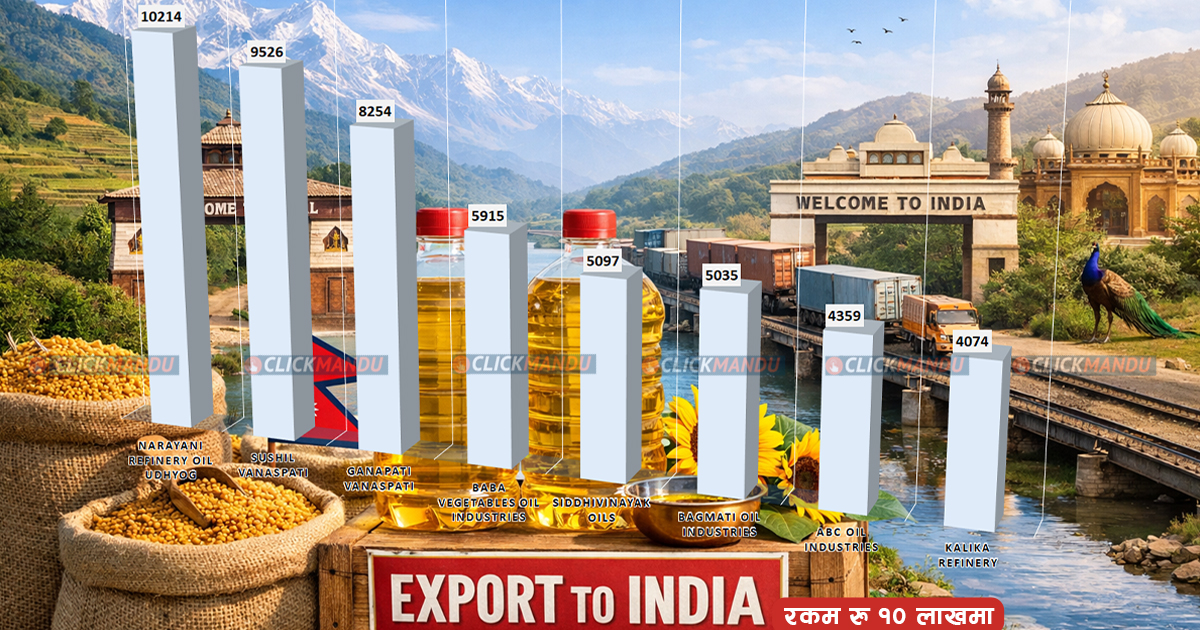
The scale of the boom is visible in trade data. In the last fiscal year alone, Nepal exported close to Rs 200 billion worth of edible oil, according to customs figures. Of the country’s roughly 27 oil refineries, just eight accounted for more than Rs 52.47 billion in sales, driven overwhelmingly by exports to India. For most of these companies, India’s tariff wall was the single most important factor behind their explosive growth.
Narayani Refinery Oil Industries, one of the biggest players, posted sales of Rs 10.21 billion in the last fiscal year, up 123 percent from a year earlier. Exports made up 67 percent of its revenue, a staggering jump from just 4 percent in 2024. After years of losses, the company swung into profitability with a net margin of 5.29 percent and closed the year with Rs 575 million in cash. Founded in 1989, Narayani refines palm, soybean, mustard and sunflower oils under brands such as Trishakti, Smail and Arogya, with an annual capacity of 128,500 metric tons, and now counts India as one of its key markets.
Sushil Vanaspati, part of the Kedia Group, recorded an even more dramatic rebound. Its turnover surged to Rs 9.52 billion, up more than fourfold from the previous year. Nearly 79 percent of its sales came from exports, mainly to India, compared with marginal export activity a year earlier. The company’s profit margin rose to 8 percent, from just 0.5 percent in 2024, underlining how the tariff shift reshaped its fortunes. Established in 1988, Sushil markets its products under the Rajhans brand and operates a distribution network of 250 dealers across Nepal and India.
Ganapati Vanaspati also rode the wave. Its revenue jumped to Rs 8.25 billion from just Rs 1.24 billion the year before, with exports accounting for 82 percent of sales. After suffering losses in 2024, the company returned to profit with Rs 261 million in net earnings. Founded in 1998 and converted into a public company in 2023, Ganapati produces a wide range of edible and industrial oils under brands such as Safari and Ramdev, with an annual capacity of 120,000 metric tons.
Baba Vegetable Oil Industries, known for its Siddha Baba brand, reported sales of Rs 5.91 billion, nearly tripling from the previous year. Exports made up 88 percent of its revenue, reflecting the scale of Indian demand. After posting losses in 2024, the company achieved a net margin of 5.7 percent. Established in 1993, it processes around 45,000 metric tons of soybean, palmolein and sunflower oil annually and operates depots in Biratnagar, Kathmandu and Pokhara.
Siddhivinayak Oil, a newer entrant founded in 2021, also saw its business explode. Its turnover climbed to Rs 5.09 billion, more than three times the previous year, as rising Indian prices pushed its average selling price from Rs 157,288 per metric ton in 2024 to Rs 207,423 in 2025. The company finally turned profitable with a 5 percent margin after two years of losses, exporting most of its soybean, palm and sunflower oil under the Samriddhi brand.
Bagmati Oil Industries, established in 2008, posted Rs 5.03 billion in sales, up 84 percent year on year, thanks largely to strong exports of sunflower and soybean oil under the Sello brand. ABC Oil Industries, which only began commercial operations in 2022, more than tripled its turnover to Rs 4.36 billion and achieved a net margin of 3.8 percent. Kalika Refinery, founded in 2019, nearly doubled its revenue to Rs 4.07 billion and lifted its profit margin to 8.58 percent as exports to India surged.
Behind these numbers lies a common pattern. Most of the companies source around 90 percent of their inputs as imported crude oil from countries such as Argentina, Brazil, Indonesia, Ukraine and the Netherlands. They add value in Nepal through refining, packaging and branding, then send the finished product south across the border. For Indian importers, buying from Nepal avoids the heavy customs burden imposed on direct shipments from global suppliers.
That window of opportunity is now narrowing. India has already cut its elevated tariffs by half, a move that is expected to reduce the incentive to route oil through Nepal. Export volumes are likely to soften in the coming months. Even so, the past fiscal year stands out as an extraordinary episode in which trade policy in New Delhi effectively turbocharged an entire sector north of the border.
For Nepal’s edible oil industry, long plagued by thin margins and volatile global prices, India’s tariff hike was a once-in-a-generation windfall. It turned a cluster of mid-sized refineries into major exporters and delivered profits after years of losses. Whether that momentum can be sustained as tariffs ease will determine if this was a temporary boom or the foundation of a lasting export industry, but for one remarkable year, Indian trade policy made Nepal’s oil refiners rich.

Comment Here