
In the middle of the 18th century, the map of the world was undergoing a violent transformation. In Europe, the concept of the “nation-state” was evolving from the ruins of old empires. In North America, a new republic was about to be born. In South Asia, the sun was setting on the Mughal Empire while rising on the British East India Company, a new predatory power.
It was against this global backdrop that a young king from a small principality called Gorkha began a campaign that would not only change the geography of the Himalayas but also create one of the few regions in Asia that would never fall to European colonialism.
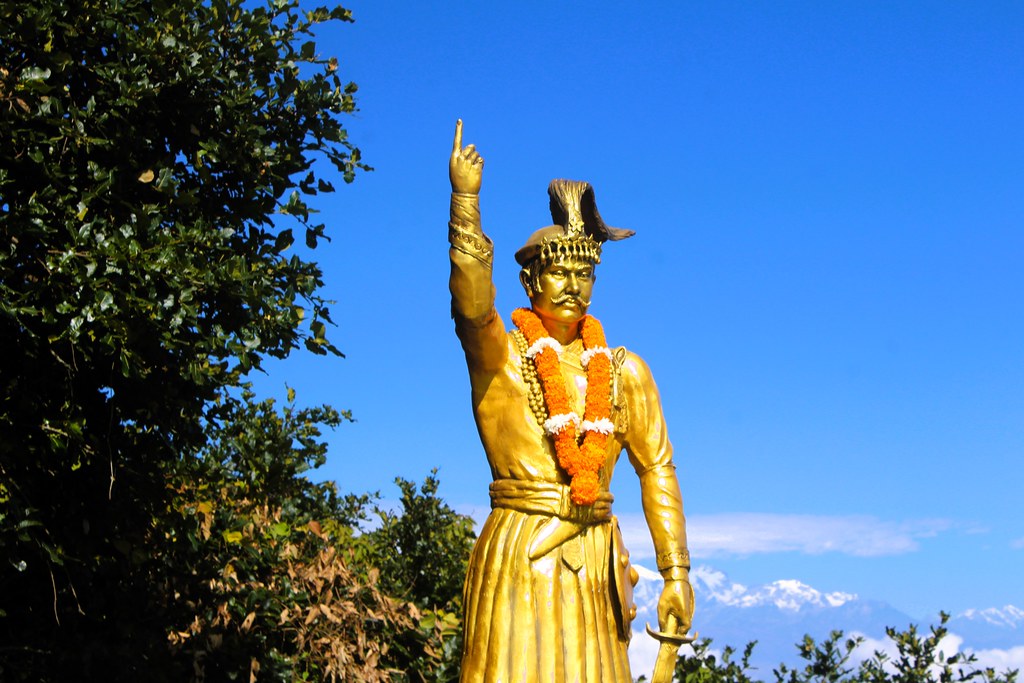
King Prithvinarayan Shah (1723–1775) is often remembered simply as a conqueror. However, modern scholarship and historical records suggest he was something far more sophisticated. He was a grand strategist who detected the shifting tectonic plates of global power long before his contemporaries.
To understand Shah’s strategy, one must look at the world he inhabited. By the 1740s, the Indian subcontinent was a patchwork of fading glories and emerging threats. The Mughal Empire, which had dominated the region for centuries, was disintegrating into warring factions. This power vacuum was being filled by the “Firangi” (the British), who were transitioning from mere merchants to territorial masters.
To the north, the Qing Empire under the Qianlong Emperor was at its zenith, extending its influence deep into Tibet. Nepal, at the time, was not a single entity but a collection of over 50 small, quarrelling principalities, namely the Baise (22) and Chaubise (24) states, and the three wealthy Malla kingdoms of the Kathmandu Valley.
As historian Ludwig F. Stiller notes in his seminal work The Rise of the House of Gorkha, Prithvinarayan Shah realized that these tiny states were “not viable political entities” in the face of the giants rising around them. If they did not unite, they would be swallowed one by one.
How did a king from a remote mountain village develop such a keen sense of global geopolitics? The answer lies in his 1743–44 visit to Varanasi (Benares). While his father, King Narabhupal Shah, had sent him for religious reasons, young Prithvinarayan used the trip as a reconnaissance mission.
In Varanasi, he witnessed the political decay of India firsthand. He saw the British East India Company’s growing influence and their superior military technology. He understood that the British were not just traders; they were cunning expansionists. He imparted this wisdom in his Dibyopadesh (Divine Counsel) towards the end of his life. “The Emperor of the South [the British] is very clever. He is occupying Hindustan. We must be cautious.”
“Nepal is a yam between two boulders.” This was not just a poetical observation. It was a blueprint for survival.
Shah saw that the British utilized trade as a Trojan horse for political control. This led to his “Closed Door” policy, where he restricted foreign traders and missionaries, whom he suspected of being spies or cultural infiltrators. As scholar Mahesh Chandra Regmi highlights in Thatched Huts and Stucco Palaces, Shah’s economic strategy was as vital as his military one. By cutting off trade routes between India and Tibet through the Kathmandu Valley, he weakened his rivals and signalled to the British that Gorkha was a force to be reckoned with.
Perhaps the most famous quote attributed to Shah is his description of Nepal’s geopolitical reality: “Nepal is a yam between two boulders.”
This was not just a poetical observation. It was a blueprint for survival. The “boulders” were the British Empire to the south and the Qing Empire to the north. Shah realized that a head-on military conflict with either would be suicidal. Instead, his strategy was one of “Strategic Neutrality” and “Buffer Statehood.”
He advised his successors to maintain a friendship with both, but to be subservient to neither. To the north, he maintained a respectful distance from the Qing, acknowledging their strength in Tibet. To the south, he prepared for the inevitable clash with the British. This preparation bore fruit in 1767 during the Battle of Sindhuli Gadhi, where his Gorkhali troops, using the terrain to their advantage, defeated a British expeditionary force led by Captain Kinloch. This victory was a turning point. It proved that a unified Himalayan state could resist the most powerful military force of the era.
In the 18th century, most wars were fought for the personal glory of kings. Shah’s unification, however, began to take on the characteristics of modern nation-building. Unlike the Malla kings, who focused on palace luxuries, Shah focused on the institutions of the state.
He pioneered a unique “Jagir System,” where land was granted to soldiers in place of cash salaries. This created a professional army that was personally invested in the defence of the land. As pioneer historian Baburam Acharya argued, this system turned “feudal skirmishes into a national war.”
Shah also understood that a nation is not just a territory but a people. His famous declaration, “This country is like a garden of four castes and thirty-six varnas,” was a strategic move toward social integration. By recognizing the diversity of the groups he conquered, including the Magars, Gurungs, Newars, Khas, and others, he attempted to build a collective identity that transcended local tribal loyalties.
Had he not unified the scattered kingdoms of the Himalayas, it is highly likely that the British East India Company would have occupied the region, just as they did the rest of South Asia.
While modern critics sometimes view his “Asali Hindustan” (Real Land of Hindus) rhetoric as exclusionary and parochial, in the 18th-century context, it was a powerful ideological counter-narrative. He wanted to differentiate his realm from the “Mughlan” (lands under Muslim/British influence) to create a sense of sovereignty and cultural pride.
Prithvinarayan Shah’s ability to detect the risks from the North and South came from a combination of first-hand observation and a deep understanding of geography. He viewed the Himalayas not just as mountains, but as a natural fort created by God Himself.
He suggested building strong forts on high peaks like Shivapuri and Chandragiri, equipped with cannons to monitor the valleys. He understood that the British, used to the plains of India, would struggle in the vertical terrain of Nepal. This “home-court advantage” became the cornerstone of Nepal’s defence for the next century.
Scholars like Manish Jung Pulami have noted that Shah’s “Yam Theory” remains the guiding star of Nepal’s foreign policy today. In an era where small nations are often pawns in the games of superpowers, Shah’s vision of a “balanced equilibrium” remains as relevant as ever.
A group of rabble rousers describes Prithvinarayan Shah as a monarch looking to expand his borders and not a unifier. But when we contextualize him with the 18th-century world, we see a man who was fighting a desperate race against time. Had he not unified the scattered kingdoms of the Himalayas, it is highly likely that the British East India Company would have occupied the region, just as they did the rest of South Asia.
He was a modernizer in a medieval age. He did not just conquer. He consolidated. He did not just fight. He strategized. As Ludwig Stiller eloquently put it, “The Gorkhali project was unique because it was not just the ambition of one man to be an overlord, but the creation of a state that could endure as a political unit.”
The unification of Nepal was a strategic masterpiece of preemption. Prithvinarayan Shah detected the colonial threat when it was still a shadow on the horizon and built a “Himalayan Fortress” to meet it. He transformed a collection of petty fiefdoms into a sovereign nation-state, using a blend of military pragmatism, economic blockades and a sophisticated understanding of geography.
Today, as Nepal continues to navigate the complex interests of its neighbours, India and China, the words of the founding father echo through time. The “yam” is still there, and the “boulders” have only grown larger. Yet, the blueprint for survival remains the same. There needs to be a unified internal front as well as a balanced, cautious and clever approach to the world outside.

Comment Here