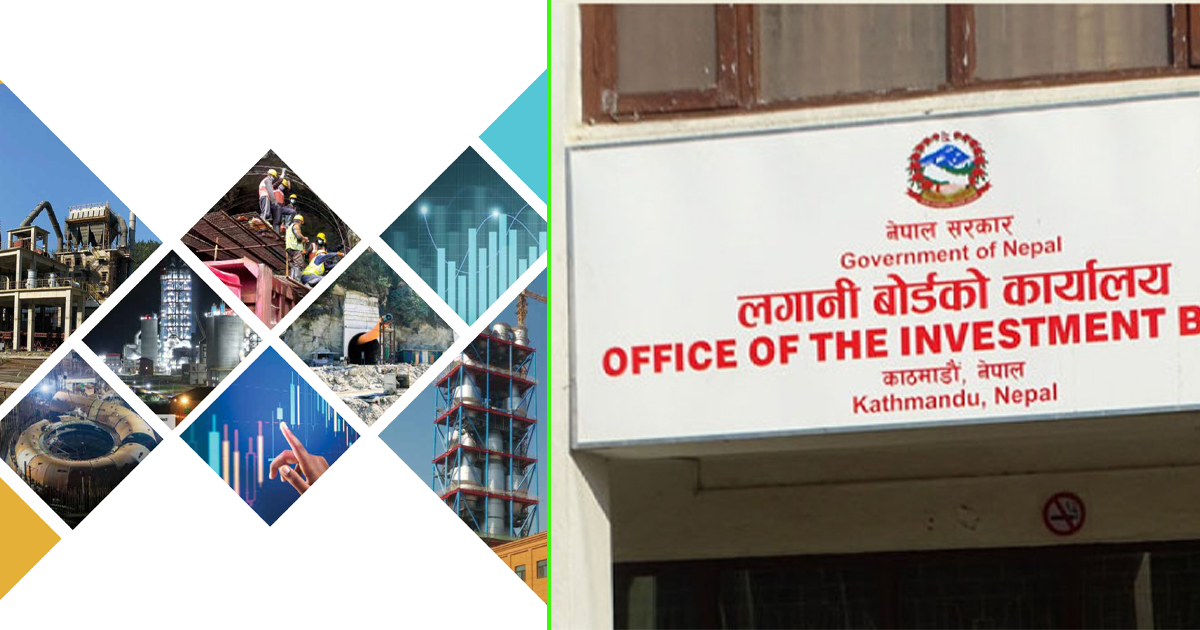

Kathmandu: Office of the Board of Investment has so far approved 55 large-scale projects with a combined value of 17.16 trillion rupees, marking one of the biggest waves of investment commitments in the Nepal’s history.
According to the Board’s Chief Executive Officer Sushil Gyawali, most of these projects are already in the construction phase, while the Board is still searching for investors for a few of the larger ventures.
Energy dominates the approved portfolio. Out of the 55 projects, 40 belong to the energy sector alone, together accounting for an investment of 13.37 trillion rupees. These range from projects launched more than a decade ago to newer ones now entering the pipeline, reflecting how Nepal’s hydropower and energy potential continues to attract strong interest from both domestic and foreign investors.
Beyond energy, investors have also shown growing enthusiasm for productive and manufacturing industries. Nine production-oriented projects have been approved, with a total committed investment of around 236 billion rupees. In addition, three utility-sector projects, worth about 50 billion rupees, have also received the green light from the Board.
Tourism has secured a notable share of investment as well. Two major tourism projects, with a combined cost of 71 billion rupees, are moving forward. Within these, a single hospitality project covering three hotels worth about 14 billion rupees is under construction in Dahachok, Bhaktapur and Pokhara after receiving approval in mid-2018. Another flagship tourism venture is the 81-kilometre New Bridge–Muktinath cable car, which aims to transform access to one of Nepal’s most important pilgrimage and tourism destinations.
In infrastructure, one major project has been approved so far: the China–Nepal Friendship Industrial Park in Damak, with an estimated investment of 65 billion rupees. This project received approval in 2019 and is now advancing toward implementation, representing a significant step in cross-border industrial cooperation.
Several large manufacturing investments are already turning into reality. Samrat Cement, backed by an investment of 15 billion rupees, Hongshi with 37 billion rupees, and Huaxin with 21 billion rupees have all begun production. Other approved industrial projects are still in the construction phase, indicating that Nepal’s industrial base is gradually expanding alongside its energy and infrastructure ambitions.

Comment Here