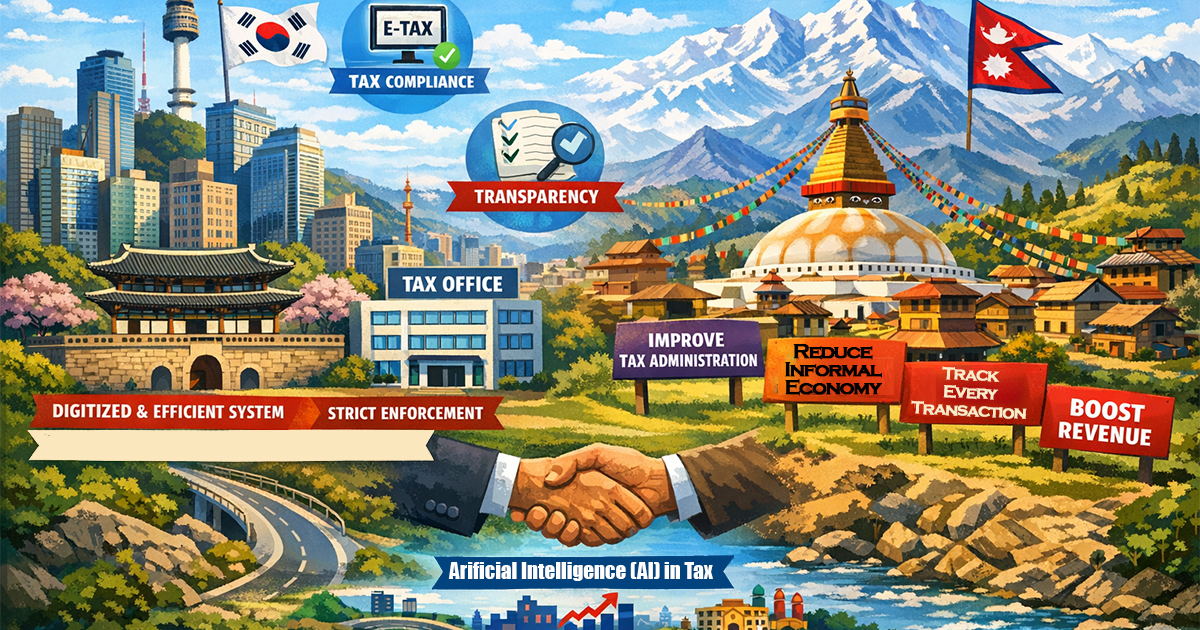

Kathmandu: The government is preparing to introduce a South Korea-style tax administration system with the goal of fundamentally transforming Nepal’s internal revenue framework over the long term.
The plan involves replacing the country’s decades-old tax system, developed incrementally since 1997, with a fully technology-driven, automated model designed to capture economic transactions in real time.
Automation within Nepal’s tax administration began in 1997, when the then Value Added Tax Department introduced basic digital processes using FoxPro software. In 2000, the system was restructured and migrated to an Oracle platform, alongside the introduction of the Permanent Account Number (PAN), which was distributed nationwide for the first time. By 2001, integration with the Income Tax Department led to the development of a joint registration system using a client–server architecture operated through local tax offices.
Over the years, the Department of Inland Revenue (IRD) expanded this digital foundation by introducing electronic systems for income tax, VAT, and excise duty with self-assessment features, a revenue accounting system linked to bank reconciliation, an online taxpayer registration platform, a withholding tax management system with payment reconciliation, an internal monitoring system tied to performance-based incentives, and electronic payment facilities. More than a dozen smaller systems have since been merged into an integrated tax system, refining a platform that is now 28 years old. At present, the department manages its core tax system centrally through web-based applications.
The IRD now plans to replace this legacy framework with what is widely known as the Korean tax administration model, regarded as one of the most advanced systems in the world. Under this model, virtually every market transaction is tracked in a government database, extending all the way to inventory management. The system allows authorities to monitor the movement of goods and payments seamlessly, significantly reducing opportunities for tax evasion.
In practice, when a product is sold and an invoice is issued, transaction data is transmitted in real time to all three parties involved: the consumer, the business, and the government. Transactions conducted using a PAN number, mobile phone, or standard internet connection are automatically recorded in the system. Payments and inventory records are updated simultaneously, and businesses are technically prevented from issuing invoices for quantities exceeding their available stock. If implemented in Nepal, officials believe this would elevate the country’s tax system to the level of the world’s most advanced economies and push informal economic activity close to zero.
According to IRD Director General Madan Dahal, the Korean model is well suited to Nepal’s needs. He said the government is working to introduce the system through government-to-government cooperation with South Korea, preferably with grant support. If grant financing is not secured, the estimated cost of implementation is between Rs 4 billion and Rs 5 billion. Dahal noted that once fully operational, the system could increase Nepal’s annual revenue collection, currently around Rs 600 billion, by as much as 1.5 to two times.
Authorities expect the system to end the common practice of issuing invoices for some goods while selling others in the black market.
Officials estimate that Nepal’s informal economy, currently believed to account for around 40 percent of overall economic activity, could be reduced to below 10 percent outside of strictly illicit markets. By making it mandatory for even cash transactions to be digitally recorded, the system would ensure that every transaction is traceable, effectively closing loopholes used for tax evasion.
The introduction of the new system would also eliminate the need for separate VAT filings. With inventory management fully integrated into the tax platform, only goods cleared through customs or produced in domestic factories would appear in the trading system. The entire supply chain, from import or production to wholesale, retail, and final consumption, would be tracked, making it impossible to sell more goods than are officially recorded in stock.
Authorities expect the system to end the common practice of issuing invoices for some goods while selling others in the black market. While Nepal’s existing tax framework has gradually added components such as registration, VAT collection, audits, and income tax modules, officials say the country now needs a fully integrated system that automatically captures all transactions without manual intervention.
Dahal acknowledged that the current system, originally introduced in 1997, has been built by attaching new components to outdated technology over time. He said the department plans to replace it with a state-of-the-art, artificial intelligence–based system. By tracking inventory from the moment goods leave customs or factories until they reach consumers, the new platform would shut down pathways for revenue leakage and smuggling.
Under the Korean model, VAT returns do not need to be filed separately, as most purchase and sales data are automatically pulled into the system. If a business has 100 items in stock, it is technically impossible to issue invoices for more than that number. Dahal said the department’s guiding principle is to reduce human discretion in tax administration and rely instead on automated systems for monitoring and enforcement.
Because sales, payments, and inventory updates occur simultaneously at the moment an invoice is issued, officials believe the scope for tax evasion would be virtually eliminated. The department’s primary objective is to bring informal economic activity into the formal system, and the new platform is being designed accordingly, Dahal said.
Even when customers pay in cash, businesses would be legally required to enter the transaction into the digital system. This requirement alone is expected to significantly reduce the size of Nepal’s informal economy.
Dahal emphasized that the department’s core reform goal is to minimize human intervention. He argued that meaningful improvements in tax administration can no longer rely on discretionary authority exercised by officials, but must instead be driven by systems that control and manage processes automatically. According to him, adopting the Korean model represents a long-term structural reform of Nepal’s tax system.
In the Korean system, transaction data is recorded in real time as soon as a sale is made. Because purchase and sales information is automatically captured, taxpayers are not burdened with repeatedly submitting VAT details.
South Korea’s tax administration is widely regarded as one of the most advanced, scientific, and technology-friendly in the world. Managed by the National Tax Service, it is built around two key pillars: an integrated online tax portal and a cash receipt management system.
Known locally as “Hometax,” the online portal allows taxpayers to complete every step—from business registration and tax calculation to invoice issuance and tax payment—from home. The system uses artificial intelligence to analyze income and expenditure data in detail and is capable of instantly flagging suspicious transactions.
Introduced in 2005, South Korea’s cash receipt system is credited with transforming the country’s economy. In many countries, cash transactions are a major channel for hiding income. In Korea, however, customers purchasing goods with cash use their mobile number or identification, automatically linking the transaction to government servers. This prevents businesses from concealing actual sales figures.
In the Korean system, transaction data is recorded in real time as soon as a sale is made. Because purchase and sales information is automatically captured, taxpayers are not burdened with repeatedly submitting VAT details. Inventory is tracked from customs or factories all the way to the end consumer, ensuring that if 100 items are imported, invoicing for 101 items is impossible. This effectively blocks smuggling and under-invoicing.
Despite its advantages, officials acknowledge that implementing such a technology-intensive system in Nepal will not be easy due to low levels of digital and tax literacy. Urban areas and major cities are expected to adapt more quickly, while rural and remote regions may face difficulties. To address this, the department plans to roll out the system gradually, with defined timelines and targeted training programs for businesses in less accessible areas.
South Korea’s experience shows that such reforms require time and incentives. Following the Asian financial crisis of 1997, Korea launched sweeping tax reforms to improve transparency. Digital tax services began informally around 2002 and were fully systematized by 2005. Between 2010 and 2011, the government made electronic tax invoices mandatory, initially for large corporations and later for small businesses as well.
The Korean government also used incentives to encourage participation, offering tax deductions to consumers who requested electronic invoices or paid through cards. This created a culture in which customers themselves demanded bills. At the same time, strict penalties and legal action against those who failed to issue invoices or concealed transactions ensured compliance.
Nepali officials believe a similar mix of incentives and enforcement could allow the Korean model to succeed in Nepal, fundamentally reshaping the country’s tax administration and bringing lasting transparency to the economy.

Comment Here