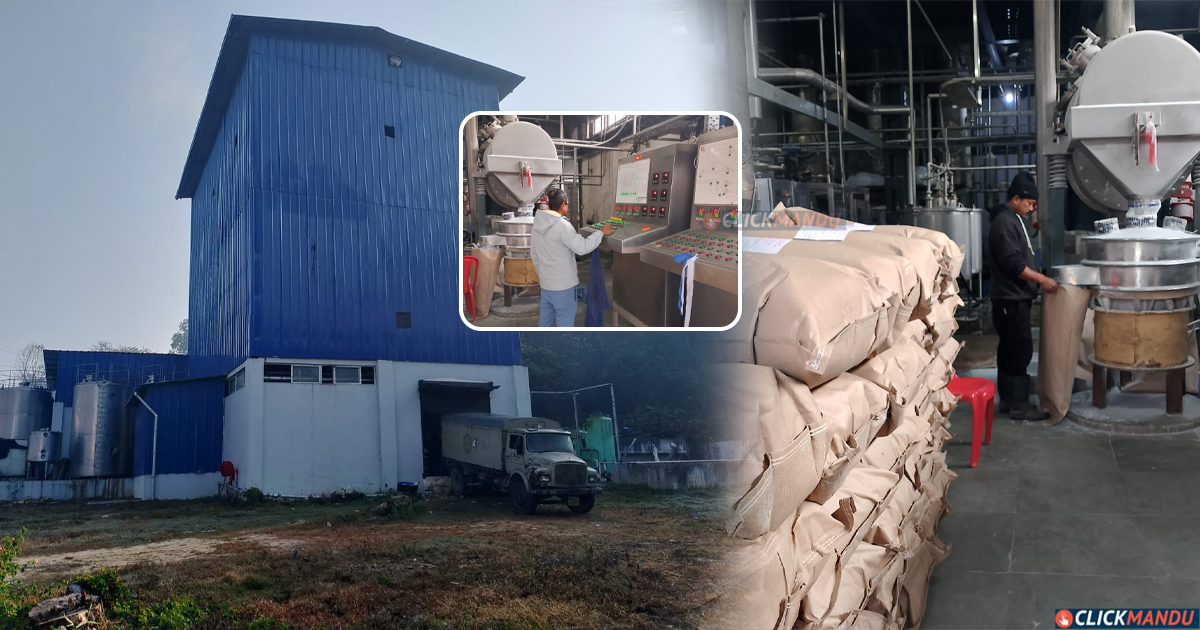

Kathmandu: A milk powder factory built by the Bagmati Province government in Hetauda has yet to come into formal commercial operation, despite construction and equipment installation having been completed.
The factory, located in Sisaughari of Nyureni, Hetauda, was developed to prevent surplus milk from going to waste. Although the physical infrastructure and milk powder plant are ready, the project has stalled due to delays in finalizing an operational model.
“We have not been able to formally launch the factory because the operating modality has not been finalized,” said Hari Paudel, vice-chair of the Bagmati Province Dairy Development Board. He explained that while the plant is not officially operational, the Dairy Development Corporation (DDC) has been entrusted with test production, which it has been carrying out continuously for the past two years.
According to Paudel, four operational options have been proposed. These include direct operation by the provincial government, operation through a public institution such as DDC, management by a specialized federation of cooperatives, or operation under a public–private partnership model.
He noted that direct government operation would involve complex challenges, including staffing and technical management. As a result, authorities are close to finalizing the second option—handing operations to DDC—following broad consultations. DDC, he said, is itself a public institution with prior experience running milk powder plants.
Since DDC has already been conducting trial production at the facility for two years, preparations are in their final stage to formally assign it operational responsibility while ownership remains with the provincial government. Paudel indicated that this handover is likely to be completed within the current Nepali month of Magh.
Under the proposed agreement, the provincial government will set conversion charges—fees for processing liquid milk into powder and butter—based on prevailing market rates. DDC would cover operating costs and remit the agreed revenue to the province. Paudel said the conversion charges are being set slightly lower than current market rates to remain competitive.
The factory was built on two bighas of government-owned land under a multi-year plan, at a total cost of Rs 470 million. Although the original construction contract was signed for Rs 412.27 million, costs rose as the construction period was extended.
The project was inaugurated on 14 January 2021, during the tenure of then Chief Minister Dormani Paudel, and test production began in December 2023. Responsibility for trial operations was given to the Hetauda Milk Distribution Project under DDC, with a formal agreement signed between the province and DDC that same month.
Rajiv Khanal, manager of the Hetauda Milk Distribution Project, said that due to the absence of a finalized operating model, the facility has been producing milk powder and butter from liquid milk for the past two years on a trial basis. He explained that surplus milk is converted into powder and butter during peak seasons, but milk shortages during the lean season make continuous plant operation difficult and can even cause technical issues with equipment.
When sufficient milk is available, the plant is capable of producing up to 2,500 kilograms of milk powder daily from around 25,000 litres of milk. Currently, conversion charges are set at Rs 113 per kilogram of milk powder and Rs 55 per litre of butter, excluding VAT, using milk supplied mainly through dairy cooperatives.
The factory has a daily production capacity of five metric tons of milk powder. To operate at full capacity, raw milk will need to be sourced from 13 districts in Bagmati Province, as well as districts in Madhesh.
Paudel said the factory has already provided significant relief to farmers who previously struggled to sell milk during periods of oversupply. Once the factory becomes fully operational on a commercial basis, he estimates that around 25,000 farmers from Hetauda and surrounding districts will benefit directly.
According to the Dairy Development Board, the plant has the capacity to process up to 60,000 litres of milk per day into milk powder. Paudel emphasized that during the off-season, large volumes of milk often go unsold due to low demand, and the factory will play a crucial role in converting excess raw milk into storable products.
The factory was strategically built in Hetauda to serve Bagmati, Madhesh, and Lumbini provinces. Nepal Dairy Association President Prahlad Dahal said the location makes it easier to collect surplus milk from all three provinces and convert it into milk powder.
The factory has a daily production capacity of five metric tons of milk powder. To operate at full capacity, raw milk will need to be sourced from 13 districts in Bagmati Province, as well as districts in Madhesh such as Mahottari, Sarlahi, Rautahat, Parsa, and Bara, and from Gandaki Province including Nawalparasi and Tanahun.
Milk production peaks between Kartik and Magh, when supply often exceeds demand and market management becomes challenging. From Falgun to Ashoj, production drops sharply, frequently leading to shortages in the market.
With the addition of the Hetauda facility, Nepal now has seven milk powder factories nationwide. Existing plants are located in Kharipati of Bhaktapur, Sujal in Pokhara, Chitwan Milk in Chitwan, the DDC plant in Biratnagar, and private-sector facilities operated by Suryodaya and Sagarmatha in Tarahara, Itahari.
Dahal said Nepal produces around 3.1 million litres of milk per day, but only about 2.6 million litres are currently sold in the market, underscoring the importance of processing infrastructure to manage surplus production.

Comment Here