
Biratnagar: Despite the government halving customs duties on sugar imports, the illegal inflow of sugar from India has not slowed, traders and industry representatives say.
Last year, sugar imports were subject to a 30 percent customs duty and 13 percent value-added tax. Citing a surge in smuggling driven by high tariffs, the government reduced the customs duty to 15 percent while retaining the 13 percent VAT from the current fiscal year. However, business owners say the move has failed to curb illegal imports.
When the customs duty stood at 30 percent, 10,142 quintals of sugar were imported through the Jogbani border point last year. After the duty was reduced to 15 percent, imports jumped to 41,580 quintals in just the first six months of the current fiscal year, according to Biratnagar Customs data.
Even this legally imported sugar is insufficient to meet eastern Nepal’s demand for more than three months, traders say. They estimate that at least twice that volume enters the market through smuggling, largely because illegally imported sugar is cheaper by around Rs 28 per kilogram.
The Nepal Sugar Producers Association has repeatedly warned that the steady inflow of low-priced Indian sugar through unofficial channels has made it difficult for domestic mills to sell their output. This, in turn, has strained their ability to make timely payments to sugarcane farmers.
According to the association, Nepal currently has 13 operational sugar mills, linked to 115,755 sugarcane-farming households nationwide. The sector is estimated to provide direct and indirect employment to 30,535 people.
During last year’s crushing season, the 13 mills processed 21.57 million quintals of sugarcane, producing 1.83 million quintals of sugar. Nepal’s annual sugar demand stands at around 250,000 metric tons.
Indian sugar is widely available across the border at around Rs 65 per kilogram, while domestically produced sugar costs about Rs 90 per kilogram. The Rs 25 price gap between the two markets has been a major driver of smuggling, industry insiders say, leaving Nepali sugar stockpiled in warehouses while cheaper Indian sugar dominates the market.
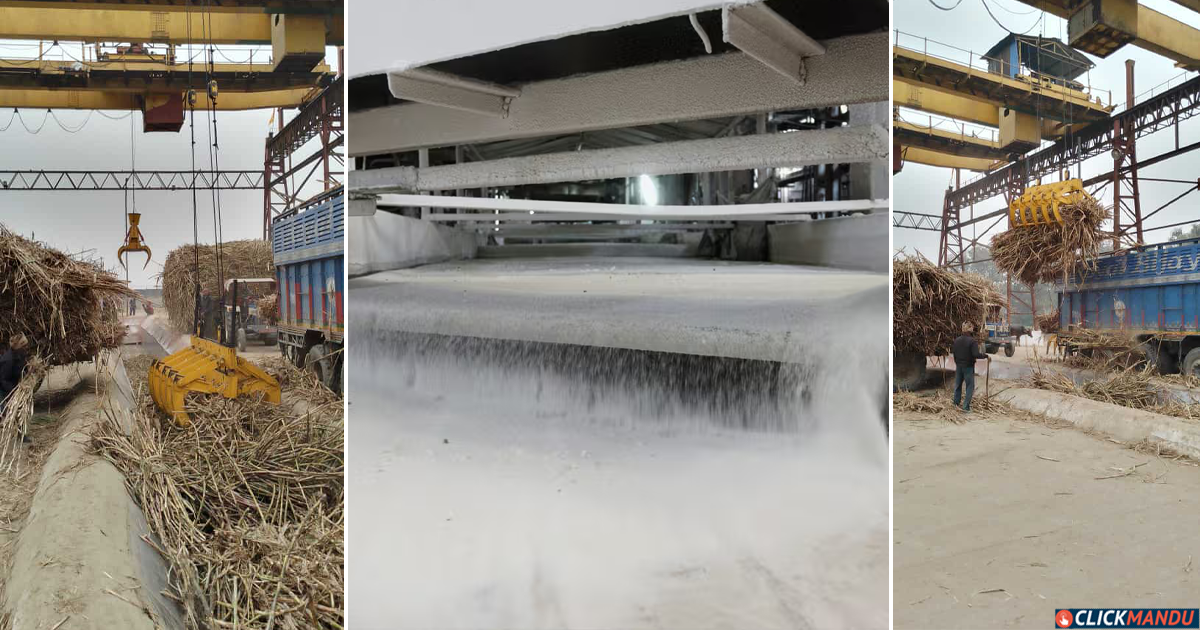
Domestic mills have borne the brunt of this price disparity. A recent example is Eastern Sugar Mill, the only sugar factory in Koshi Province, which has been forced to store 408 quintals of sugar produced last year that remain unsold even as it has begun producing new stock this season.
The association warned that if domestic sugar cannot be sold smoothly, regular and timely payments to sugarcane farmers will also be jeopardized.
The mill processed 1.855 million quintals of sugarcane last year, producing 153,978 quintals of sugar. Of this, 408 quintals are still sitting in storage. Industry sources say the prolonged storage has caused the sugar to clump, forcing the mill to recycle it before it can be sold.
While the mill has already paid farmers promptly after cane crushing, unsold sugar has pushed the company into financial stress. Industry sources say this situation is not unique, with mills across the country compelled to store unsold stock while continuing new production.
Eastern Sugar Mill aims to crush around 1.8 million quintals of sugarcane again this year, targeting production of more than 150,000 quintals of sugar. By Wednesday, the mill had already processed about 600,000 quintals of cane and is simultaneously recycling older, clumped sugar stock while continuing fresh crushing.
In a recent statement, the Nepal Sugar Producers Association said unchecked illegal sugar imports have severely disrupted domestic sales and pushed the industry into crisis. The association has urged the government to immediately curb uncontrolled sugar inflows facilitated by Nepal’s open border.
To protect domestic producers, the association has called for stricter controls on sugar imports, an increase in customs duties, and a quota-based import system that allows imports only after confirming domestic production shortfalls. It has also demanded that any permitted imports be handled exclusively through Nepal Food Corporation and Salt Trading Corporation.
The association warned that if domestic sugar cannot be sold smoothly, regular and timely payments to sugarcane farmers will also be jeopardized. It claims that farmers have received payments on time over the past four to five years, a stability now at risk due to market distortions.
Illegal imports have left some mills with unsold sugar from the previous season still in storage, even as crushing has begun this year. The association estimates that sugar production this season could reach 227,000 metric tons and says tighter import controls are essential to prevent further damage to the domestic industry.

Comment Here