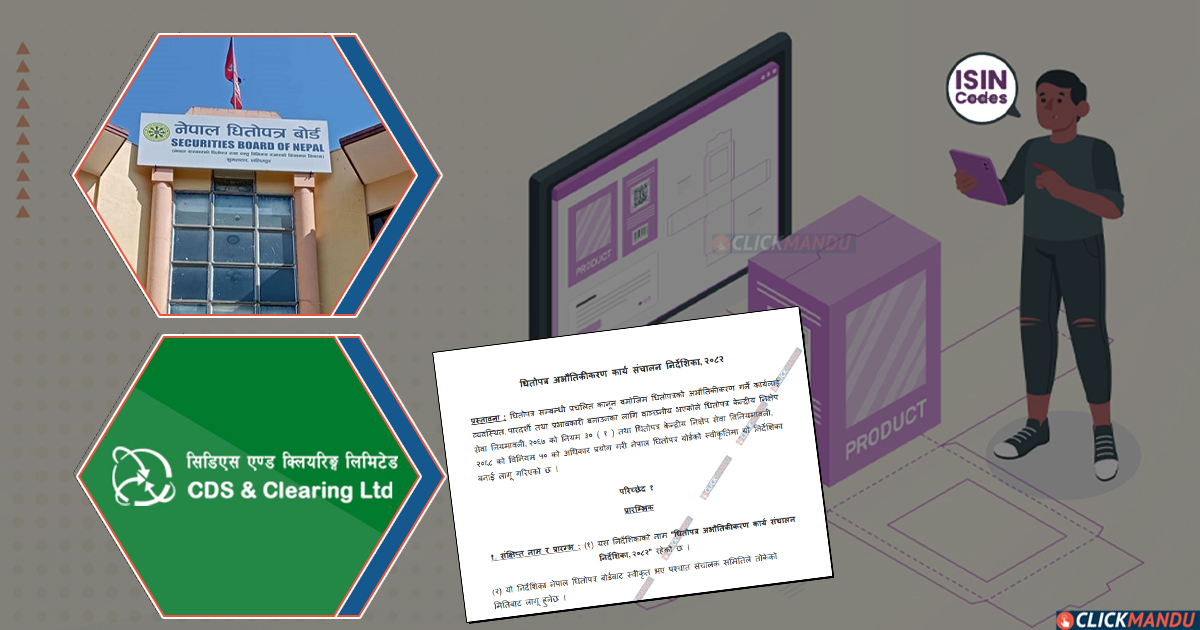

Kathmandu: Nepal’s central securities depository, CDS and Clearing Limited (CDSC), is facing mounting allegations of unlawful conduct after it halted the lock-in release and dematerialization of shares of several listed companies, citing a controversial “dual ISIN” requirement that critics say has no legal basis.
The dispute has unsettled investors, drawn regulatory complaints, and escalated into court proceedings, raising broader concerns about governance and rule of law in Nepal’s capital market.
Under existing regulations — the Securities Registration and Issuance Regulation, 2016 and the Securities Issuance and Allotment Directive, 2017 — founder shares of listed companies are subject to a three-year lock-in period from the date of allotment. Once that period expires, such shares are legally treated on par with public shares and are eligible for trading and dematerialization. Market participants argue that CDSC’s decision to block dematerialization after the lock-in period violates these provisions.
At the centre of the controversy is CDSC’s insistence on separate International Securities Identification Numbers (ISINs) for founder and public shares, even when both are of the same class of common equity. Investors and companies contend that no approved law or directive authorizes such a requirement. Notably, a proposed guideline on dual ISINs submitted by CDSC has not been approved by the Securities Board of Nepal (SEBON), effectively leaving the policy without legal standing.
Several companies have been directly affected. Emerging Nepal Limited claims that despite completing all procedures with the Nepal Stock Exchange (NEPSE), including securing a single stock symbol after the expiration of its founder share lock-in period, CDSC refused to consolidate ISINs without a shareholders’ meeting and further regulatory approvals. Even after the company complied with those demands, CDSC continued to withhold approval, prompting allegations of arbitrary and prejudicial decision-making.
Pure Energy Limited, one of Nepal’s largest private solar power producers, has taken the dispute to court. After completing its IPO in April 2025, the company applied for dematerialization and lock-in tagging in accordance with existing laws. CDSC rejected the application, prompting Pure Energy to file a writ petition at the Patan High Court. The company has sought an interim order directing CDSC to dematerialize its founder shares without requiring a separate ISIN. The court has ordered an expedited hearing, signalling the seriousness of the issue.
Critics allege that CDSC’s actions have effectively rendered founder shares “non-existent” within the system, depriving shareholders of the ability to exercise ownership rights over assets worth hundreds of millions of rupees. Investor groups argue this amounts to an infringement of constitutionally protected property rights.
The controversy has also reached the Commission for the Investigation of Abuse of Authority (CIAA), where a complaint was filed months ago alleging abuse of authority and regulatory overreach. However, no decisive action has yet been taken.
ISINs are globally recognized 12-character codes used to uniquely identify securities for clearing, settlement, and reporting. International practice assigns a single ISIN to each class of security, such as common equity, regardless of shareholder category. In Nepal, dual ISINs exist only in specific cases involving banks and insurers due to sectoral regulations, not for hydropower or manufacturing companies.
With CDSC wholly owned by NEPSE, the standoff has also strained institutional relationships within the capital market ecosystem. As legal proceedings advance and investor pressure mounts, the outcome is expected to set a critical precedent for regulatory authority, market transparency, and investor confidence in Nepal’s financial system.

Comment Here