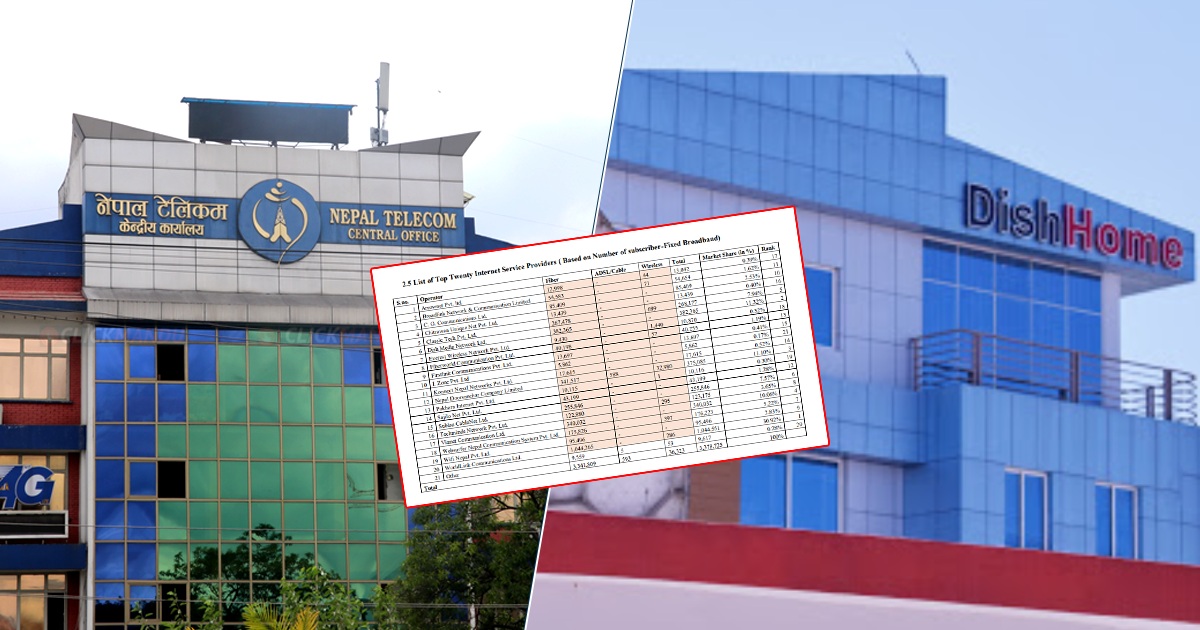

Kathmandu: Nepal’s fixed broadband market is heating up, with state-backed Nepal Telecom and private provider DishHome Fiber locked in a close race to expand their subscriber base.
The latest figures from the Nepal Telecommunications Authority, covering data up to mid-December 2025, show the gap between the two companies has narrowed to just 7,000 customers.
By that date, Nepal Telecom had reached 375,000 broadband subscribers, while DishHome slightly pulled ahead with 382,000. Despite the tight numbers, Nepal Telecom currently ranks third in the country’s fixed broadband market in terms of customer base, while DishHome holds second place.
The overall market leader remains WorldLink, which dominates both in subscriber numbers and revenue. As of the same reporting period, WorldLink had 1.044 million customers, accounting for about 31 percent of Nepal’s total internet market which is a commanding lead over its competitors.
DishHome’s rise has been particularly notable. Over the past seven months, it has consolidated its hold on second place, pushing Nepal Telecom down to third. Earlier, for about five months leading up to April 2025, Nepal Telecom had briefly overtaken DishHome in market share to claim second position. Before that, Nepal Telecom had generally been in third, with WorldLink first and other private providers competing for the next spots.
Growth rates between DishHome and Nepal Telecom appear broadly similar, suggesting the rivalry for second place will remain intense. Among the top 20 internet service providers operating in Nepal, WorldLink holds a market share of 30.92 percent. DishHome follows with 11.32 percent, Nepal Telecom with 11.10 percent, and Vianet close behind at 10.06 percent.
Vianet serves around 340,000 customers, placing it among the strongest challengers. Classic Tech ranks fifth in market share with 267,000 subscribers, while Subisu has 255,000 customers and sits eighth overall. Together, these numbers highlight an increasingly competitive broadband sector, where private firms are steadily challenging the long-standing dominance of the national telecom operator.

Comment Here