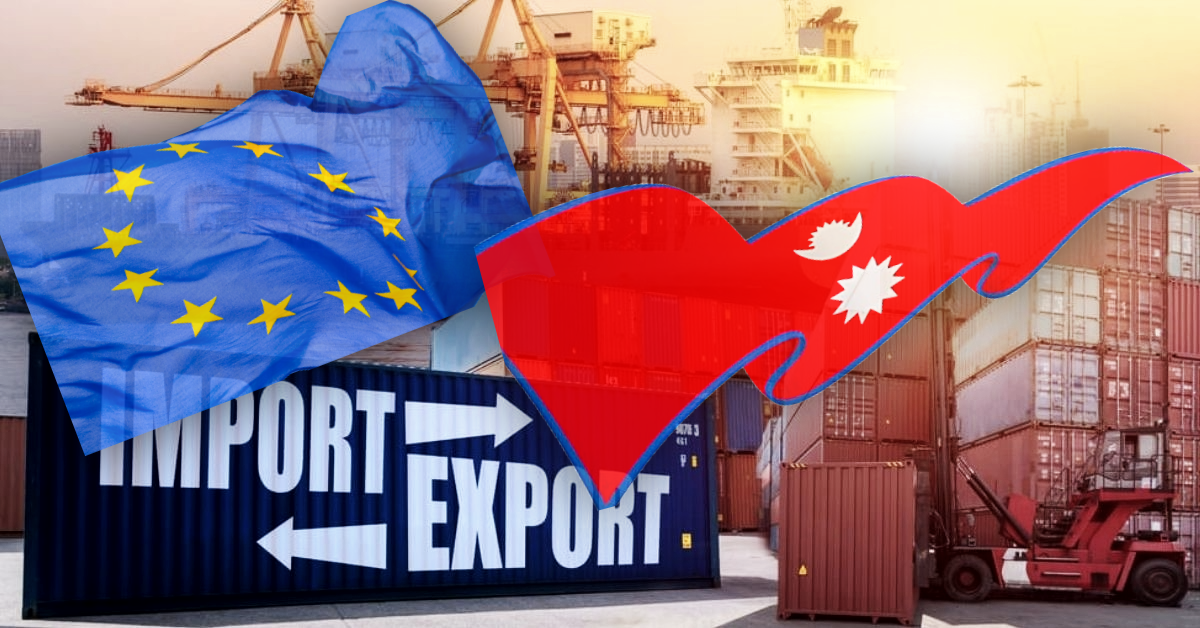

Kathmandu: India and the European Union have recently concluded two major trade agreements that significantly deepen their economic partnership.
As a result, Indian goods will gain duty-free access to EU member states, opening the door to one of the world’s largest consumer markets. The breakthrough is seen as the outcome of more than two decades of sustained Indian trade diplomacy aimed at securing wider global market access.
The agreements allow India to export dozens of products to all 27 EU countries at zero customs duty. Signed by Indian Prime Minister Narendra Modi and European Commission President Ursula von der Leyen, the deals include a Free Trade Agreement (FTA) and preferential trade arrangements under the Generalized System of Preferences. EU countries have agreed to remove tariffs on more than 99 percent of goods imported from India. Analysts say this could enable India to expand exports by an additional US$ 75 billion.
Under the terms, the EU will immediately eliminate tariffs on about 90.7 percent of product categories, phase out duties on 2.9 percent over five years, and manage 6.4 percent under quota systems. India, now considered the world’s fourth-largest economy, and the EU, the second-largest economic bloc, together account for roughly a quarter of global GDP and nearly one-third of world trade.
Current annual goods trade between India and the EU stands at US$ 136.54 billion, with India exporting US$ 75.85 billion worth of products and importing $60.68 billion. Services trade between them totals another US$ 83.10 billion.
Trade experts say the deal opens vast third-country market opportunities for India and could create jobs for women, youth, artisans, and small and medium-sized enterprises.
Sectors gaining major tariff relief include textiles and garments, leather and footwear, marine products, gems and jewelry, handicrafts, engineering goods, and automobiles. Around US$ 33 billion worth of Indian exports that previously faced tariffs of about 10 percent will now enter Europe duty-free. Indian products such as garments, carpets, leather goods, jewelry, seafood, machinery, and chemicals will benefit directly.
The EU has also granted India meaningful access in services, including IT, education, financial services, tourism, construction, and professional services. Indian providers gain entry into 144 service sub-sectors, while the EU gains access to 102 in India. India also receives zero-tariff treatment for tea, coffee, spices, fruits, vegetables, and processed foods, though sensitive agricultural areas such as dairy, grains, poultry, soy meal, and some produce remain protected.
Trade experts say the deal opens vast third-country market opportunities for India and could create jobs for women, youth, artisans, and small and medium-sized enterprises. A trade expert and former Joint Secretary at the Ministry of Industry, Commerce, and Supplies Ravi Shankar Sainju said that India is upgrading production through budget incentives, manufacturing corridors in seven locations, garment ecosystem hubs, and programs to boost yarn output.
“To capture that market, India is working to establish itself as a production hub by significantly increasing production in software, semiconductors, machinery parts, IT, garments, carpets, and more. Through its current budget, it has announced upgrades and ‘Production Hub Corridors’ in seven locations, and is working to create an ‘ecosystem hub’ for garments. Similarly, it has introduced a separate program to increase yarn production,” said Sainju.
According to him, China currently accounts for 28 percent of the world’s total production capacity. By adopting various such agreements and policies, India is working to increase its global production capacity from 3 percent to approximately 9 percent.
“Once production capacity expands, India will require a large market share. That is why it signed the FTA with the EU. In search of potential markets, India is currently pursuing FTAs with several other countries besides the EU,” Sainju added.
What kind of risk is there for Nepal?
According to bilateral and multilateral trade experts, the India-EU Free Trade Agreement is likely to deal a major blow to Least Developed Countries (LDCs) like Nepal.
As a Least Developed Country, Nepal has long enjoyed the “Everything But Arms” (EBA) facility, which allows it to export goods to the EU at zero customs duty.
According to Dr. Paras Kharel, trade expert and Executive Director of SAWTEE, under the facilities provided by the EU, Nepal has primarily been exporting carpets, ready-made garments, pashmina, shawls, mufflers, craft cloth, handicrafts, jerseys, and other products at zero customs duty.
The EU accounts for about 40 percent to 50 percent of Nepal’s total exports. Within that, ready-made garments and carpets hold the largest share. It is estimated that once India receives free trade facilities, Nepal’s market share for such goods could shrink by 20 percent to 30 percent.
The European Union includes countries such as Austria, Belgium, Bulgaria, Croatia, Cyprus, the Czech Republic, Denmark, Estonia, Finland, France, Germany, Greece, Hungary, Ireland, Italy, and Latvia. It also includes Lithuania, Luxembourg, Malta, the Netherlands, Poland, Portugal, Romania, Slovakia, Slovenia, Spain, and Sweden.
“After graduating from the LDC status, Nepal will receive zero-percent duty facilities from the EU for three years; even after moving to GSP Plus, Nepal will be able to utilize zero-percent facilities,” said Dr. Kharel. “By utilizing the zero customs duty facility, we were somehow managing to export even when our production costs were 30 percent more expensive. However, the zero-duty facility recently obtained by India from the EU is set to cause major damage to Nepal’s exports.”
Until the agreement with the EU, India had been paying customs duties of 8 percent on carpets, 10 percent to 12 percent on garments, 8 percent on shawls and scarves, 12 percent on jerseys, cardigans, and sweaters, and 8 percent on pashmina mufflers. Overall, before this agreement, customs duties on exports from India to EU countries ranged from 8 percent to 17 percent. Nepal, meanwhile, enjoyed zero-duty access for these items.
With the India-EU agreement, India now enjoys the same zero-percent duty facility as Nepal.
Even though Nepal enjoys the same zero-duty facility as India, because Nepal’s production costs are nearly 30 percent higher than India’s, Indian goods will be significantly cheaper in comparison. As a result, the export of goods that Nepal has traditionally sent to the EU is expected to suffer a major setback.
According to Sainju, the FTA agreement between the EU and India has provided India with benefits beyond its imagination, while creating a situation where Nepal may lose its EU market.
“No matter how much we boast, India believes in mass production, and large-scale investment and facilities have been provided by both the private sector and the state accordingly; as a result, their production costs are very low,” he told Clickmandu. “Compared to India, our production cost is 30 percent more expensive. On the other hand, there is a lack of investment and facilities from the private and state sectors for quality mass production. In this situation, while goods from both India and Nepal are duty-free in the EU, Nepal risks losing its existing market share while India has succeeded in securing a massive market share.”
According to Sainju, the FTA completed between India and the EU has hit not only Nepal but also Bangladesh. Bangladesh had also been exporting large quantities of carpets and ready-made garments to EU member states by paying customs duties.
“Due to geopolitical competition, production costs, and brand recognition, competing with India can be very challenging,” Sainju said.
Nepal also imports the raw materials needed to produce finished goods like garments and carpets from abroad, which is very expensive. Trade expert Sainju informed that this increases production costs, making it impossible to compete with Indian goods on price, leading to a major crisis in the export of such items.
The wool required for carpet production is imported to Nepal from Tibet and New Zealand. From that wool, the processes of spinning yarn, dyeing, weaving on looms, and producing finished carpets reflecting Nepali art and culture take place in Nepal.
“If we do not move toward a Regional Value Chain by collaborating with India, our export situation will collapse in the coming days. A situation has arisen where we must produce by integrating into the Regional Value Chain that India produces,” Sainju said. “If we cannot do this, it will be very difficult for us. It will have a major long-term impact on our export process. Nepal must increase large-scale production of specialized, high-quality goods with unique characteristics and identity. This increases market value, which will make it easier to protect the export situation, even if only slightly.”
Large direct blow, indirect benefits: Pandey
Pashupati Dev Pandey, President of the Garment Association of Nepal, stated that the India-EU agreement poses great harm but also some small benefits for Nepal. Stating that Nepal could take indirect but significant advantage of the agreement, Pandey noted that there are opportunities for Nepal to benefit in five ways.
According to him, due to the agreement, the demand for Nepali raw materials and intermediate goods linked to the Indian supply chain could increase significantly. Similarly, the impact of increased investment from the EU into India could spill over into Nepal. Specifically, possibilities for investment in hydropower, tourism, information technology (IT), and manufacturing industries could increase.
Nepal must immediately begin ‘Trade Diplomacy’ negotiations regarding the facilities it will receive after graduating from the LDC status and that it is necessary for the government and the private sector to formulate the required strategy in time.
“Likewise, regarding transit and transport benefits, regional infrastructure and connectivity may expand as India-EU trade grows,” Pandey said. “This helps increase the competitiveness of Nepali businesses. Additionally, regarding regional stability and economic impact, the strengthening of India-EU relations creates a situation that boosts economic activity and stability in South Asia, from which Nepal can also receive indirect benefits.”
Trade expert Kharel also mentioned that a market still exists for Nepali products due to their original craftsmanship and unique nature. “Compared to India, our production costs for carpets, garments, pashmina, shawls, mufflers, etc., are about 30 percent more expensive. However, carpets, garments, pashmina, and shawls produced in Nepal with specialized designs, vibrant colors, artistry, and a distinct identity are highly favored by ‘hippies’ (niche collectors/tourists) even if the price is high,” Kharel said. “The fact that they like Nepali goods and purchase them in large quantities despite the high price suggests that a market is still secure for our products. In the coming days, if we can produce in large quantities with better quality, branding, and reduced costs, our market can expand.”
Furthermore, Kharel informed that Nepal must immediately begin ‘Trade Diplomacy’ negotiations regarding the facilities it will receive after graduating from the LDC status and that it is necessary for the government and the private sector to formulate the required strategy in time.
Trade deficit with European countries despite zero-percent facility
Although Nepal receives a zero-percent customs duty facility when exporting goods to European countries, bilateral trade is not in a satisfactory state. In other words, Nepal has been bearing a trade deficit with European countries.
In the last fiscal year 2080/81 (2023/24), Nepal conducted bilateral trade worth more than Rs 43.88 billion with European countries. At that time, Nepal imported various goods worth more than Rs 32.62 billion from European countries.
Meanwhile, it succeeded in exporting only Rs 12.25 worth of Nepali goods. In that year, Nepal bore a trade deficit of Rs 19.37 billion in its trade with European countries.
According to data from the Department of Customs, Nepal conducted bilateral trade with 27 European countries in that fiscal year. Among them, Nepal achieved a trade surplus with only six countries: Denmark, Romania, Austria, Latvia, Malta, and Croatia.
Among these, Nepal earned the highest profit in trade with Denmark. In that year, Nepal conducted total bilateral trade worth more than Rs 1.06 billion with Denmark.
While importing goods worth Rs 362.6 million from Denmark, Nepal succeeded in exporting various goods worth nearly double that amount (Rs 701.5 million) to that country. Nepal earned a profit of Rs 338.9 million in bilateral trade with Denmark.
Apart from these, Nepal was forced to bear a large trade deficit with 21 countries under the European Union: Cyprus, Slovakia, Luxembourg, Portugal, Greece, Slovenia, Lithuania, Estonia, Bulgaria, Hungary, Sweden, the Czech Republic, Belgium, Finland, the Netherlands, Ireland, Poland, Spain, Italy, Germany, and France.

Comment Here