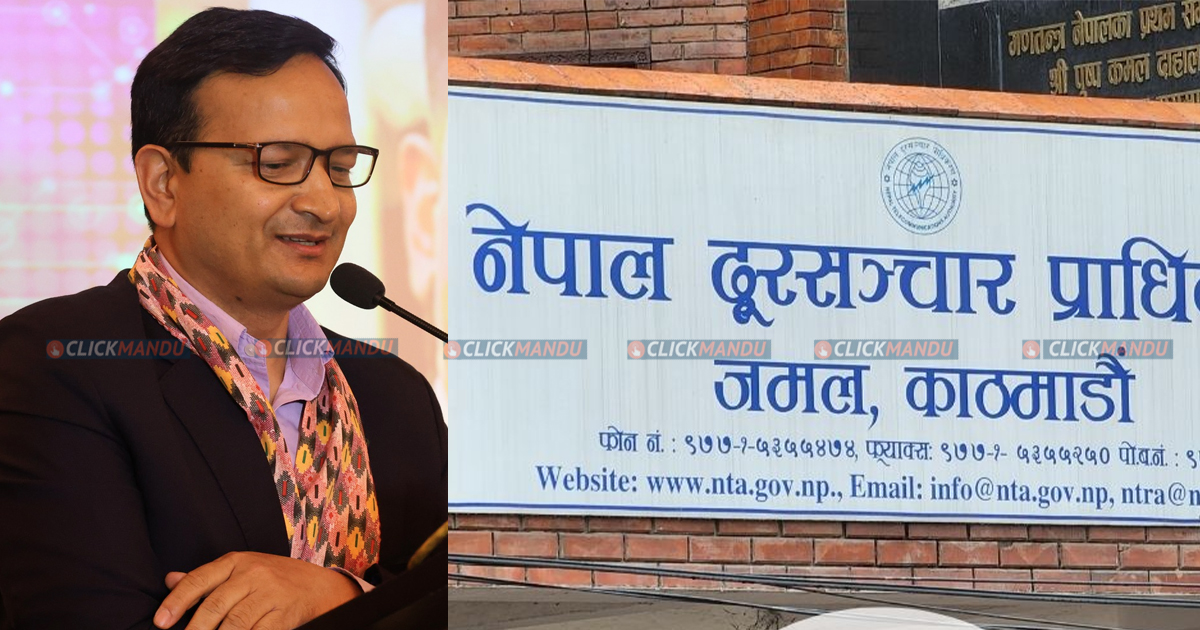

Kathmandu: Telecommunications regulator, the Nepal Telecommunications Authority (NTA), is facing growing criticism for what service providers describe as a biased and restrictive approach that is hurting the sector.
Operators complain that instead of facilitating business in a market that has already shrunk from six providers to just two major players, the regulator has focused mainly on imposing tight controls, leaving companies struggling to operate smoothly.
The NTA is currently chaired by Bhupendra Bhandari, who will complete two years in office on February 18. During his tenure, critics say he has failed to adopt a cooperative stance toward service providers. While the authority routinely highlights its role in collecting and transferring telecom taxes to the government, operators argue that it has done little to ease regulatory hurdles or support business growth.
The frustration came into the open on Thursday during the 22nd anniversary celebration of Nepal Telecom, the state-owned operator. Addressing the event, board member Lok Bahadur Katuwal publicly stated that the NTA has not made a decision for the past eight months on proposals submitted by Nepal Telecom, directly affecting the company’s business operations.
Representing employees on the board, Katuwal made the remarks in the presence of Chairperson Bhandari himself, saying the regulator’s prolonged inaction has stalled service improvements. He later explained that the authority has yet to approve a proposal to extend the international call pulse rate from 30 seconds to 60 seconds.
According to Katuwal, international operators charge Nepal Telecom on a 60-second basis. However, Nepal Telecom currently bills customers in 30-second pulses, meaning it pays foreign carriers for a full minute even when customers are charged for half. With the Nepali rupee weakening against the US dollar and global practice favoring 60-second billing, Nepal Telecom proposed aligning customer billing accordingly, but the NTA has still not granted approval.
“At present, if a customer talks for 28 seconds, they are charged for 30 seconds,” Katuwal said. “If the goal is to provide convenience to customers, why not offer a full 60-second pulse?” he questioned.
Nepal Telecom is not alone in facing delays. The regulator has also been accused of sitting on proposals from private operator Ncell for extended periods. Previously, several service-related proposals were held up for nearly two years and were approved only after pressure from the Ministry of Communications, which cleared multiple submissions at once toward the end of the last fiscal year.
The NTA has also been accused of failing to utilize monitoring equipment worth more than Rs 3 billion that was procured for regulatory oversight.
Since Bhandari assumed leadership, complaints have intensified that both private and state-owned telecom companies have received little regulatory facilitation. In one instance, the authority reportedly blocked Ncell’s access to foreign exchange facilities for about two years, delaying payments for telecom equipment imported into Nepal.
Last year, during Nepal Telecom’s anniversary event, Bhandari announced a study on Wi-Fi hotspot services, arguing that such services should be operated only by licensed telecom companies and not by internet service providers offering mobile hotspots. Although the authority later issued a notice reflecting this position, it has yet to effectively monitor the situation or take a clear, enforceable decision.
The NTA has also been accused of failing to utilize monitoring equipment worth more than Rs 3 billion that was procured for regulatory oversight. Critics allege that despite having advanced tools at its disposal, the authority under Bhandari’s leadership has shown little interest in putting them into use.
Bhandari, however, has pushed back against the criticism. He has accused service providers of underperformance, claiming they have failed to fully utilize funds allocated from the Rural Telecommunications Development Fund. He has also argued that Nepal Telecom has benefited financially from concessions granted by the regulator during license renewals and has focused more on distributing bonuses than improving services.
According to Bhandari, Nepal Telecom planned to distribute bonuses amounting to Rs 5.4 billion by allocating 30 percent for each of two fiscal years. He also stated that out of 38 recommendations given to Nepal Telecom last year, only nine were implemented within a year.
He further pointed to weak fiber-to-the-home (FTTH) coverage, unsuccessful 5G testing despite regulatory approval, and said Nepal Telecom must take immediate corrective action to improve service delivery.

Comment Here