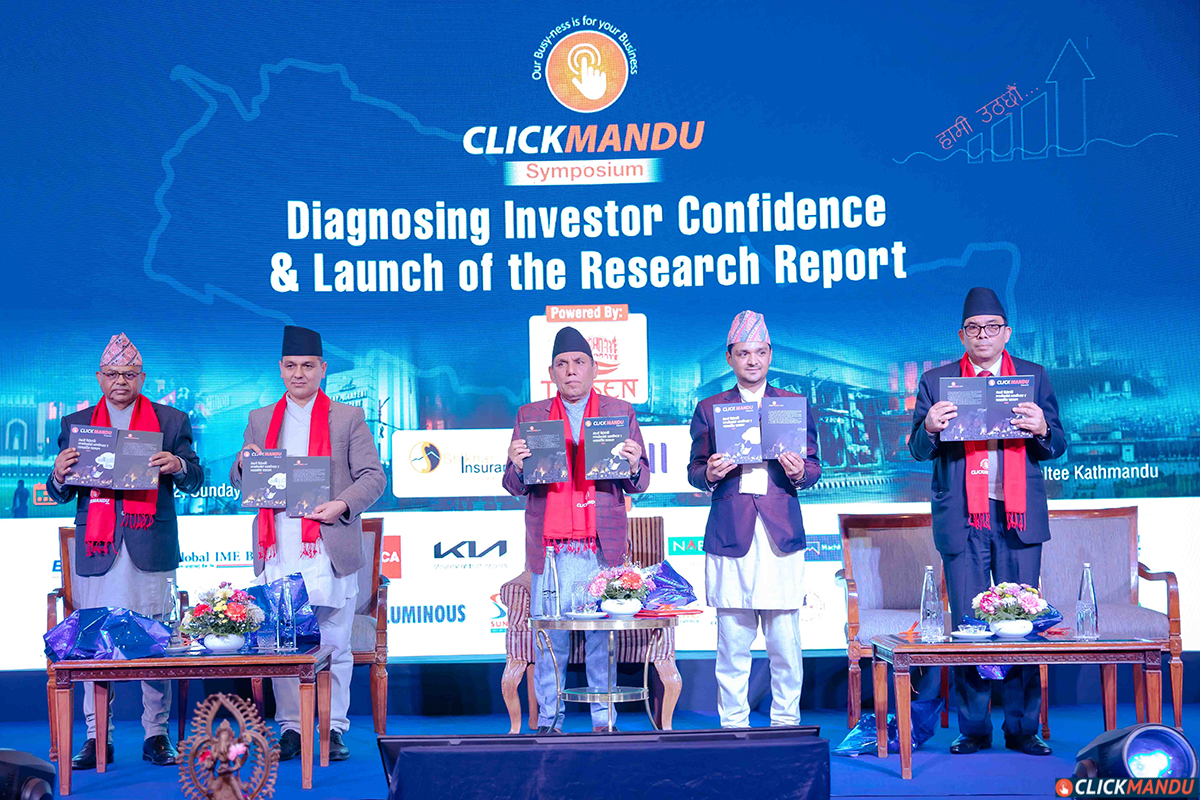

Kathmandu: Clickmandu.com has released a major study titled Investor Confidence and the Business Environment After the Gen Z Uprising 2082 (Clickmandu Research), examining the impact of the recent unrest on Nepal’s private sector. The report was officially unveiled on Sunday at a program held at the Soaltee Hotel in Kathmandu by National Assembly Chair Narayan Prasad Dahal.
The study comes in the aftermath of the Gen Z–led protests on 8 and 9 September 2025, during which key government and private-sector infrastructure and properties were targeted with arson and vandalism. As a result, the private sector, widely regarded as a pillar of the national economy, suffered not only extensive physical damage but also deep psychological harm.
Against this backdrop, Clickmandu conducted a comprehensive analysis of the multidimensional impact of the Gen Z uprising on the business community. The study surveyed 121 billionaire investors active across sectors including industry, finance, tourism and services, energy, education, healthcare, and construction.
All 121 respondents completed a digital questionnaire. More than half reported total investments exceeding Rs 5 billion. Of the respondents, 46 percent have investments in industry and 37 percent in the financial sector. The findings show that 98 percent of business owners said their morale weakened following the uprising, while 97 percent felt that the overall investment climate had deteriorated.
An analysis of physical and economic losses revealed that 46 percent of respondents suffered direct damage during the unrest. The total physical losses incurred by participants were estimated at around Rs 25 billion, with an average loss of Rs 440 million per business. The report also notes that 21 percent of respondents experienced attacks not only on their business operations but also on personal homes and vehicles.
The study further found that 67 percent of surveyed business owners suffered psychological trauma, while 54 percent reported direct negative effects on market operations. When assessing the impact of the protests on morale, 98 percent said their confidence was affected to some degree, ranging from mild to severe, while only 2 percent said their morale remained unchanged.
These findings point to a sharp erosion of business confidence. However, the study indicates that investors have not completely withdrawn from future plans. While 8 percent said they would not increase investment under any circumstances, 70 percent have adopted a wait-and-see approach, and 21 percent expressed willingness to invest further if conditions improve.
Clickmandu Research was designed to highlight the structural, institutional, and practical role of the private sector in Nepal’s economy, with a focus on measuring investor confidence and assessing the business environment rather than only quantifying physical and financial losses. The report concludes that the uprising has inflicted profound psychological and economic damage on Nepal’s established and large-scale entrepreneurs.
The report was launched at an event chaired by Clickmandu Chair and Executive Editor Pushpa Dulal, with National Assembly Chair Narayan Prasad Dahal attending as chief guest. Special guests included Industry Minister Anil Kumar Sinha, Home Minister Om Prakash Aryal, and Vice Chair of the National Planning Commission Dr. Prakash Kumar Shrestha. Nepal Rastra Bank Governor Bishwanath Paudel addressed the program virtually.
The event was attended by senior government secretaries, as well as leaders and representatives from the Federation of Nepalese Chambers of Commerce and Industry, the Confederation of Nepalese Industries, and the Nepal Bankers’ Association. Officials from regulatory bodies including Nepal Rastra Bank, the Securities Board of Nepal, and the Nepal Insurance Authority were also present. Alongside the report’s release, the program featured a panel discussion on investor confidence and the broader investment environment.

Comment Here