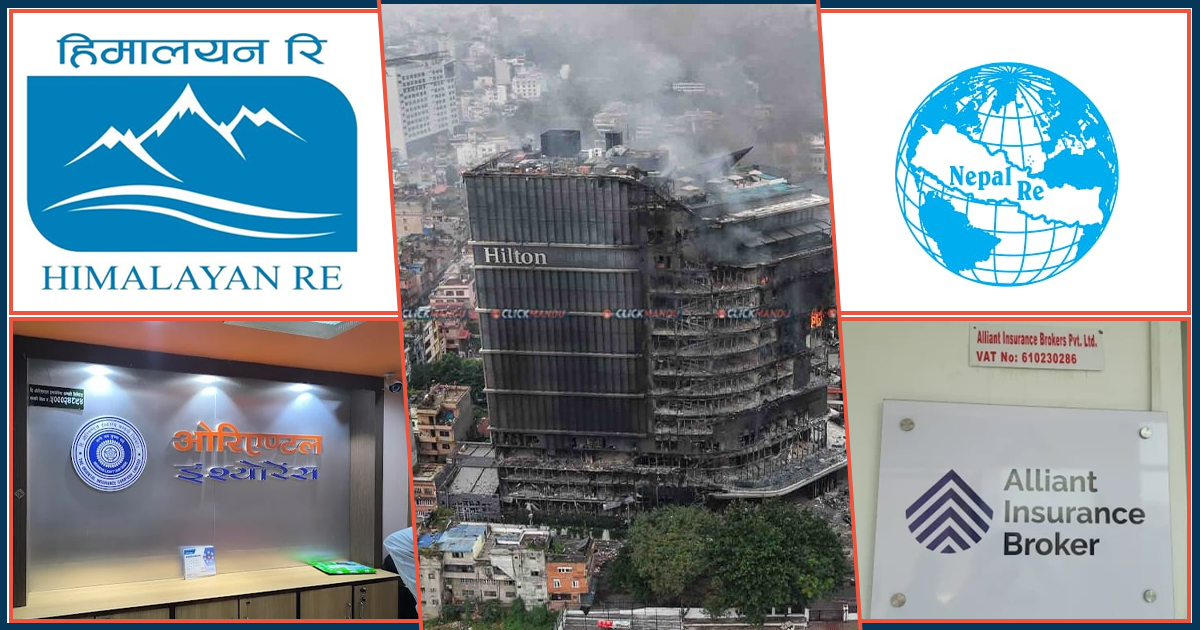

Kathmandu: Five months after arson and vandalism during the Gen Z protests, the reinsurance dispute surrounding the Hilton Hotel remains unresolved, delaying compensation for the damages. The incident occurred on Bhadra 24, when the hotel was set on fire and attacked, yet the insurance mechanism, meant to absorb such risks and support recovery, has failed to deliver clarity or closure.
At the heart of the problem appears to be regulatory and institutional lapses. Nepal’s insurance regulator has yet to determine which company actually holds the reinsurer’s responsibility and who is liable for the claim. While the hotel’s primary insurance was issued by Oriental Insurance, uncertainty over where the risk was reinsured has stalled the entire claims process.
The regulator has investigated multiple entities, including Nepal Reinsurance Company, Himalayan Reinsurance, Oriental Insurance, and Alliant Insurance Brokers, but progress has been slow. Although explanations have now been sought and received from all four, officials say no concrete decision has been made on how to proceed. A final determination on responsibility is expected soon, especially with increased attention from the regulator’s leadership.
Initial findings show that Oriental Insurance retained part of the risk and assigned the remaining portion for reinsurance through Alliant Insurance Brokers. However, the critical question—where that risk was ultimately placed—remains unanswered. Alliant claims that its records, including computers and storage devices, were destroyed in a fire during the same wave of unrest, leaving no traceable evidence of the reinsurance placement. This has raised serious doubts about whether the risk was reinsured at all.
The absence of documentation has deepened suspicion around Alliant’s role, with the regulator hinting at possible negligence. If it is proven that the broker failed to place the risk after accepting the mandate, it could face regulatory action. The case has already been escalated, with a report forwarded to the Ministry of Finance and subsequently to the Commission for the Investigation of Abuse of Authority, though no visible action has yet followed.
The controversy has also revived longstanding policy questions around riot and terrorism insurance in Nepal. Historically, such risks have been reinsured domestically through Nepal Reinsurance, following the reluctance of foreign reinsurers during the conflict era. Even after the establishment of Himalayan Reinsurance as a private-sector player, policy provisions have largely required that riot and terrorism risks be handled by Nepal Re.
However, the Hilton case appears to deviate from this practice. Last fiscal year, there were indications that the reinsurance may have been placed with Himalayan Reinsurance with the consent of Nepal Re, a move that industry experts argue contradicts established norms. This year, however, even that level of clarity is missing, leaving regulators unable to confirm whether the liability lies with Nepal Re, Himalayan Re, or elsewhere.
Despite document requests, field inspections, and preliminary investigations, the regulator has been unable to establish definitive accountability. Industry insiders maintain that riot and terrorism reinsurance should have been placed with Nepal Re, and any deviation from that norm requires thorough scrutiny.
With nearly Rs 8 billion invested in the Hilton project and around NPR 4.5 billion financed through bank loans, the stakes are high. Yet, even after months of investigation, the central question, who bears the reinsurance liability, remains unanswered, prolonging uncertainty for all parties involved.

Comment Here