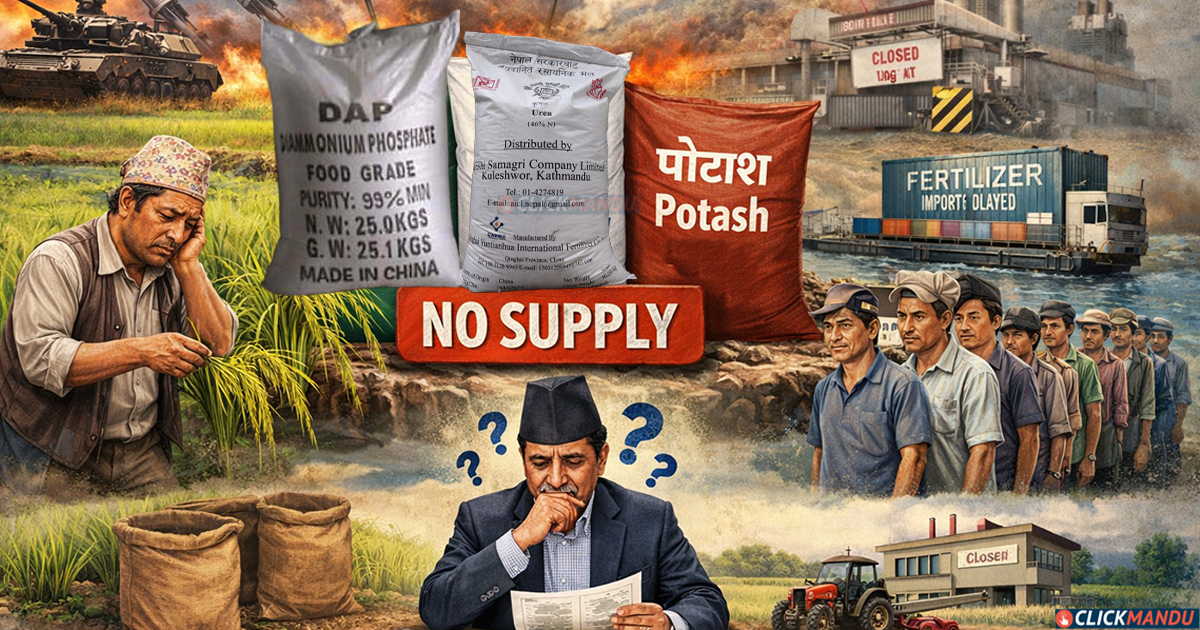

Kathmandu: The ongoing tensions among the United States, Israel, and Iran are not only shaking the global economy but also casting a long shadow over agricultural systems across South and Southeast Asia.
Countries such as Nepal, India, Pakistan, Bangladesh, Sri Lanka, and Bhutan rely heavily on chemical fertilisers during the monsoon rice-planting season, when demand for urea, DAP, and potash peaks. Any disruption in supply during the critical early growth phase and later cultivation stages can significantly reduce crop yields.
Nepal, which produces no chemical fertilizer domestically, is particularly vulnerable. The country depends entirely on imports, primarily from Middle Eastern nations and China, through global tenders. During the paddy season alone, Nepal requires around 200,000 metric tons of urea, 150,000 metric tons of DAP, and 15,000 metric tons of potash. With regional tensions escalating, even major producers like India are struggling to meet internal demand, as they themselves rely heavily on imports, especially for DAP and potash.
The crisis has been compounded by disruptions in the Strait of Hormuz, a critical shipping route between Iran and Oman. Missile threats to cargo vessels, attacks on gas refineries, rising freight costs, and soaring marine insurance premiums have pushed global fertilizer prices sharply upward. Since fertilizer production, particularly urea, is closely tied to natural gas, supply constraints in energy markets are directly affecting output worldwide.
For Nepal, the timing could not be worse. Fertilizer procurement through global tenders typically takes six to seven months, meaning preparations for the June–July planting season must begin as early as December–January. While the government had initiated multiple tenders targeting this year’s paddy season, officials warn that deliveries could now be delayed or disrupted due to external factors beyond Nepal’s control.
An official from the state-owned Agricultural Inputs Company noted that although tenders were issued on schedule, the evolving geopolitical situation has made timely delivery uncertain. Alternative shipping routes are adding up to 20 extra days and significantly increasing costs. Freight charges have reportedly risen by around 30 percent, while marine insurance premiums have surged dramatically, pushing up overall prices.
Despite these concerns, the Ministry of Agriculture and Livestock Development maintains that there will be no immediate shortage. Officials say Nepal currently holds around 137,000 metric tons of fertilizer in stock, with an additional 46,000 metric tons already at Kolkata Port awaiting transport. This brings the assured supply for the upcoming season to approximately 183,000 metric tons. Furthermore, contracts have been signed for an additional 92,000 metric tons, which are expected to arrive in the coming months.
Still, authorities acknowledge that supply chains could face disruptions and have urged farmers to use fertilizers more efficiently and avoid hoarding. They are also encouraging greater use of organic alternatives such as compost and farmyard manure to ease pressure on chemical supplies. At the same time, the government is exploring government-to-government arrangements with India and China as a contingency plan.
Fertilizer shortages carry serious economic implications for Nepal, where rice is both a staple food and a key economic driver. Paddy contributes about 5 percent to the country’s GDP and roughly 15 percent to agricultural GDP. A 10 percent fluctuation in rice production can shift the overall GDP by about 1 percent. With annual demand at around 6.7 million metric tons of paddy and 4 million tons of rice, Nepal already imports significant quantities each year to bridge the gap.
As global fertilizer prices continue to rise, urea prices alone have jumped about 40 percent in recent weeks, experts warn that prolonged disruption in the Strait of Hormuz could drive prices even higher. For a country like Nepal, where agriculture remains the backbone of the economy, the ripple effects of distant geopolitical conflicts may soon be felt directly in its fields.

Comment Here