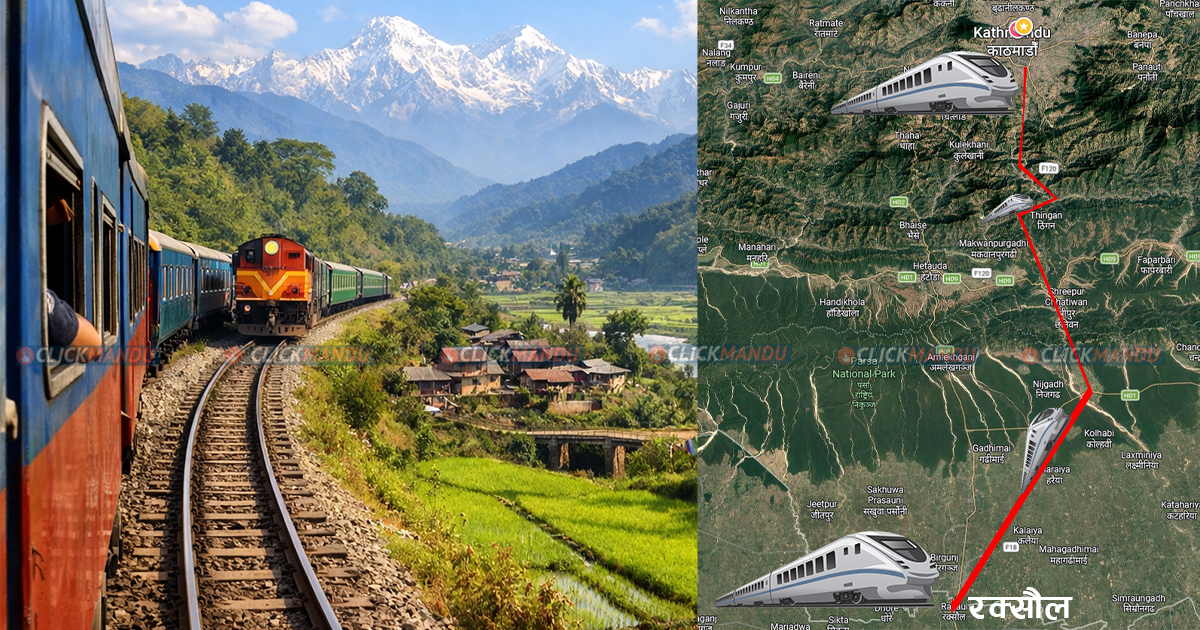

Kathmandu: The long-awaited Raxaul–Kathmandu railway project between Nepal and India has reached a major milestone, with the detailed project report (DPR) now completed following a final location survey by India’s railway authorities.
The proposed 136-kilometre electrified rail line now moves into the approval phase, which will require consultations with multiple agencies, as well as evaluation by Nepal’s National Planning Commission and Ministry of Finance.
The railway initiative stems from a joint declaration made on April 7, 2018, to expand cross-border rail connectivity, with India expected to finance the project. In parallel, both countries have already exchanged a Letter of Exchange to revise transit agreements, aiming to ease cargo movement, particularly along the Jogbani–Biratnagar section.
The project is estimated to cost around Rs 450 billion (approximately US$ 3 billion), but concerns have been raised over its financial viability. The financial internal rate of return stands at just 4.81 percent, lower than prevailing bank interest rates in Nepal, suggesting it may take around 25 years to recover costs.
However, the economic rate of return is estimated at a more promising 14.3 percent, indicating long-term macroeconomic benefits.
According to a study prepared by Konkan Railway Corporation Limited, the route will include around 42 kilometres of tunnels and 124 major bridges, reflecting the challenging terrain. Designed as a broad-gauge line, trains could run at speeds of up to 120 km/h. The proposed alignment starts from Raxaul in India and passes through Jitpur, Nijgadh, Shikharpur, Sisneri, and Sathikhel before reaching Chobhar in Kathmandu.
A key unresolved issue is the track gauge. While Nepal has adopted a policy favouring standard gauge railways nationwide, India has proposed broad gauge based on its existing systems and operational experience. This difference remains under discussion.
Nepal has been requesting that the project be developed under a grant model to improve feasibility, while also emphasizing cargo transport as a priority to ensure economic sustainability. Former Department of Railways Director General Rohit Bisural noted that passenger services alone would not justify the investment, stressing the importance of freight to lower import costs and facilitate trade with third countries via Indian ports.
Final decisions regarding the investment modality, India’s construction role, and the implementation timeline are still pending. However, both sides are gradually advancing technical cooperation, capacity building, and railway infrastructure development.
If successfully implemented, the Raxaul–Kathmandu railway would become the first direct rail link connecting the capitals of Nepal and India, significantly boosting trade, tourism, and broader economic integration. Recently, Indian Railway Minister Ashwini Vaishnaw also confirmed in the Rajya Sabha that the study for the project has been completed.

Comment Here