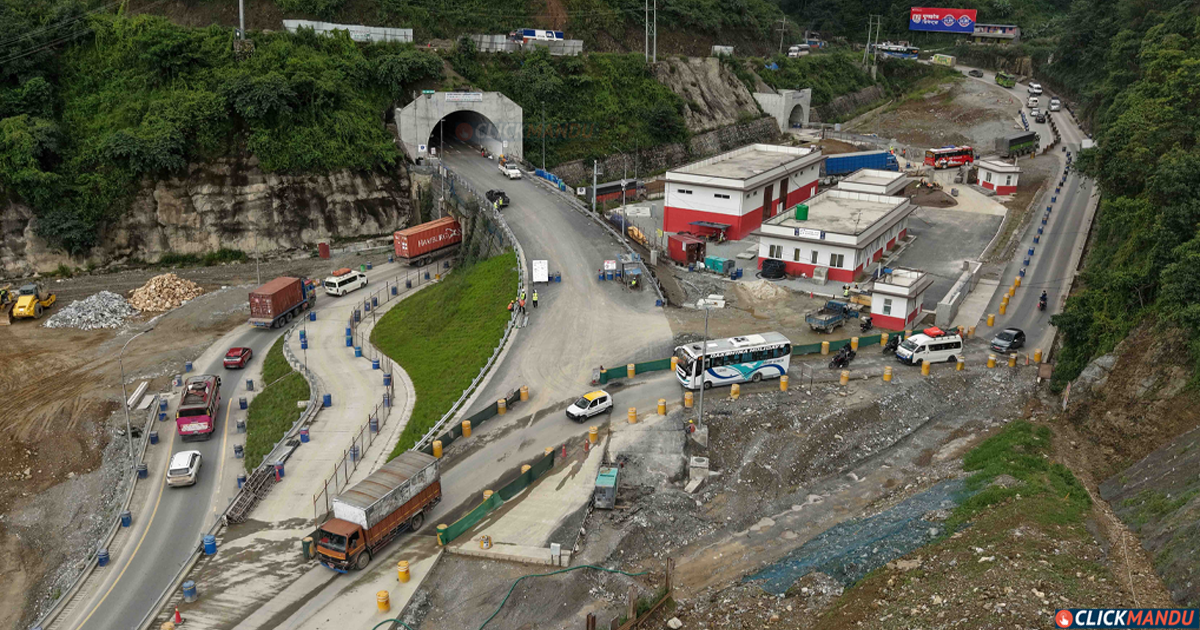

Kathmandu: Nepal–China joint venture has been selected to operate the Nagdhunga Tunnel for the next five years. The joint venture, Yusin–ART JV, has secured the contract for Rs 1.10 billion, although the formal agreement is yet to be signed.
According to project officials, it will take around 15 more days to finalize the contract. Senior Divisional Engineer Sanjay Panthi said the selection followed a global tender process in which 10 domestic and international companies participated.
The contract was awarded to the joint venture of Chongqing Yusin Road and Bridge Development Company of China and Nepal’s ART Construction after it quoted the lowest bid. The project has already issued a letter of intent to the selected company, allowing a seven-day window for any claims or objections.
If no objections are filed within that period, the agreement will be signed within the next two weeks. Afterwards, the operator will recruit and train staff, and the tunnel is expected to open to the public by the last week of May.
The joint venture will be responsible for deploying around 150 skilled personnel, including security staff. Of these, five are expected to be Chinese nationals. Teams will be mobilized in shifts based on operational requirements.
As part of its responsibilities, the operator will collect toll fees from vehicles using the tunnel and deposit the revenue into the government’s account, while also handling maintenance and day-to-day operations.
Several other international and domestic firms had competed for the contract, including Indian, Chinese, and Turkish companies partnering with Nepali firms.
Although most of the construction work has been completed, some structures remain unfinished, prompting an extension of the deadline until April 2026. Delays were caused by repeated landslides near the Sisne Khola entrance on the Dhading side, which damaged infrastructure and delayed the construction of the toll plaza and access road.
Work on landslide control and the western toll gate is currently progressing, while the eastern toll plaza has already been completed and tested.
The tunnel project includes two tunnels: a 2,688-meter main tunnel for vehicle movement and a 2,557-meter parallel evacuation tunnel for emergencies. The evacuation tunnel is connected to the main tunnel through seven cross passages placed at intervals of 300 to 350 meters to facilitate rescue operations in case of accidents or breakdowns.
The evacuation tunnel runs parallel at a distance of about 20 meters from the main tunnel and measures approximately 4.5 meters in width and 5 meters in height.
The government has already fixed toll rates for vehicles using the tunnel. Cars and vans entering Kathmandu will pay Rs 65 and Rs 60 when exiting. Mini buses and trucks will be charged Rs 115 when entering and Rs 80 when exiting, while larger buses and trucks will pay Rs 260 and Rs 200 respectively. Heavy equipment will be charged Rs 600 when entering and Rs 250 when exiting.
The Nagdhunga Tunnel is being constructed at a total cost of Rs 22 billion. Of this, Rs 16 billion is being financed through a concessional loan from Japan at an interest rate of 0.01 percent for 40 years, while the remaining Rs 6 billion is being borne by the Government of Nepal.
The Department of Roads Nepal, had signed the construction contract with Hazama Ando Corporation on September 23, 2019, with an initial completion deadline of April 2023.
However, the project timeline has been extended multiple times due to COVID-19 disruptions, local protests, closure of crusher plants, and challenging geological conditions. The government had previously extended the deadline twice—first by one year and then by 18 months.
Although the tunnel was initially planned to be operational earlier, delays and project variations have pushed the expected opening to around May this year, with preparations now underway to bring the tunnel into operation.

Comment Here