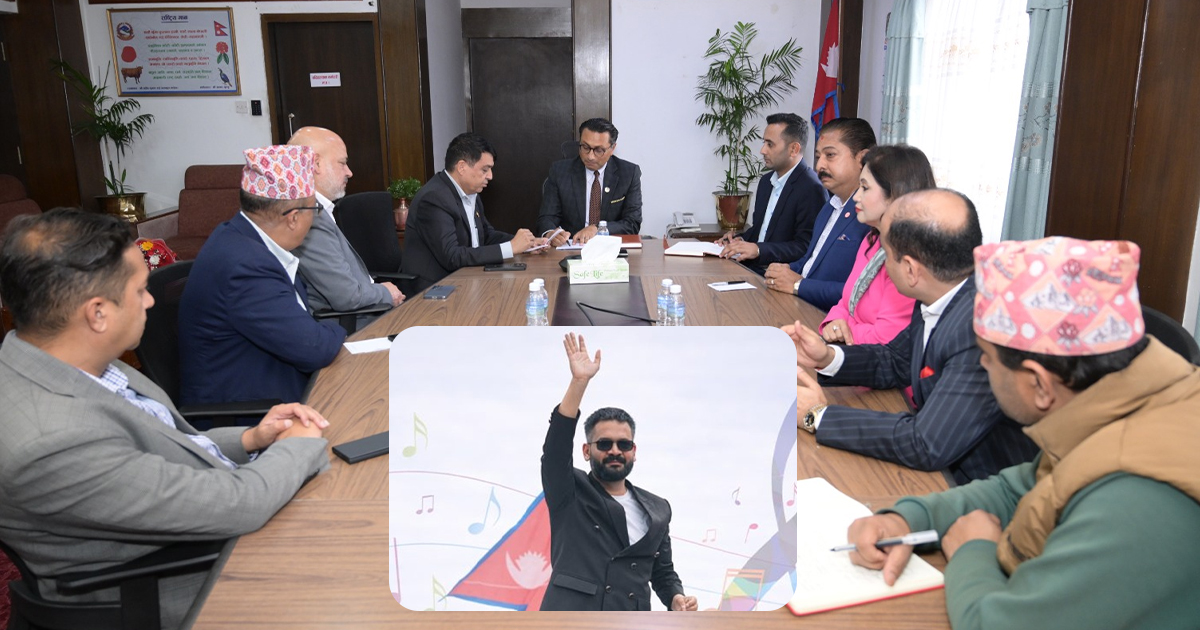

Kathmandu: Finance Minister Swarnim Wagle held a high-level meeting with private sector representatives at the Ministry of Finance on Monday, delivering strong assurances of sweeping reforms aimed at improving the business climate.
The meeting, held between Wagle and officials from the Federation of Nepalese Chambers of Commerce and Industry, was significant given the new government’s 100-day reform agenda, which places notable emphasis on private sector growth and governance reforms.
Representing the private sector were FNCCI President Chandra Prasad Dhakal, former president Shekhar Golchha, Senior Vice President Anjan Shrestha, Vice Presidents Hemraj Dhakal and Jyotsna Shrestha, Treasurer Bharat Acharya, and Director General Gokarna Raj Awasthi.
During the discussion, Wagle pledged to eliminate long-standing policy, administrative, and legal hurdles faced by businesses, signalling a reset in government–private sector relations. He urged entrepreneurs to invest with confidence, assuring them that the era of intimidation, arrests, and unnecessary crackdowns on businesses was over.
“I am here to steer the economy in the right direction—not to engage in corruption, nor to allow it,” Wagle said, emphasizing a firm stance against administrative malpractice. He added that businesses would no longer need to rely on bribery or bureaucratic delays to get work done, declaring that the government would act as a partner rather than an obstacle to the private sector.
Addressing a major concern of the business community, Wagle indicated that minor commercial disputes and financial irregularities would no longer lead to criminal prosecution or detention. Instead, such cases would be handled through financial penalties. However, he warned that deliberate fraud against the state would be dealt with strictly.
Wagle also conveyed a message from Prime Minister Balen Shah, stating that the government is strongly supportive of private enterprise and committed to maintaining business confidence. He revealed that the government is preparing to roll out a “second phase of economic reforms,” focused on simplifying processes, improving the ease of doing business, and creating an investment-friendly environment.
Under this reform agenda, the government aims to build trust with the private sector, introduce systemic improvements, reduce bureaucratic inefficiency, and roll out tax incentives alongside pro-investment policies.
Meanwhile, FNCCI welcomed the government’s decision to implement a long-advocated strategy for protecting and promoting the private sector, calling it a major achievement. Business leaders praised the government for prioritizing private sector input in policymaking.
The finance minister also signalled that the upcoming budget would be more predictable, while outdated and conflicting laws would be repealed or amended to reduce the cost of doing business. Immediate steps are also expected to address raw material shortages and supply chain bottlenecks, alongside identifying “game-changer” projects and high-growth sectors for targeted investment.
Wagle noted that soon after assuming office, he had already moved to repeal 15 laws, and that the government’s 100-day agenda includes 21 specific measures aimed at promoting the private sector.
During the meeting, FNCCI representatives emphasized the need for policy stability, structural reforms, and stronger collaboration between the government and businesses to energize the economy. They also welcomed the government’s decision to adopt recommendations from a high-level economic reform commission formed to guide the second phase of reforms.
FNCCI President Dhakal expressed appreciation for the government’s early reform initiatives addressing key private sector concerns. He stressed expectations for an investment-friendly environment, tax reforms, and policies that boost business confidence in the upcoming budget and policy framework.
He also highlighted the importance of mobilizing both domestic and foreign investment for Nepal’s economic development, noting that FNCCI has already initiated efforts by establishing the Nepal Development Company with a capital of Rs 10 billion.
Dhakal further suggested that, given Nepal’s ongoing economic transition and similar moves by neighbouring countries like Bangladesh to delay graduation timelines, the government should also consider seeking a postponement of Nepal’s own economic transition schedule.

Comment Here