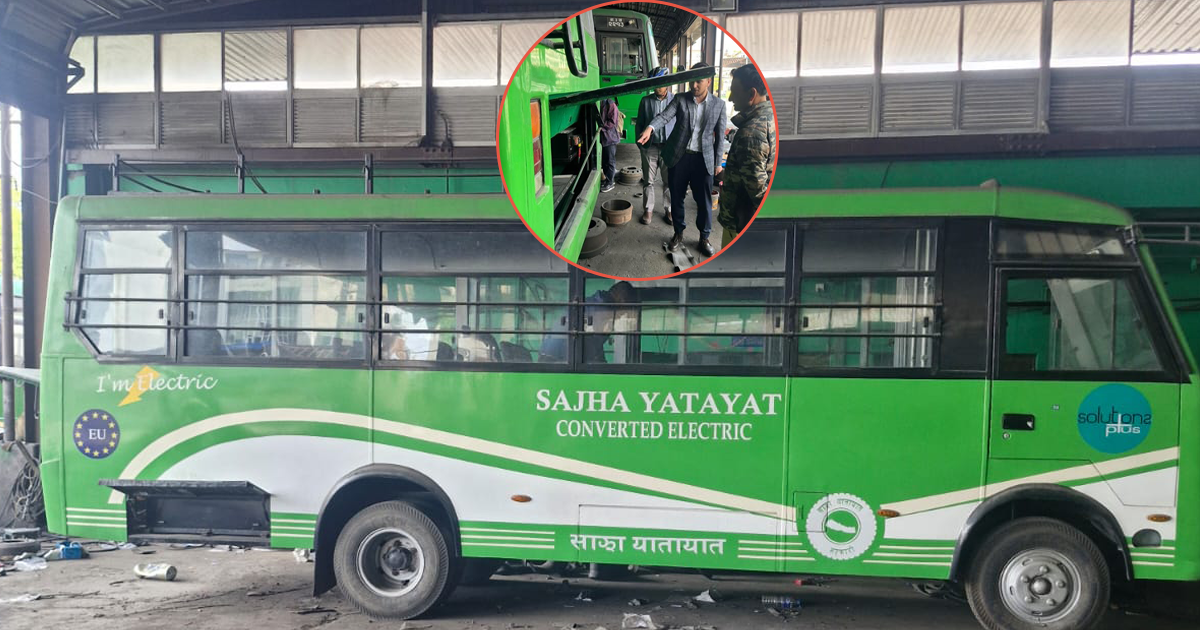

Kathmandu: Sajha Yatayat has successfully converted a diesel-powered bus into an electric vehicle, marking a major step toward cleaner public transport in Nepal.
Chief Executive Officer Bhupendra Aryal said the milestone was achieved after nearly three years of continuous effort by the organization’s mechanical engineering team. The pilot conversion was completed and unveiled in April 2024, overcoming technical hurdles, policy ambiguities, and procurement challenges along the way. As it was the first such attempt, sourcing equipment and navigating regulatory processes took time, with the actual conversion completed in about six months.
Encouraged by this success, Sajha Yatayat now plans to convert all 71 of its diesel buses into electric ones. The move aligns with a recent government decision to shift public transport from petroleum to electric systems, a development Aryal described as “very encouraging.” However, he noted that the absence of clear guidelines and standards still poses a barrier to scaling up the initiative.
The pilot project used a 14-year-old bus acquired through an agreement with the Spinal Injury Rehabilitation Centre. Converting that single vehicle cost around Rs 8 million, including Rs 6.5 million for the conversion kit and Rs 1.5 million for motor and system integration. Much of the equipment had to be imported, which significantly increased costs due to high taxes and customs procedural delays.
Aryal explained that costs could drop substantially if conversions are carried out at scale. He urged the government to introduce tax waivers on EV components, provide subsidies, and establish clear operational standards covering everything from route allocation to fare structures to make large-scale conversion viable.
Despite the technical success, the converted electric bus has yet to hit the road due to the lack of regulatory approval and operational guidelines. “We have the technology and the experience, but without a clear policy framework, the bus is effectively sitting idle,” Aryal said.
The project was carried out with support from the Nepal Electricity Authority. The initiative has also drawn attention from policymakers, including lawmaker Ashish Gajurel, who recently shared images of the converted bus on social media.
Currently, Sajha Yatayat operates 71 diesel buses and 40 electric ones. If enabling policies are introduced, the organization says it is capable of converting its entire diesel fleet to electric within a year.
Beyond urban routes, Sajha is expanding services, including intercity operations such as Kathmandu–Baglung and a planned Kathmandu–Chitwan shuttle starting soon. Meanwhile, similar innovation efforts are underway elsewhere in Nepal. Students at Kathmandu University have converted an old car into an electric vehicle, and the National Innovation Centre is also working on EV conversion technologies.
Nepal has prior experience with such transitions. In the 1990s, a team led by Govind Raj Pokharel, with support from USAID, converted petroleum-powered three-wheelers into electric “Safa Tempos,” which eventually replaced diesel-run vehicles in many areas.
Although legal provisions allow modifications to vehicle systems under special government approval, the lack of detailed standards for EV conversion has delayed implementation. Officials say it may take time before such projects are fully operationalized.
Aryal also highlighted the potential of hybrid systems, vehicles that can run on both diesel and electricity, especially for long-distance routes. Hybrid buses could offer flexibility in areas with limited charging infrastructure, reduce fuel consumption, and lower operating costs. According to him, such technology could significantly improve efficiency, delivering higher mileage while cutting reliance on fossil fuels.

Comment Here