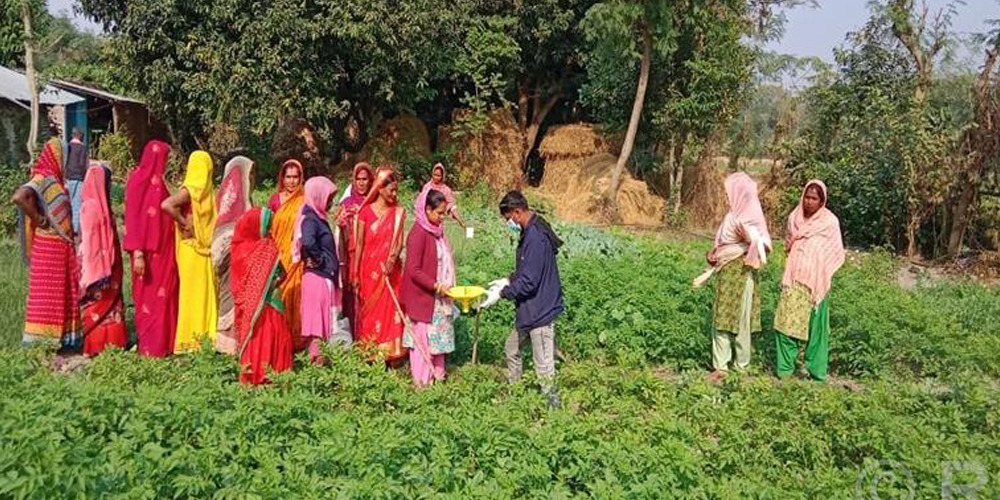

Siraha: Pramod Kumar Mandal, a farmer from Laxmipur Patari Rural Municipality-4 in the district of Siraha, was worried until some years ago that his land plots would remain uncultivated due to a longstanding drought, unseasonal rain, and a decline in the underground water level.
Mandal, who had to rely on rainwater for farming, was a victim of heavy rain at times and then scanty rain. Now, Mandal is not worried about the erratic climatic conditions, as he has opted for climate-friendly agriculture by doing away with the traditional ways of farming.
Mandal shared that he had to struggle and toil hard to manage the costs of fertilizer and seeds due to the severe drought in the past, but now he has grown massive vegetables and crops through mulching technology and a drip irrigation system. “Not only has the income increased, but I feel a great relief after shifting the style of farming,” Mandal shared.
The Mandal family is earning a living through vegetable farming.
Mandal’s family has done better in vegetable farming by preparing fertilizer on their own and by reducing chemical fertilizers adding that the latter reduces the cultivability of the soil.
The Mandal family has made almost Rs 120,000 in the past six months by growing cauliflower, tomatoes, mushrooms, and other green vegetables. He has constructed a tunnel and has installed a solar facility to irrigate the vegetables.
Likewise, Anita Mahato of Dhangadhimai Municipality-10 has earned more than Rs 100,000 from vegetable production in a season. Recently, Anita’s husband has joined her by quitting his job abroad.
Jageshwor shared, “There is no problem with electricity and fuel expenses are saved. There is no worry about water as long as there is sunny weather. The farming inside the tunnel has protected crops from hailstones and extreme temperatures. This has not only increased the income of the family, but also fostered self-reliance.”
The National Farmers’ Group Federation, in Lahan, Nepal, has been supporting a climate-friendly village project to adopt modern and climate-resilient systems.
Field Supervisor of Laxmipur Patari of the organization, Umesh Nandan Chaudhary, mentioned that the project run with financial and technical support of ‘Care Nepal’ has been carrying out activities from running a school for farmers to providing agricultural tools.
He added that the farmers were taught about soil conservation farming techniques. Out of six wards of the municipality, women farmer groups were formed, improved ovens as well as climate-friendly seeds were distributed in five wards.
Similarly, senior programme officer of the project, Ishwor Thapa, viewed that this programme has been launched in four municipalities–Dhangadhimai municipality, Laxmipur Patari, Bhagawanpur and Sakhuwanankarkatti of Siraha, as well as Rupani and Agnisair Krishnaswaran rural municipalities of Saptari.
Activities are underway to develop a climate-resilient farmer community in these six local levels, he opined.
“The project’s main objective is to reduce the emission of greenhouse gases and to enhance the capacity of the women by reducing their workload,” Thapa said, adding that in this province, they were working with a cost-sharing model of 70 percent from institutions and 30 percent from local farmers to develop a climate-resilient farming community. This model also fosters a sense of ownership among farmers.
According to him, so far, 93 groundwater irrigation systems (borings) have been installed in these municipalities to benefit 518 households, and 500 women’s groups are active in this.
Works are being carried out here in a planned way, also for marketing the produce. The farmers’ group has made initiatives for managing a suitable market and price for the agricultural produce at Laxmipur Patari of Siraha, entrusting to Manakidevi Moch and Gitadevi Mandal the responsibility of selling the vegetables.
Consumers have been able to buy organic vegetables with confidence. When it comes to vegetables from a certain place, everyone now recognises them as not grown using chemical fertilisers or pesticides,” said Thapa, Senior Programme Officer of the project.
According to him, climate-friendly agricultural systems mainly focus on three things: proper water management, improving soil health and the use of adapted seeds.
Thapa says, “Adopting this system reduces production costs by 30 to 40 percent and helps stabilise production even in adverse weather conditions.”
As the importance of climate-friendly agriculture increases, the government has also given it special priority. The recently issued ‘100 Action Agenda for Governance Reform’ by the government also includes the issue of increasing carbon content in the soil.
It is said that increasing carbon content in soil reduces nutrient leaching, retains moisture for a long time after irrigation, and enhances root expansion.
Sah said that this not only improves aeration in the soil but also increases the number of microorganisms, maintaining the balance of the food chain in the ecological system, which ultimately enhances the physical, chemical, and biological properties of the soil and helps mitigate the effects of climate change.
For local farmers who have been facing problems such as drought and pest infestations, the ‘climate-friendly agriculture’ method has proven to be a ‘blessing’. However, these technologies have not reached all farmers. The success of leading farmers is encouraging other farmers to move in this direction as well.

Comment Here