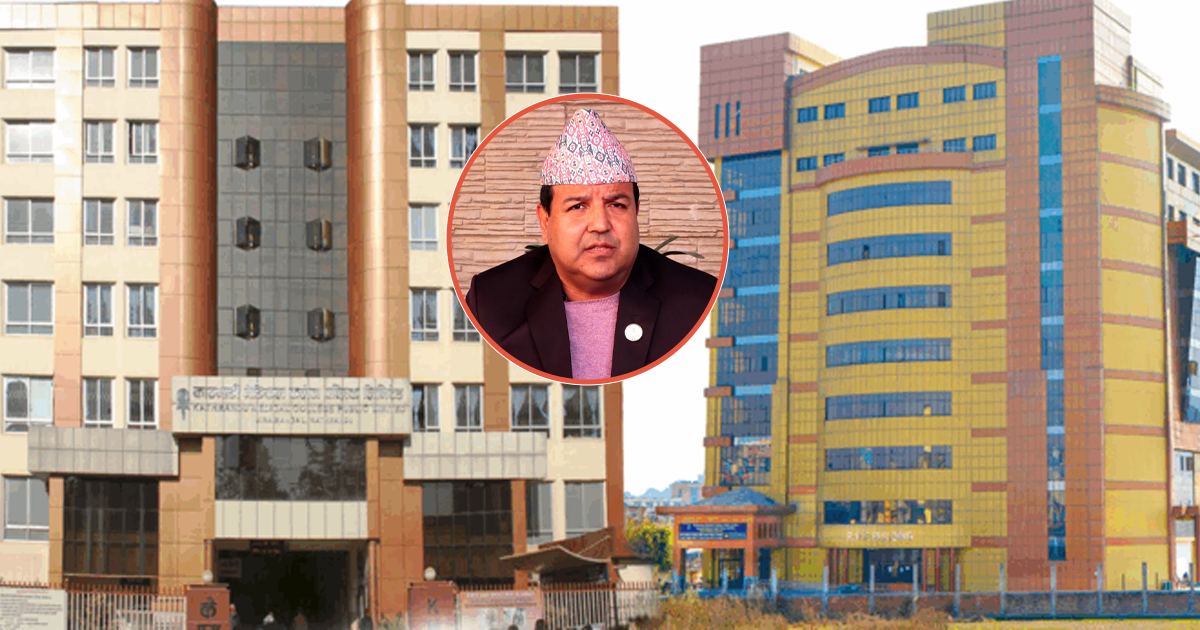

Kathmandu: Kathmandu Medical College has posted its strongest financial performance to date, generating Rs 2.47 billion in revenue in the last fiscal year as rising patient inflow, higher tuition earnings and diagnostic service expansion significantly boosted the institution’s income profile.
The college and teaching hospital reported a sharp climb from Rs 1.85 billion in 2024, following a steady upward trajectory over the past five years. Revenue stood at Rs 1.49 billion in 2023, Rs 1.28 billion in 2022 and Rs 1.13 billion in 2021, indicating that the institution has more than doubled its business volume within four years.
The company recorded 25 per cent growth in 2024 and an even stronger 33 per cent increase in 2025. That momentum has continued into the current fiscal year, with the first six months already showing robust expansion.
Hospital management attributes the surge largely to increasing patient numbers drawn by what it describes as competitive service pricing. Higher patient footfall has translated not only into stronger hospital billing but also into parallel growth in pharmacy sales and pathology revenues, making healthcare services a major engine of consolidated income.
Established as a medical education institution affiliated with Kathmandu University, KMC operates its main college at Sinamangal and runs a combined 500-bed teaching hospital network in Sinamangal and Duwakot. The institution offers a wide range of medical and paramedical programs, including DM/MCh, MBBS, BDS and BSc Nursing, giving it a dual revenue base from both healthcare delivery and higher education.
A major contributor to last year’s revenue jump was a revision in tuition fees for foreign student quotas, which pushed fee collections up by 33 percent. Although the college retains some flexibility in fee setting, it must remain within the regulatory ceiling of USD 75,000 per student.
The earnings outlook is expected to improve further after the MBBS intake capacity was expanded from 100 seats to 300 beginning this academic year. The higher student volume is projected to strengthen the medical college’s contribution to overall income gradually. Despite rising expenses, KMC maintained an operating profit margin of around 29 percent in the last fiscal year.
Recent salary revisions for healthcare workers mandated by the government are expected to increase operational costs, but management believes additional tuition income from the enlarged MBBS cohort and continued hospital revenue growth will offset the pressure. In fact, during the first six months of the current fiscal year, income is reported to have risen by 43 percent compared to the previous annualized period.
The ownership structure of KMC has also shifted in recent years. In 2020, Nobel Medical College Teaching Hospital acquired a 44 percent stake in the institution, adding to the growing integration of two major private medical businesses under the influence of the same promoter group. Following a rights issue in August 2025, the shareholding has increased further, with the final ownership ratio to be determined once all subscription proceeds are fully realized.
KMC’s wholly owned diagnostic subsidiary, Kasthamandap Diagnostic and Medical Service, has also emerged as a fast-growing ancillary revenue source. The company generated Rs 161 million in the last fiscal year, up from Rs 152 million in 2024, Rs 67 million in 2023 and just Rs 19 million in 2022. Based in Sinamangal, the centre currently provides radiology services and has been steadily broadening its imaging portfolio.
Founded in 2021, the diagnostic unit began operating from its own premises in 2022 and has since expanded beyond CT scan services to X-ray, ultrasonography and MRI scanning. It is also operating MRI equipment leased from KMC, allowing the parent institution to deepen vertical integration in high-margin diagnostic care.
Kasthamandap Diagnostic posted an extraordinary 127 percent income surge in 2024, followed by another 6 percent rise last year and a further 29 percent increase during the first half of the current fiscal period, signalling sustained demand in specialized imaging services.
To support future expansion, KMC Hospital has secured credit ratings for total borrowings of Rs 2.82 billion, including Rs 2.12 billion in long-term debt and Rs 700 million in short-term facilities. Meanwhile, Kasthamandap Diagnostic has obtained a long-term debt rating of Rs 684 million, indicating that both entities are preparing for continued capital expenditure and service enhancement.
The institution is controlled by former lawmaker and Nepali Congress leader Sunil Sharma, who has built one of Nepal’s most influential private medical education and hospital networks through KMC and Nobel.

Comment Here