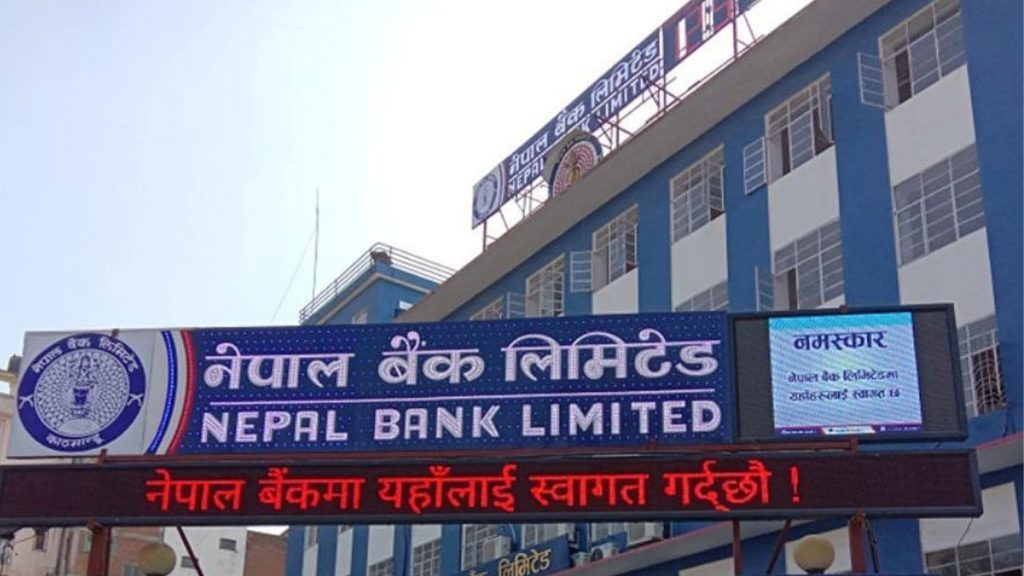

Kathmandu: Nepal Bank Limited posted only a marginal rise in profit by the end of the third quarter of the current fiscal year 2025/26, even as its lending business expanded and net interest earnings improved noticeably.
According to the bank’s unaudited financial statement for the period ending mid-April, Nepal Bank recorded a net profit of Rs 2.79 billion, up from Rs 2.78 billion during the same period last fiscal year. The year-on-year increase stands at just 0.34 percent, indicating that stronger core banking income was largely offset by rising operational expenses.
The bank’s net interest income, the key revenue generated from loans and investments after paying depositors, climbed 3 percent to Rs 7.31 billion, compared to Rs 7.10 billion in the corresponding quarter last year. The improvement was supported by growth in credit disbursement and a reduction in bad loans.
A notable positive came from loan-loss provisioning. While Nepal Bank had set aside Rs 282.8 million as impairment provision in the third quarter of the previous fiscal year, it was able to write back Rs 391 million this year as non-performing assets improved. This reversal helped lift operating income, but the gain was diluted by a sharp rise in staff and tax-related expenses.
Employee benefit expenses surged significantly to Rs 3.29 billion, up from just under Rs 3 billion a year earlier, becoming one of the main reasons the bank failed to translate higher banking income into stronger bottom-line growth.
Although the bank earned Rs 2.79 billion in total profit, the amount available for shareholder distribution remains much lower. After regulatory adjustments and mandatory transfers to reserve funds, distributable profit stands at only Rs 321.3 million.
Nepal Bank, however, reported visible progress in asset quality. Its non-performing loan ratio declined to 4.96 percent from 5.45 percent a year ago. Despite this improvement, the bank has still identified bad loan management and recovery as an internal challenge in its financial disclosures.
The bank’s earnings per share inched up to Rs 25.34 from Rs 25.26. Annualized net worth per share stands at Rs 272.79, while its capital adequacy ratio is 13.05 percent and core capital ratio 10.37 percent. Meanwhile, the base rate has fallen to 4.71 percent and the interest spread has narrowed to 3.70 percent, reflecting the broader low-interest and high-liquidity environment in the banking sector.
Despite pressure on profitability, Nepal Bank appears to be in a stronger position operationally, having improved both interest income and loan quality. With borrowing costs falling and excess liquidity in the system, the bank may have room to accelerate business expansion in the coming quarters if it can keep administrative expenses under control.
The third-quarter report also shows healthy growth in both deposits and lending, though deposits are rising at a faster pace than credit demand. Total deposits increased 15.74 percent over the nine months to Rs 384.37 billion, up from Rs 332.09 billion at the end of the last fiscal year.
Loan disbursement also expanded, rising 8.59 percent to Rs 239.44 billion from Rs 220.49 billion during the same period, suggesting that while Nepal Bank is growing its lending book, liquidity accumulation remains stronger than credit absorption.

Comment Here