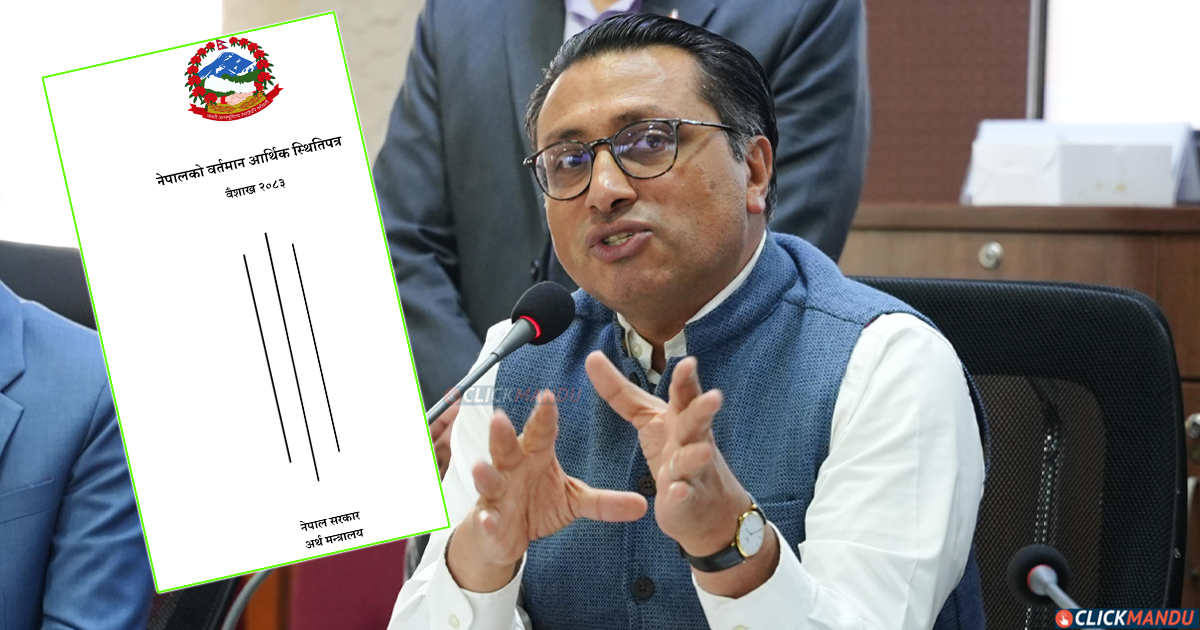

Kathmandu: Finance Minister Swarnim Wagle has unveiled the government’s much-anticipated Nepal Current Economic Status Report 2026, a white paper that lays bare the fragile foundations of the national economy and warns that Nepal is trapped in a deep structural crisis.
The report, released on April 27 as one of the new government’s first major policy documents, was commissioned shortly after Wagle assumed office on March 27 with the stated goal of presenting an unfiltered macroeconomic diagnosis before introducing reform measures.
The most alarming revelation in the white paper is the relentless expansion of public debt. As of mid-March, Nepal’s total public debt has climbed to Rs 2.878 trillion, equivalent to 43.8 percent of gross domestic product. More troubling is the fact that nearly one-fourth of the national budget is now being consumed merely by principal and interest repayments.
This means a growing share of state resources is being diverted toward debt servicing rather than infrastructure, capital formation or productive public investment, squeezing the government’s fiscal room at a time when development spending is already weak.
The report states that Nepal is suffering from what Wagle calls “premature deindustrialization”, an economy losing its productive industrial base before reaching middle-income maturity. Average economic growth over the last decade has remained stuck at just 4.2 percent, while current fiscal year growth is projected to slow further to 3.5 percent.
The industrial sector’s contribution to GDP has shrunk to only 12.8 percent, underscoring the collapse of domestic manufacturing capacity and Nepal’s increasing inability to generate jobs through production.
Trade imbalance remains another major fault line. Exports are covering only 14.8 percent of total imports, exposing a dangerously import-dependent economy. Even within that modest export basket, 42 percent is concentrated in edible oil re-exports — a low-value segment with little domestic value addition. In practical terms, Nepal is importing consumption and exporting very little that is technologically advanced, industrially processed or globally competitive.
The white paper also confirms that the economy is now surviving overwhelmingly on migrant labor income rather than internal productivity. In just the first eight months of the current fiscal year, remittance inflow reached Rs 1.449 trillion. But this inflow came alongside the departure of 557,000 young Nepalis for foreign employment during the same period.
The report warns that this model is creating a dangerous illusion of stability: foreign cash is sustaining consumption and foreign exchange reserves, but the country is steadily losing skilled and working-age human capital needed for long-term domestic growth. The World Bank also noted in its latest Nepal Development Update that migration remains Nepal’s dominant livelihood strategy even as private-sector growth inside the country remains structurally constrained.
Government finances, according to the white paper, are under equally severe strain. Nepal’s cumulative unsettled audit irregularities have ballooned to Rs 733 billion, while more than Rs 290 billion in payment liabilities remain unpaid despite contracts already being awarded.
Revenue collection has reached only 87.6 percent of the target, reflecting both sluggish economic activity and chronic administrative inefficiency. This combination of weak revenue, unpaid obligations and rising debt points to a state apparatus that is increasingly cash-stressed even before accounting for future spending commitments.
On the social front, the report delivers little comfort. About 20.27 percent of Nepal’s population, roughly six million people, still live below the poverty line. Unemployment has climbed to 12.6 percent, while inflationary pressure continues to erode household purchasing power. The white paper bluntly concludes that the average citizen is facing a progressively harsher cost-of-living reality despite headline remittance growth and periodic optimism in formal macro indicators.
In the introductory section of the report, Wagle directly blames years of rent-seeking, policy corruption and non-productive wealth accumulation for pushing the economy into its current state. His diagnosis aligns with a growing public perception that Nepal’s economy has been designed to reward brokerage, imports, land speculation and political access rather than entrepreneurship and industrial production, a frustration increasingly echoed in public debate since the new government took office.
Still, the finance minister has paired the grim assessment with an ambitious reform vision. The government says it wants to push economic growth to 7 percent within the next five to seven years, raise per capita income to US$ 3,000 and expand electricity generation to 15,000 megawatts through structural reforms, legal simplification and stronger private-sector participation.

Comment Here