
Kathmandu: Prime Minister Balen Shah has moved to confront one of Nepal’s most deeply entrenched barriers to development, not the shortage of money, not the absence of ambition, but the suffocating web of laws and procedures that routinely strangle infrastructure before it even begins.
Under his instruction, the Prime Minister’s Office has drafted a legal reform framework aimed at suspending or replacing a series of outdated laws that have long obstructed hydropower, industrial corridors, tourism infrastructure, roads, urban projects, and other large-scale development works.
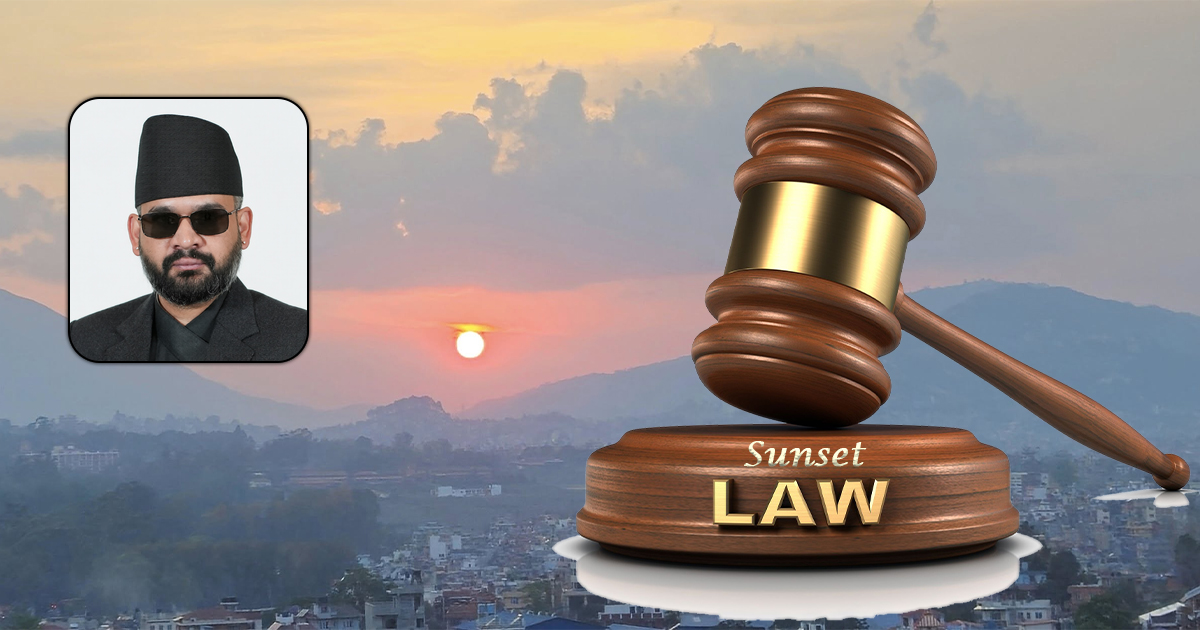
The Prime Minister’s Office has formally instructed the National Planning Commission to prepare a report within 15 days based on this framework. At the centre of the proposal lies an unusually bold concept: the introduction of a “Sunset Law,” a temporary but powerful legal regime that would suspend development-obstructing provisions for the next ten years and replace them with faster, project-friendly procedures.
Following the directive, a seven-member committee has been formed under Planning Commission expert member Arjun Jung Thapa, comprising joint secretaries from the Ministry of Finance, Ministry of Physical Infrastructure, Ministry of Urban Development, Ministry of Energy, Ministry of Water Supply, the Public Procurement Monitoring Office, and other relevant agencies.
Their task is to determine whether Nepal should simply amend troublesome clauses in existing laws permanently, or whether it should go further and enforce a ten-year extraordinary legal override through a sunset framework.
The fact that such an idea is even being seriously discussed reflects how severe Nepal’s procedural paralysis has become.
For years, hydropower projects, highways, transmission lines, cable cars, tourism ventures, and industrial plants have remained stuck not because investors lacked capital or engineers lacked expertise, but because files could not move through forest clearance, environmental approvals, land ceilings, procurement procedures, administrative consent, and bureaucratic fear.
In many cases, developers complain that even routine approvals become impossible without bribing officials who sit behind rigid legal clauses. What should be a technical process becomes a maze of rent extraction.
Public procurement law has made things worse by creating a risk-averse state machinery
Forest laws are perhaps the most notorious example. Under current provisions, cutting trees for nationally important infrastructure can take years of paperwork, field verification, environmental conditions, and ministerial approvals.
Developers repeatedly argue that many projects are not delayed by engineering difficulty but by the inability to remove a few thousand trees lying on a transmission corridor or road alignment. The Prime Minister’s Office has reportedly received numerous complaints that forest administration has become less of a conservation tool and more of an extortion checkpoint.
Environmental impact assessments are another bottleneck. In theory, they exist to ensure sustainability; in practice, they often become endless procedural loops. Land ceiling restrictions, compensation disputes, fragmented ownership records, procurement disputes, delayed power connectivity, lack of cooperation from security agencies, and even the never-ending conflict over stone, gravel, and sand extraction all add layers of uncertainty that can delay projects by years.
Public procurement law has made things worse by creating a risk-averse state machinery. Officials frequently avoid making timely decisions because of the fear of future anti-corruption scrutiny. As a result, projects do not die not from corruption alone, but from bureaucratic paralysis disguised as caution.
This is the institutional backdrop against which Balen Shah’s government is proposing a Sunset Law.
In the simplest sense, a Sunset Law is a time-bound law with a built-in expiry date. Unlike ordinary legislation that remains active until repealed by Parliament, a sunset provision automatically expires after a pre-defined period—say two years, five years, or in this case ten years—unless renewed. It is designed to create a temporary exceptional regime to address urgent structural blockages while forcing periodic review.
The philosophical basis is simple: prove your usefulness or disappear.
Such laws are commonly used when governments need emergency flexibility without permanently dismantling the existing legal order. Rather than spending years trying to amend dozens of individual acts through Parliament, a Sunset Law can temporarily neutralize the clauses that are creating paralysis and replace them with a special legal channel focused solely on delivery.
That is exactly the logic now under discussion in Kathmandu.
Officials involved in the consultation say the proposed framework would either suspend the most obstructive provisions of forest, environment, land, company, procurement, and administrative laws for ten years or create a superseding legal mechanism under which development projects can obtain approvals through a single accelerated window. Existing ministries would still exist, but their power to indefinitely hold files hostage would be sharply reduced.
One senior finance ministry official involved in the informal discussion says the spirit is to “supersede impractical laws” with a more rational temporary architecture aligned with the Prime Minister’s development agenda. In other words, the goal is not merely to amend a few technical sections, but to create an alternative legal highway where projects can move without getting trapped in the old spiderweb.
Many policy experts and private sector groups have for years argued that ordinary amendment is too slow for an economy in urgent need of delivery
And that spiderweb is the best metaphor for Nepal’s development state.
Nepal’s large projects are often like elephants trapped in a spider’s net. The elephant has strength, mass, and potential movement. But dozens of thin, sticky, seemingly minor legal threads—land acquisition notices, tree inventory verification, EIA approval loops, departmental no-objection letters, source consents, procurement objections, payment clearances, local disputes, and inter-ministerial approvals- bind it so tightly that it cannot take even a single meaningful step.
A road that should take two years takes twenty. A hydropower project that should generate electricity in four years remains trapped in file circulation for eight. Private industrial projects burn interest costs while waiting for signatures. Foreign loans begin accruing commitment charges before construction even starts. By the time approvals are granted, inflation, interest, and contract revisions have doubled the original cost.
This is why many policy experts and private sector groups have for years argued that ordinary amendment is too slow for an economy in urgent need of delivery. They have demanded either a powerful one-stop project authority or a temporary legal override that consolidates land, forest, environmental, financial, and procurement approvals under one decisive mechanism. Balen Shah’s initiative appears to be Nepal’s first serious attempt to convert that long-standing demand into state policy.
There are signs that even the definition of “forest” itself may be revisited. Officials say Nepal’s current legal interpretation often categorises barren slopes, grasslands, community-managed patches, private forest, leasehold forest, conservation areas, and productive woodland under overlapping restrictions, making rational land use nearly impossible. A new law could redefine forests based on utility, ecological significance, and development compatibility rather than blanket administrative labelling.
This reflects Balen Shah’s broader political instinct: development cannot be permanently subordinated to procedural rigidity.
Just last week, he reportedly instructed ministers and Planning Commission officials to ensure that “forest does not stand in the middle of development.” The statement was blunt, but it captures his central thesis—that the state exists to balance conservation and development, not to use conservation as an excuse for inaction.
Importantly, Balen does not appear to be pursuing a purely coercive route. During the election campaign, he had famously said that roads delayed for twenty years must be completed in eighteen months, “whether by tying people to trees, laying them on roads, or locking them in enclosures.” That rhetoric reflected public anger. But now in office, his government seems to be replacing brute administrative pressure with legal engineering—trying to solve delay not by shouting at officials, but by removing the legal shields behind which delay survives.
This shift gives the initiative more credibility.
A temporary suspension of multiple laws can become a development accelerator, but it can also become a corruption accelerator if not designed carefully
The private sector has long argued that legal barriers are the single biggest hidden tax on investment. Before the last investment summit, the government had amended several laws through an omnibus Nepal Act amendment package, yet businesses still insist that the core problem remains unresolved. Hydropower entrepreneurs in particular have repeatedly demanded a sunset framework for large projects, saying Nepal cannot industrialize if every project must individually fight ten ministries for ten years.
Finance Minister Dr Swarnim Wagle has also signalled similar thinking. On his very first day in office, he initiated the process of scrapping around 15 outdated laws, including the Revenue Investigation Department Act and other provisions seen as hostile to modern business operations. Balen’s push, therefore, appears to fit into a broader attempt by the current administration to clear Nepal’s legal underbrush.
Still, the Sunset Law proposal is not without risk.
A temporary suspension of multiple laws can become a development accelerator, but it can also become a corruption accelerator if not designed carefully. Fast-track approval should mean no accountability. Forest clearance should not become ecological vandalism. Procurement simplification should not become contractor favouritism. Land acquisition flexibility should not become arbitrary dispossession. The success of any sunset framework will therefore depend entirely on whether it creates speed with transparency, not speed with impunity.
That is the line Nepal must walk.
If designed well, this could become one of the most consequential governance reforms in decades: a ten-year legal breathing space in which the country finally builds roads, dams, industrial zones, transmission corridors, tourism infrastructure, and urban facilities at a pace matching its ambitions. If designed poorly, it could become merely another extraordinary law captured by the same bureaucratic and political interests it seeks to defeat.
But one thing is now undeniable: Balen Shah has correctly identified that Nepal’s development problem is no longer just a funding problem; it is a legal metabolism problem. And unless that metabolism is repaired, the country will continue to have money, plans, speeches, and groundbreaking ceremonies, but very little that actually gets built.

Comment Here