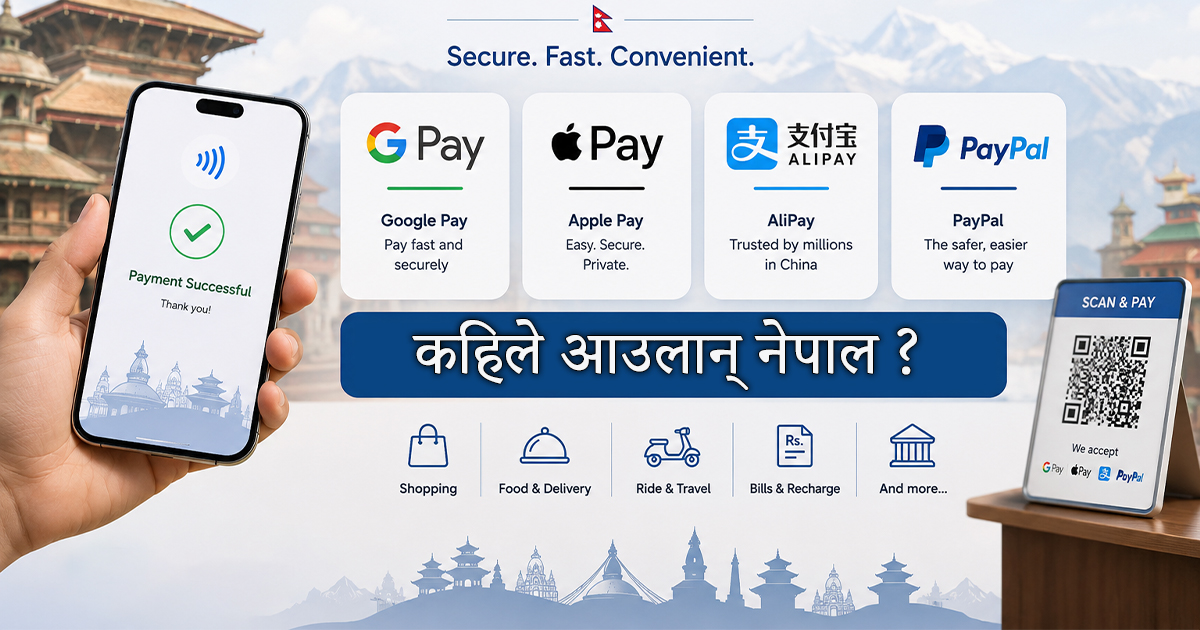

Kathmandu: Nepal’s digital wallet ecosystem may have evolved from scratch cards to QR payments and even cross-border transactions, but it still lags far behind the sophisticated systems seen in countries like China and India. While global fintech leaders are moving toward invisible payments and super apps, Nepal remains stuck in the early stages of QR-based utility payments.
The reasons behind this stagnation are not difficult to understand. Nepal currently has 27 licensed digital wallets, yet almost all of them offer the same basic services — mobile top-ups, bill payments, and QR scans. Genuine innovation has been largely absent.
One of the latest milestones in Nepal’s payment infrastructure has been the launch of cross-border payment connectivity with India. However, the system remains one-sided: Indian visitors can use their wallets in Nepal, but Nepalis still cannot use domestic wallets while travelling in India.
Partnerships with platforms such as Alipay have enabled Chinese and some East Asian tourists to make payments in Nepal, but integration with the wider global digital economy remains minimal. Nepali wallets cannot be used to pay for services like Netflix subscriptions or international online shopping, while dollar cards issued by banks remain restrictive and cumbersome.
At the same time, mobile banking apps offered by banks now provide nearly all the features available in standalone wallets, making digital wallets increasingly redundant in Nepal’s financial ecosystem.
In developed economies, scanning QR codes is already considered outdated. Consumers simply tap their phones, smartwatches, or even smart rings using Near Field Communication (NFC) technology to complete transactions instantly. In China, platforms like WeChat combine payments, ride-hailing, messaging, and social media into a single super app. Nepal’s wallets, by contrast, remain limited to basic payment functions that still require internet access, app launches, and QR scanning.
The country’s small market size and limited investment capacity have prevented local wallet companies from introducing advanced technologies. Nepal’s Payment and Settlement Act also protected domestic firms by effectively blocking foreign wallet providers from entering the market. Regulators and policymakers remained cautious, fearing capital flight and money laundering risks, while also doubting the population’s readiness to adopt advanced financial technologies.
To some extent, the protectionist approach helped local companies like eSewa and Khalti establish themselves. The law required wallet operators to register locally with full Nepali ownership, preventing global fintech companies from entering directly. Local firms benefited from limited competition, but the absence of foreign rivals also reduced pressure to innovate.
Nepal Rastra Bank prioritized security and financial stability over innovation. Only recently has the central bank introduced a regulatory sandbox framework allowing new technologies to be tested in a controlled environment. Previously, concerns over illicit financial flows and foreign exchange leakage often delayed approvals for emerging payment technologies. As a result, Nepal’s fintech sector has not progressed as rapidly as it could have.
Despite Nepal’s small market, global players like Google Pay and Apple Pay have gradually started showing interest. However, regulators still appear worried that easier outbound payments could reduce the country’s foreign currency reserves.
Advanced technologies such as NFC-based tap-and-pay systems are also significantly more expensive than QR systems. QR codes can simply be printed and displayed, while NFC requires merchants to install point-of-sale terminals, making adoption costly for small retailers.
Limited digital and financial literacy has also pushed Nepal toward cheaper but more secure payment systems.
As the world rapidly advances in fintech innovation, Nepal’s wallet industry remains confined to its early developmental phase. While global wallet providers are expanding into lending and broader financial services, Nepal continues to debate the boundaries between banks and wallet operators. Consequently, local wallets remain largely limited to handling small payments.
The rise of digital wallets in Nepal
Nepal’s digital payment journey is still relatively young. Before 2009, debit cards and ATMs were the country’s primary forms of digital banking.
The launch of eSewa in 2009 introduced the concept of digital wallets to Nepal. Initially operating as a web portal, the idea of storing money digitally and paying utility bills or recharging mobile phones without physical recharge cards seemed almost futuristic to many Nepalis. Early adoption was slow due to low internet penetration and a strong cash-based culture, but wallets gradually gained popularity for mobile top-ups and utility bill payments.
Following eSewa’s success, competitors such as Khalti and IME Pay entered the market, gaining users through better interfaces and aggressive marketing. More wallets like Prabhu Pay, CellPay, and MyPay later followed. The Payment and Settlement Act 2019 formally regulated the sector.
The QR payment era truly accelerated after 2019, especially during the COVID-19 pandemic. Fear of handling cash encouraged consumers to install wallets and mobile banking apps. Wallets expanded beyond recharges and bill payments into airline ticketing, movie and sports ticket purchases, share market payments, remittance collection, and other digital services.
Yet despite this growth, the market eventually became saturated.
The Payment and Settlement Act, enacted under a protectionist mindset, ended up weakening the competitive capacity of Nepali wallets. The law required any payment service provider operating in Nepal to establish a company locally, effectively preventing global platforms like Apple, Google, or PayPal from offering services directly through their international systems.
The law primarily focused on regulating domestic transactions and did not provide a clear framework for cross-border payments or foreign wallets operating in Nepal. This left local wallets confined to the domestic market while advanced international technologies failed to enter the country.
Wallet providers also remained dependent on banks because settlement operations had to be routed through licensed settlement banks. Strict limits were imposed on wallet balances, forcing users to transfer larger sums into bank accounts. As a result, mobile banking apps gradually overshadowed digital wallets.
The legislation ultimately protected domestic firms but prevented them from becoming globally competitive. Nepal shielded itself from foreign competition but also blocked access to world-class payment technologies.
Why Nepal needs foreign wallet providers
In today’s interconnected digital economy, payment systems are increasingly global. Nepal, which has embraced globalization and open-market policies, faces growing pressure to modernize its financial infrastructure.
Just as Nepalis can purchase goods and services from around the world, they should also be able to use digital wallets internationally. Nepali consumers should be able to pay for global services, online advertising, e-commerce platforms, and subscriptions directly from local wallets. Similarly, foreign visitors should be able to pay seamlessly for Nepali goods and services using their own digital wallets.
Since Nepali wallets are still not accepted internationally, opening the market to established global wallet providers appears increasingly necessary. Doing so would allow Nepalis to use platforms like PayPal, Google Pay, Apple Pay, and Alipay for international transactions, digital subscriptions, and global e-commerce payments.
The arrival of international wallets could also significantly improve Nepal’s tourism sector. Most foreign tourists are already accustomed to using Google Pay or Apple Pay. Many currently face payment difficulties at small shops and restaurants in Nepal. Wider wallet compatibility would allow travellers to make seamless transactions directly from their phones.
Global wallets would also introduce more advanced technologies such as NFC-based tap-and-pay systems and tokenization, which protect users’ financial data by avoiding the direct sharing of card details with merchants. This would make digital payments both more secure and more convenient.
Foreign competition could also force local wallet companies to invest in innovation and improve service quality. Easier international money transfers could reduce remittance costs while discouraging illegal channels such as hundi. It would also simplify outbound payments from Nepal.
Government’s push to amend the law
Recognizing the limitations of existing laws, the government has already drafted amendments to the Payment and Settlement Act to allow foreign wallet companies into Nepal. The reform process stalled after political instability and the dissolution of parliament, but momentum has resumed following the appointment of Finance Minister Swarnim Wagle.
The proposed amendments aim to modernize Nepal’s payment ecosystem and integrate it with the global digital economy.
One key proposal would introduce a new legal category for “technology service providers.” Since companies like Apple and Google are technology platforms rather than banks, the amendment seeks to formally recognize them within Nepal’s payment framework.
The draft also proposes allowing Nepal Rastra Bank to approve pilot testing for new payment technologies through regulatory sandbox mechanisms. This could open the door for technologies such as NFC payments, beyond existing PIN, fingerprint, and facial recognition systems.
Most importantly, the proposed amendment would allow foreign payment companies operating in at least 10 countries to apply directly to Nepal Rastra Bank for permission to operate in Nepal. This would create a legal pathway for global giants such as Apple Pay, Google Pay, PayPal, and Alipay to enter the Nepali market without establishing fully Nepali-owned companies.
If passed by parliament, the reforms could transform Nepal’s payment sector from a protected local industry into a globally connected digital ecosystem. At the same time, local wallet providers would face greater pressure to innovate and modernize in order to survive in a more competitive environment.

Comment Here