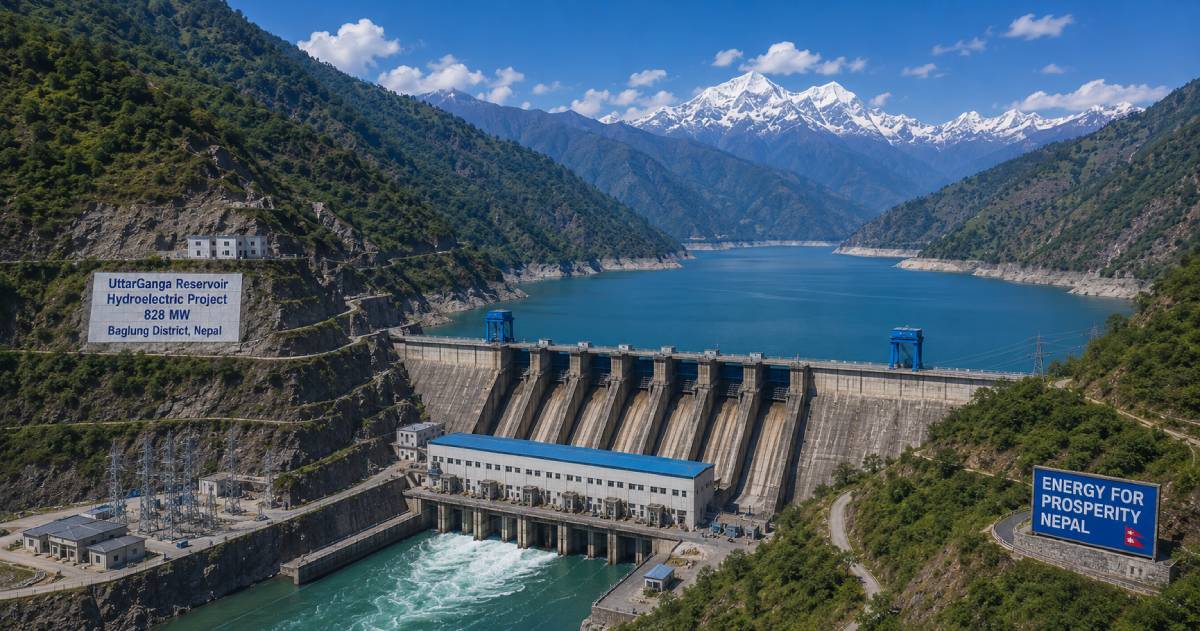

Kathmandu: Nepal has finally moved forward with the long-awaited 828-megawatt Uttarganga Reservoir Hydropower Project in Dhorpatan, Baglung, more than two decades after the project first entered public discussion in 2004.
The massive reservoir-based project is now expected to cost significantly more than initially estimated due to years of delay and the appreciation of the U.S. dollar against the Nepali rupee. The total projected investment stands at U$ 1.08 billion, or around Rs 164 billion, with the per-megawatt cost estimated at roughly Rs 190 million.
Earlier projections had estimated the cost at around Rs. 175 million per megawatt, but despite the increase, the project is still being described as relatively cost-effective compared to similar large-scale hydropower developments in Nepal.
The project is being developed by Uttarganga Power Company Limited, a subsidiary of Nepal Electricity Authority, with a target to begin electricity generation within the next decade. Once completed, the project is expected to play a major role in ending winter power shortages and strengthening Nepal’s long-term energy security.
Although discussions around the project began in 2004, its Environmental Impact Assessment (EIA) report was only submitted to the Ministry of Forests and Environment in 2019 and approved four years later, in 2023.
Located in the Baglung district, the project’s main infrastructure will lie within Dhorpatan Municipality-9 and the Dhorpatan Hunting Reserve area. The design involves damming the Uttarganga River and diverting water toward Nisikhola Rural Municipality wards 4 and 5. The project will operate with a gross head of 1,350 meters above sea level and utilize a flow rate of 79.06 cubic meters per second.
A 200-meter-high and 840-meter-long rock-fill dam will be constructed on the Uttarganga River, creating a large reservoir stretching 14 kilometres and covering an area of 12.178 square kilometres.
The reservoir will have a total storage capacity of 455.95 million cubic meters and a usable storage capacity of 419.98 million cubic meters. Its operational lifespan is estimated at around 50 years.
Water from the reservoir will be diverted through a 6.51-kilometre-long tunnel with a diameter of seven meters. The project will feature two major underground powerhouses.
The first powerhouse, with a capacity of 420 megawatts, will be located at an elevation of 2,200 meters above sea level. It will house four vertical shaft Pelton turbines, each with a capacity of 106.5 megawatts, along with four synchronous generators rated at 123.5 MVA each.
The second underground powerhouse, with a capacity of 408 megawatts, will reuse water discharged from the first powerhouse after collecting it in a 350-meter-long retention pool. Situated at an elevation of 1,537 meters, this facility will also contain four 106.5-megawatt turbines and four 120-MVA generators.
Electricity generated by the project will be connected to the Nisi substation in Baglung through double-circuit 400 kV transmission lines measuring 1.25 kilometres and 1.5 kilometres in length. To support construction and operations, access roads spanning 16.18 kilometres near the dam site and 25.13 kilometres near the powerhouse area will also be developed.
The project’s EIA was formally approved on January 16, 2024. To maintain environmental balance, developers have committed to releasing a minimum flow of 3.52 cubic meters of water per second into the Uttarganga River throughout the year.
The hydropower plant aims to begin commercial electricity generation by 2035. The core objective of the reservoir project is to ensure stable electricity production during both the dry winter season and the monsoon period by storing water in the Uttarganga River valley in Dhorpatan.
According to the project’s feasibility study, water stored behind the 200-meter-high dam will be dropped 1,634 metres through tunnels before being discharged into the Nisikhola River system.
Nepal’s Department of Electricity Development has now made the project’s detailed documents public and has invited individuals or communities who may be adversely affected by the development to submit written feedback or suggestions to the department or the developer within 35 days of the notice publication.

Comment Here