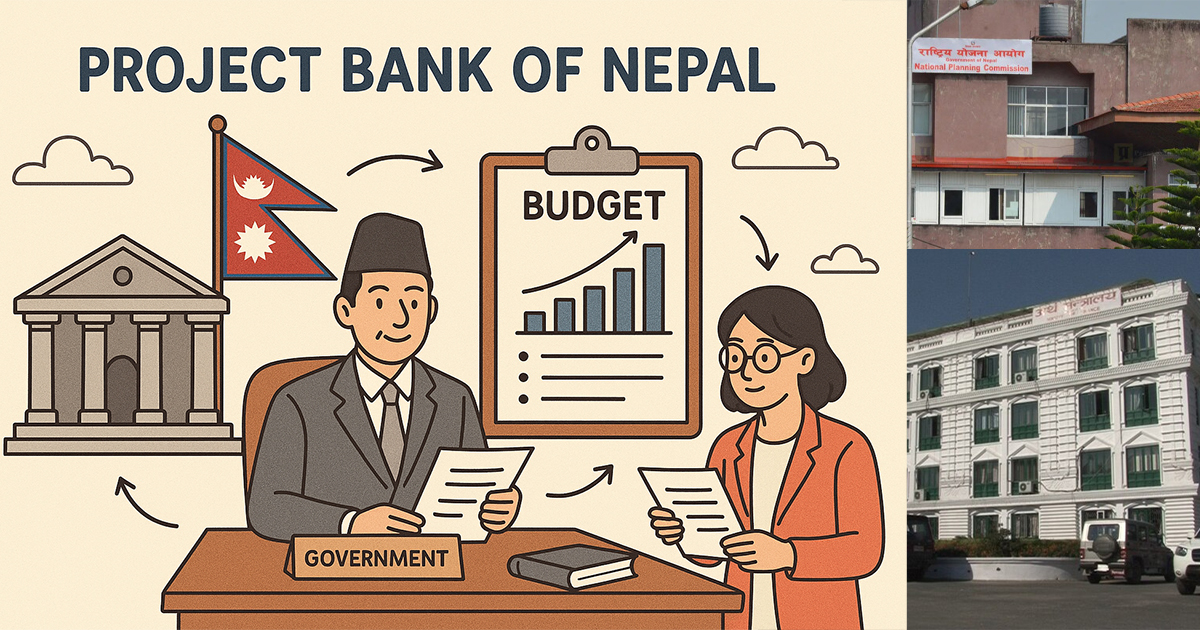

Kathmandu: Nepal’s National Planning Commission has long been responsible for setting budget ceilings and recommending development projects for government funding. The government has also formally adopted a policy stating that only projects listed in the national “Project Bank” are eligible for budget allocation. In practice, however, that rule has repeatedly been bypassed.
Since fiscal year 2019/20, the government has maintained that only projects entered into the Project Bank would qualify for funding. But because the Ministry of Finance ultimately controls the budget-writing process, both listed and unlisted projects have continued to receive allocations.
For the upcoming fiscal year 2025/26, thousands of projects have already been entered into the Project Bank. As in previous years, the Finance Ministry is preparing the budget while receiving policy direction from the Prime Minister’s Office.
The Finance Ministry continues to insist that projects outside the Project Bank will not receive funding. The system was designed to end the long-standing practice of inserting projects into the budget based on political access or influence, even when they lacked adequate preparation. To address this, the government made Project Bank registration mandatory for development projects.
Only ministries and government agencies are authorized to submit projects to the Project Bank. Those entities, in turn, upload projects forwarded by subordinate offices, including fully prepared projects ready for implementation, ongoing multi-year projects, and proposals requiring further study.
The government had promised stricter enforcement of the Project Bank rule in the current fiscal year’s budget. However, projects that were already included in the budget were later retroactively entered into the bank, undermining the intended discipline of the system.
Ahead of the next fiscal year, the government has repeatedly extended the deadline for project submission. Under the National Project Bank Operations and Management Standards 2024, the system is supposed to open in mid-July and close by the end of February. But this year’s political transition delayed the process. Parliamentary elections were held on March 5, and the government was only fully formed on March 26. As a result, the submission window was extended until April 4.
Even that extension proved insufficient. The government, led by Kathmandu Metropolitan City Mayor Balen Shah, pushed the deadline several more times — first to April 22, then April 27, and later into the first week of May. The system remains open for entries.
Government officials have reportedly continued encouraging ministries and agencies to submit projects until May 26, with assurances that they may still receive budget allocations. A similar practice occurred last year, when project submissions were accepted until just two days before the national budget speech. The same pattern appears likely to repeat this year.
At present, the Project Bank contains more than 5,000 projects. According to decisions approved by the National Planning Commission on April 27, the bank includes 293 new projects, 87 ongoing projects, and around 5,000 study-oriented proposals.
The number of new projects has risen sharply from last year, when only 126 new entries were approved.
To qualify as a new project, proposals must meet eight mandatory criteria, including environmental impact assessments, total cost estimates, detailed project reports, land acquisition plans, procurement strategies, implementation frameworks, results matrices, and evaluation mechanisms.
In addition to the new projects, the bank also includes 87 ongoing projects and roughly 5,000 study proposals. Last year, the number of study-based entries stood at around 4,200.
The growing volume of entries has intensified questions over whether the government will genuinely enforce the rule that only Project Bank-listed initiatives receive funding.
According to Dr Diwakar Luintel, information officer at the National Planning Commission, inclusion in the Project Bank does not automatically guarantee budget allocation.
“The commission has only included projects costing more than 30 million rupees in the bank,” Luintel told local media. “Not every project in the bank will necessarily receive funding, but every project that receives budget allocation must be listed in the Project Bank.”
Luintel said the Project Bank concept was introduced to prevent politically motivated “pocket projects” from entering the national budget and argued that, if implemented sincerely, it could strengthen fiscal discipline and improve budget execution. The idea, he said, is to ensure projects are fully prepared before receiving funding so they can move into implementation immediately after allocation.

Comment Here