
Kathmandu: Reflecting on one of the most volatile moments in Nepal’s legislative history, former Finance Minister Surendra Pandey recalled the harrowing experience of being physically targeted while attempting to fulfil his constitutional duties.
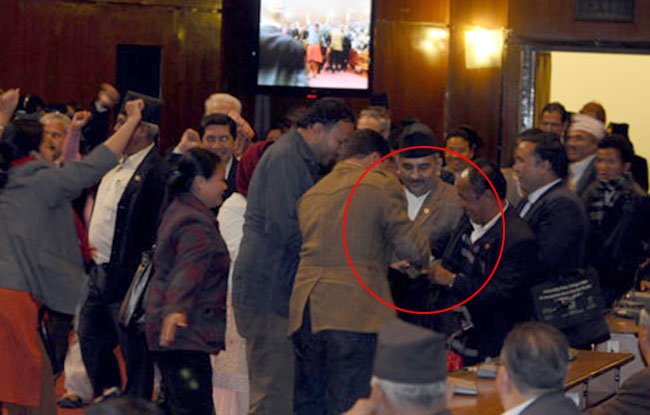
“The moment I rose from my seat to head toward the parliamentary rostrum, I was suddenly attacked,” Pandey noted in a sombre address following the incident in November 2010. He described his shock at the unexpected physical assault and the snatching of the budget briefcase, an act that left the nation outraged as images of the chaos inside the sovereign parliament flashed across television screens.
The incident occurred during a period of intense political deadlock, marked by the first time since the establishment of the republic that a budget had to be introduced via an executive ordinance. At the time, the coalition government of the Nepali Congress and CPN-UML, led by Prime Minister Madhav Kumar Nepal, was struggling to navigate a fractured transition.
The constitution-drafting process had stalled despite eleven deadline extensions, and the legislature was paralysed by seven inconclusive rounds of voting to elect a new Prime Minister between Pushpa Kamal Dahal ‘Prachanda’ and Ram Chandra Paudel. Even though Prime Minister Nepal had resigned, the parliament had failed to find a successor, leaving the country in a state of administrative limbo.
The climax of this tension erupted on November 19, 2010, when Minister Pandey attempted to present the budget for the fiscal year 2010/11. A procedural dispute between the government and the opposition Maoist party quickly devolved into a physical brawl on the house floor. Maoist lawmakers charged at the Minister, leading to a scuffle where the budget briefcase was mangled, and the official documents were torn to pieces.
The violence grew so intense that several lawmakers’ clothes were ripped, forcing Speaker Subas Nembang to adjourn the session indefinitely. In the immediate aftermath, the cabinet decided to end the parliamentary session and bring the budget forward through an ordinance to prevent a total shutdown of the state’s financial machinery.
Minister Pandey later clarified that he had made every effort to secure a national consensus before the session, even meeting with Maoist leader Dr Baburam Bhattarai at the Godavari Resort to share the budget draft. He claimed that while the opposition had initially signalled their cooperation, they reneged on their word once the session began.
For Pandey, bypassing the parliament was a painful but necessary move; by that point, the previous temporary spending authority had nearly expired, and the government was on the verge of being unable to pay civil servant salaries or fund essential services. He maintained that the final budget he eventually released was identical to the one the Maoists had previously reviewed and later accepted when they joined a subsequent coalition government.
In the wake of the incident, the government declared the day a “dark chapter” in parliamentary history and made a symbolic vow to preserve the mangled briefcase and the torn budget papers in the National Museum as a cautionary relic for future generations. However, years later, the whereabouts of these historic items have become a mystery. Despite the public commitment to archive them, neither the Parliament Secretariat, the National Archives, nor the National Museum at Chhauni has any record of the artefacts. Even Pandey himself remains unaware of where the briefcase went, leaving a significant piece of Nepal’s political history unaccounted for.
Nepal #Budget #Economy #Finance

Comment Here