
Kathmandu: Finance Minister Swarnim Wagle mentioned the city of Biratnagar only twice during his budget speech for the fiscal year 2026/27.
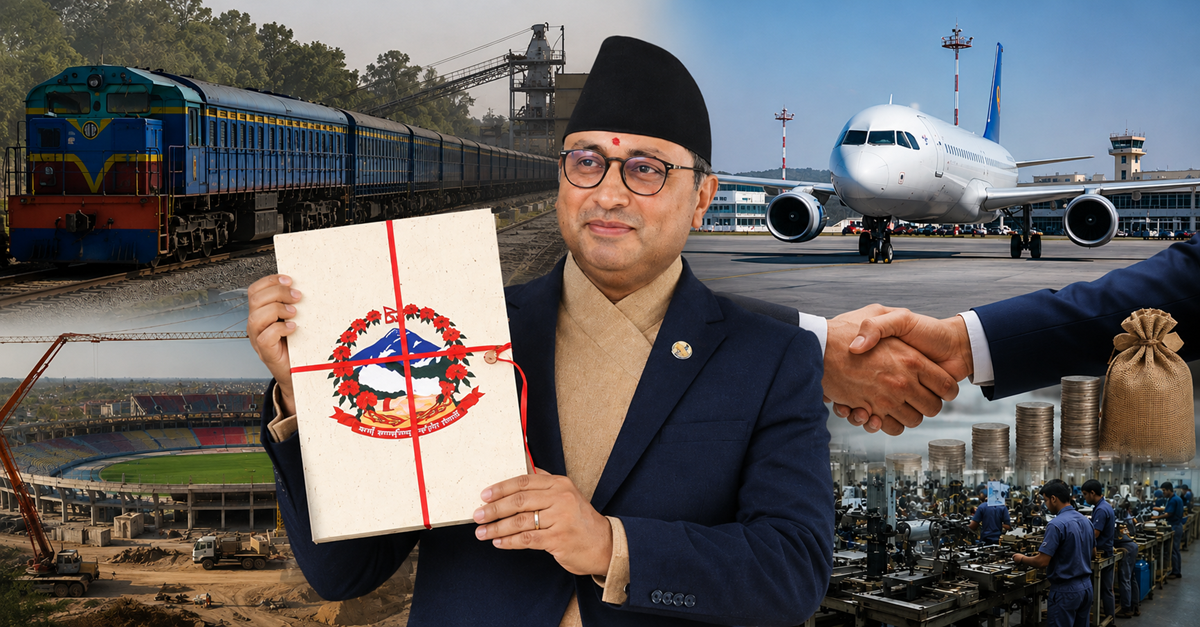
His first mention was the commitment to quickly complete the 18.7 km Bathnaha-Katahari cargo railway, and the second was the construction of the Girija Prasad Koirala International Cricket Stadium in Baijanathpur. While these announcements were delivered with characteristic eloquence, they have been met with scepticism by locals who feel the Minister is merely repackaging old, stalled projects to pacify the region.
The reality of the cargo railway is that its completion lies almost entirely outside the Nepal government’s control. Under a bilateral agreement signed two decades ago, India is responsible for the entire construction cost, while Nepal’s only obligation is to provide the land.
Despite this, the project has dragged on for twenty years because the government has failed to hand over the necessary land for the final stretch to Katahari. Even though a small section of the track was ceremonially inaugurated by the Prime Ministers of both nations in 2023, not a single cargo train has returned to the terminal since that day, leaving the infrastructure idle.
Similarly, the Minister’s proposal to “study” the Girija Prasad Koirala Cricket Stadium is seen as a regression rather than progress. The project had already been designated as a National Pride Project years ago, with the National Sports Council having already spent millions on a Detailed Project Report and environmental assessments.
The original master plan envisioned a massive 2.8-billion-rupee complex featuring a 15,000-seat stadium, athletic tracks, a swimming pool, and a hostel. However, the project was left in limbo after the administration formed after the Gen Z movement froze its funding. By suggesting a new study, the Finance Minister is viewed as ignoring the significant groundwork already completed.
While the general public feels sidelined, Biratnagar’s powerful industrial community is celebrating the budget as a historic win. Business leaders are particularly pleased with the sweeping tax reforms, including the reduction of customs duties on 273 items and the total abolition of excise duties on 360 products.
The private sector has hailed the decision to treat capital gains tax on share trading as final and the introduction of VAT rebates for digital payments. Industry representatives noted that, for the first time, a budget has addressed the majority of their long-standing fiscal grievances, providing much-needed relief to the country’s manufacturing heartland.
However, even this industrial optimism is tempered by the lack of investment in local business infrastructure. For decades, Biratnagar has demanded a dedicated industrial exhibition centre and an upgrade of the local airport to regional international status, both of which were ignored in this budget.
The airport expansion, in particular, remains a sensitive issue; a previous plan to transform it into a hub for flights to neighbouring countries like India and Bangladesh led to the freezing of land belonging to 350 families for two years, only for the government to eventually scrap the project due to a lack of funds.
Ultimately, the budget presents a stark divide for Biratnagar. While it offers a sophisticated suite of fiscal reforms that could revitalize the city’s industries and please the middle class with higher tax exemptions, it offers little to address the city’s stagnating physical infrastructure. As one local business leader noted, the budget provides unprecedented economic relief but leaves Biratnagar’s dreams of becoming a modern, well-connected regional hub deferred once again.

Comment Here