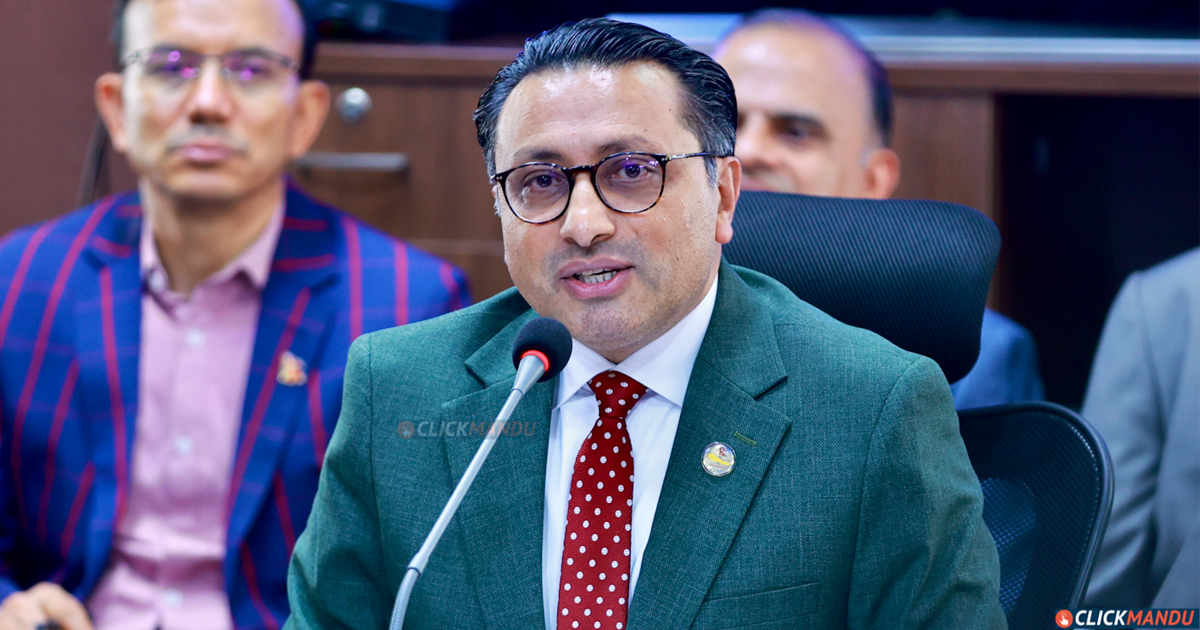

Kathmandu: Finance Minister Dr Swarnim Wagle held his first post-budget press conference at the Ministry of Finance on Sunday, where he vigorously defended the government’s fiscal plan against critics and market speculation.
Addressing rumours that the budget would reach a staggering 25 trillion rupees, Dr Wagle clarified that he had opted for a more disciplined and realistic outlay of 21.24 trillion rupees. This figure represents approximately 28 percent of the projected 74.58 trillion rupee GDP for the upcoming fiscal year.
He further noted that the government has remained within legal fiscal boundaries by keeping total borrowing within the mandatory 5 percent GDP threshold, signalling a commitment to long-term economic stability.
The Finance Minister also addressed concerns within the education sector, asserting that the government has no intention of suppressing private enterprises. Instead, he explained that the “Education Equity Fee” imposed on private schools is a strategic move to fund the improvement of public education and support an 8-billion-rupee nutrition program for 313,000 Dalit children.
Dr. Wagle argued that this fee allows the state to fulfil its social obligations to the most vulnerable populations while simultaneously working to elevate the quality of the public school system to match private standards.
A significant portion of the conference was dedicated to justifying the historic introduction of Value Added Tax (VAT) on electricity consumption exceeding 50 units. Dr Wagle presented a detailed breakdown to demonstrate that the actual financial impact on households would be negligible. For instance, approximately 1.2 million households consuming between 51 and 150 units will only face an additional monthly burden of 24 rupees.
Even high-end users who consume up to 250 units for luxuries like air conditioning or electric vehicle charging will only see an increase of 25 to 100 rupees. Because the first 50 units remain free, he argued that the effective tax rate is much lower than the nominal 5 percent, ensuring that the burden does not fall heavily on any single consumer.
Dr Wagle emphasized that this revenue is essential for overhauling the nation’s crumbling energy distribution infrastructure. He pointed out that while Nepal has made strides in electricity production, the current network of wires and transformers cannot handle the load if every household switches to induction stoves and electric vehicles simultaneously.
With over 85 billion rupees allocated for energy production and distribution, the Minister argued that internal resource mobilization through VAT is necessary to prevent system failures and accidents. He also left the door open for future adjustments, suggesting that the Electricity Regulatory Commission could adjust tariffs or the government could utilize dividends from state-owned hydropower projects to compensate citizens if the tax burden ever becomes unsustainable.
Finally, the Finance Minister provided much-needed clarity for stock market investors by confirming that the capital gains tax (CGT) on listed securities is now a final withholding tax. Under the updated policy, the tax rate stands at 10 percent for short-term holdings and 7.5 percent for long-term holdings.
Dr Wagle assured the public that for individuals earning up to 4 million rupees annually, this tax is definitive, meaning they will not face additional tax liabilities or the need to consolidate these gains with other income sources. This move is intended to provide tax certainty and encourage broader participation in the capital market by simplifying the reporting process for small and medium-scale investors.

Comment Here