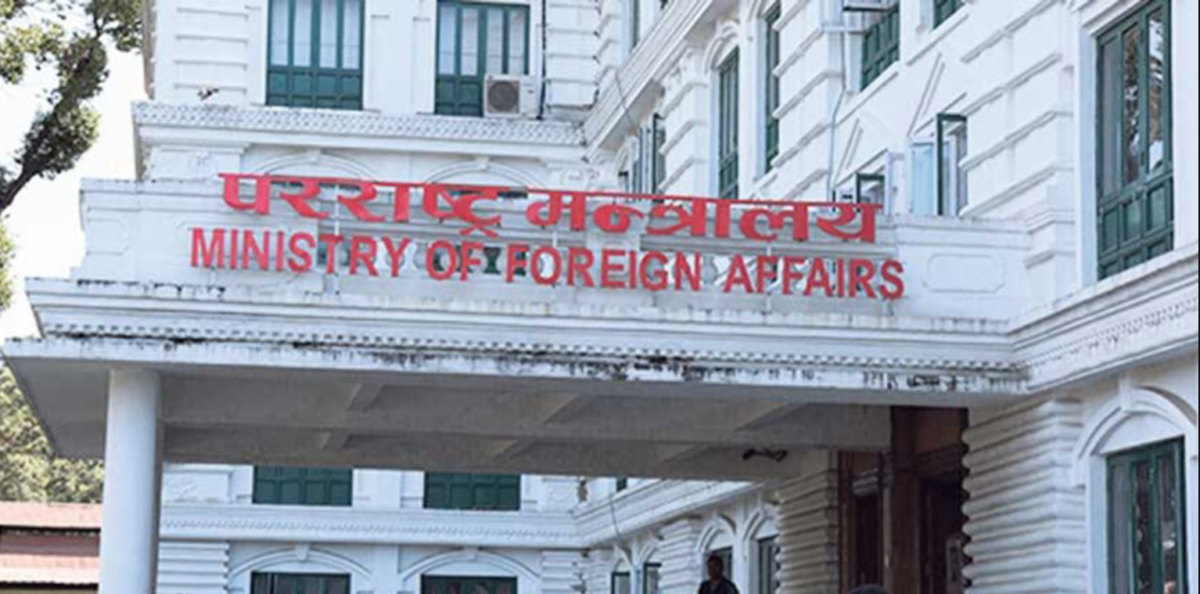

Kathmandu: The Government of Nepal has reiterated its commitment to resolving long-standing border issues with India through diplomatic channels and technical dialogue, according to the statement issued by the Ministry of Foreign Affairs on Sunday.
The clarification comes in response to recent discussions regarding the Mansarovar pilgrimage route via the Lipulekh region and Prime Minister Balendra Shah’s recent remarks in Parliament concerning land ownership along the border.
The Ministry confirmed that following Nepal’s official stance on the Lipulekh, communicated on 3 May 2026, the Indian government has responded via a diplomatic note. Both nations have expressed a mutual commitment to addressing border disputes through peaceful discussion.
Nepal maintains that its international borders are established and guided by the Sugauli Treaty of 1816. While the majority of the border is defined, the Ministry noted that mapping remains incomplete in the Susta, Limpiyadhura, Lipulekh, and Kalapani regions. Beyond these specific areas, the border faces challenges such as encroachment on the “No-Man’s Land” (Dashgaja) and the phenomenon of “Cross-Border Occupation.”
A significant portion of the Ministry’s statement addressed the technical concept of “Cross-Border Occupation,” which was mentioned by the Prime Minister in Parliament. The Ministry explained that during the determination of the Nepal-India border, a “Fixed Boundary Principle” was adopted for riverine areas.
Because river courses change over time while the official boundary remains fixed at the original coordinates, a unique situation has arisen. In several locations, citizens of one country are legally or traditionally residing and farming on land that, according to technical maps, now falls within the territory of the neighbouring country.
“The Prime Minister’s statement that ‘Indian land being used by the Nepali side’ refers specifically to this technical reality,” the Ministry stated. “Technical studies suggest that just as some land currently used by Nepalis may technically belong to India, land currently occupied and used by Indians may technically fall within Nepali territory.”
After a period of inactivity, joint technical committees and boundary mechanisms have resumed field operations. These teams are currently working to construct and repair border pillars in scientifically mapped areas, clear encroachments in the No-Man’s Land and collect comprehensive data on “Cross-Border Occupation” to settle land rights.
The Ministry emphasized that the government remains steadfast in its resolve to protect Nepal’s territorial integrity. It concluded that all border-related issues will be handled in the spirit of the close bilateral relationship between the two neighbours, based on historical treaties, maps, and facts.

Comment Here