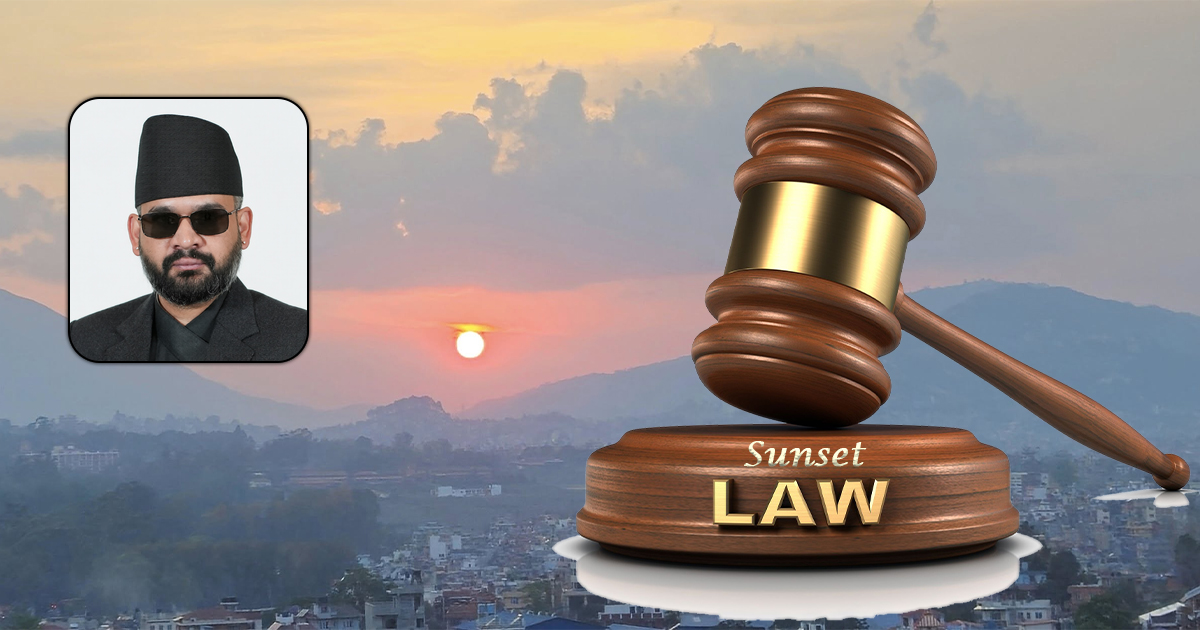

Kathmandu: The Government of Nepal is currently drafting a “Sunset Law” specifically designed to expedite the implementation of infrastructure development projects.
A dedicated committee, formed to study and suggest improvements, has reviewed existing legislative barriers and prepared a series of amendment proposals. These proposals aim to reform restrictive provisions in current laws that have historically hampered construction and development efforts across the country.
Arjun Jung Thapa, a member of the National Planning Commission and coordinator of the committee, explained that the “Sunset Law” is intended to resolve procedural and legal complexities found in the Forest Act, Environment Protection Act, and Land Acquisition Act.
These complications often cause major projects to remain stalled for years. Thapa noted that while the proposal addresses legal reforms, it also seeks to eliminate implementation-level obstacles, including instances where projects are delayed due to the vested interests of specific individuals or local entities.
Citing the Prithvi Highway expansion as a case study, Thapa pointed out that although environmental and social impact assessments were completed in 2018 with clearly defined material sources, the project was delayed because local authorities demanded a new, redundant Initial Environmental Examination (IEE). To prevent such issues, the proposed law stipulates that if an approved Environmental Impact Assessment (EIA) already specifies the source and quantity of construction materials, a separate IEE will no longer be necessary.
The draft also introduces strict timelines for bureaucratic decisions. It proposes a mandatory three-month deadline for authorities to decide on forest land usage and tree-felling permits. Should an agency fail to decide within this period, a steering committee chaired by the Prime Minister will be empowered to make the necessary ruling to ensure the project continues. This measure is intended to end the culture of unnecessary delays for projects that have already met legal requirements.
Special provisions have also been proposed for renewable energy and infrastructure projects located within national parks or conservation areas. For projects designated by the government as “Transformational Projects,” relevant agencies must provide a decision within three months. The draft includes accountability measures, stating that responsible officials who fail to meet these deadlines may face disciplinary action, while the Prime Minister-led steering committee takes over the decision-making process.
In addition to environmental reforms, the draft suggests amendments to the Guthi Act, Land Acquisition Act, Electricity Act, and Public Procurement Act.
One significant proposal involves streamlining the process for shifting utility lines, such as electricity poles, during road expansions. The new law would allow for shorter, more efficient procurement processes for such tasks, replacing the current protracted cycles that often halt road work.
The proposed “Sunset Law” also addresses the practical issue of construction materials. It suggests that stones, gravel, and sand excavated during the foundation-digging or road-cutting phase of an injury can be used for that same project without paying royalties. Royalties would only remain mandatory if those materials are sold or transported for use elsewhere.
This is expected to resolve frequent disputes where local governments demand payments for materials reused within the project site itself.
Thapa emphasized that this legislative move is based on the principle of the “Rule of Law” rather than “Rule by Law.” He clarified that the objective is not to weaken existing protections but to remove impractical and overlapping procedural hurdles. The committee plans to submit the preliminary draft to the government this week. Following this, the proposal will undergo discussions with the Ministries of Finance, Law, Forests and Environment, Energy, and Physical Infrastructure before being sent to the Cabinet and eventually to Parliament.
Former Secretary Keshav Kumar Sharma commented that the government could ideally introduce a comprehensive “Infrastructure Law” or a “Legal Framework Sunset Law” to address these systemic issues. He suggested that if this framework is finalized within the first quarter of the current fiscal year, it would allow the government to significantly accelerate project implementation and capital expenditure in the remaining quarters.
Sharma also noted that “price adjustments” for contractors should be understood as standard fluctuations based on market rates rather than simply being viewed as demands for extra money, a distinction that is crucial for maintaining the financial health of the construction sector.

Comment Here