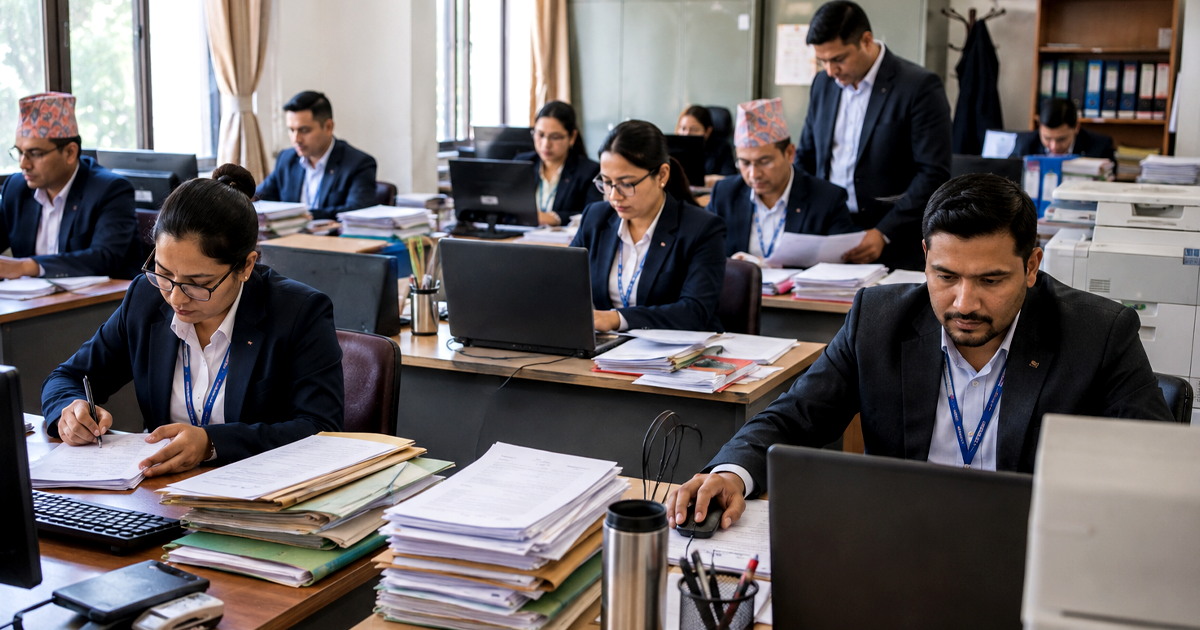

Kathmandu: Over the last 66 years, the salaries of government employees in Nepal have undergone 31 adjustments. While some of these increments were categorized merely as dearness allowances to combat inflation, there have been 31 distinct instances where the core pay scales were officially revised. These changes reflect the shifting economic landscape of the country since the fiscal year 1960/61 (2017 BS).
The salary of a Section Officer has seen a massive 192-fold increase during this period. Records show that in 1960, a Section Officer earned a starting salary of just Rs 275 per month. According to data from the Department of Civil Personnel Records (Rastriya Kitabkhana), that same position now commands a monthly salary of Rs 52,864 as of mid-2026. This trajectory highlights the significant nominal growth in government compensation over more than half a century.
Interestingly, data reveals that lower-level employees have experienced a much higher rate of salary growth compared to their senior counterparts. For instance, the position of Kharidar (Junior Assistant), which paid only Rs 120 in 1960, has now reached Rs 39,811, representing a staggering 331-fold increase. Similarly, the salary for a Nayab Subba (Non-gazetted first-class officer) has grown by 240 times.
This disparity in growth rates stems from a deliberate government policy aimed at ensuring social justice and uplifting the living standards of support staff by focusing more heavily on basic pay increments for the lower tiers.
When analyzed through the lens of Compound Annual Growth Rate (CAGR), civil service pay has grown at an average annual rate of 7.2 percent to 9.1 percent. The Kharidar level saw the highest annual growth at 9.17 percent, while the Section Officer level grew by an average of 8.31 percent per year. These figures indicate a consistent effort by successive administrations to adjust pay in line with the changing times.
However, economists point out that while these numbers appear impressive on paper, the real-world purchasing power of civil servants tells a different story. When accounting for decades of high inflation and the sharp devaluation of the Nepalese Rupee against the US Dollar, the actual value of these earnings has struggled to keep pace. Experts argue that the Rs 275 earned in 1960 could purchase a far greater quantity of gold, land, and essential food supplies than today’s Rs 52,000 can provide, suggesting that the nominal “192-fold increase” has not translated into a proportional increase in financial well-being.

Comment Here