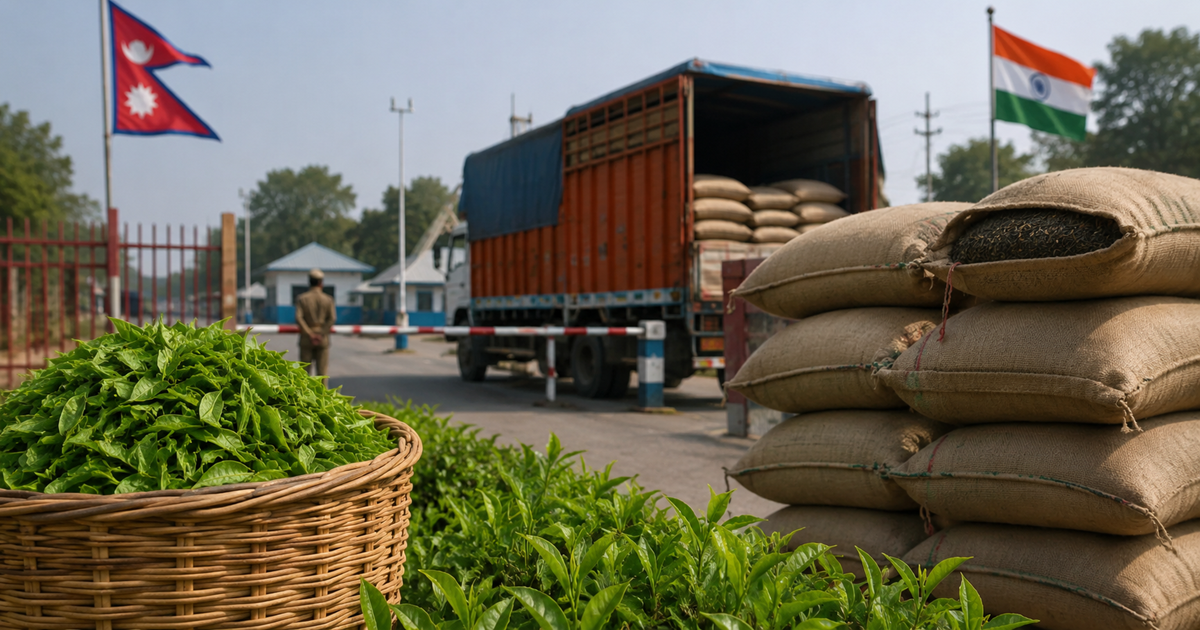

Kathmandu: The Indian Tea Board has once again imposed non-tariff barriers on the export of Nepali tea, bringing shipments through the Mechi customs point to a complete standstill for the past week. This latest disruption follows a previous 21-day halt that began on May 1, when India introduced a new Standard Operating Procedure (SOP) requiring mandatory laboratory testing for all tea entering the country from Nepal.
That initial three-week blockage was temporarily resolved after the Indian Tea Board agreed to ease its stance. Under the revised agreement, tea consignments intended for internal consumption in India were to be subject only to random sampling rather than a full inspection of every truck, allowing trade to briefly resume.
However, officials at Mechi Customs report that despite the border technically being open, no exporters have come forward to file the necessary paperwork for tea clearance over the last seven days.
Business insiders explain that although a few trucks did manage to cross over after the new provisions were announced, the Indian Tea Board shifted its tactics. Inspectors began visiting importers’ warehouses to pull samples from every single bag of tea for laboratory analysis. Crucially, authorities issued orders that none of the tea could be sold or moved until the final laboratory reports were received, effectively freezing the stock and forcing a fresh halt to exports.
Aditya Parajuli, President of the Nepal Tea Producers Association, stated that the export flow has been crippled because India has essentially reverted to a 100 per cent testing requirement despite a prior written commitment to use older, more flexible protocols. He clarified that while there are no immediate logjams at the Panitanki customs office or the Indian Tea Board’s border stations, the trouble starts as soon as the tea arrives at the importers’ warehouses. The mandate to sample every bag and ban sales until cleared has made it impossible for businesses to continue shipping.
Currently, more than half a dozen trucks loaded with Nepali tea are stranded in Kolkata. Although samples were collected for testing over a week ago, lab reports are still pending, and the cargo remains locked in warehouses. Parajuli noted that this bottleneck is the primary reason exporters have stopped sending new shipments, as the entire process has become unpredictable.
Following the previous month’s dispute, there was an understanding that tea could be sent based on “provisional certificates” after initial sampling at the border. However, the process has now collapsed in Kolkata because the food testing laboratories lack the necessary technical staff to collect and process the samples on time. At present, six trucks have been waiting for over ten days; only two have received reports, while the samples for the others have not even been processed, leaving approximately 50,000 kilograms of tea in limbo.
The situation is further complicated by new administrative hurdles where Indian importers must upload exhaustive details, including arrival dates, warehouse locations, and container specifics, to the “Tea Council” portal before the tea even reaches India. Only after this digital filing can they receive a Provisional Clearance Certificate, a process that can take up to two weeks. The Indian Tea Board has also mandated that the tea be stored in specific, designated warehouses for 14 to 20 days during the testing period, during which time it cannot be sold or re-exported.
Furthermore, exporters are now burdened with a testing fee of 11,120 Indian Rupees (approximately 17,800 Nepali Rupees) per sample, plus additional Goods and Services Tax (GST). In response to these escalating costs and delays, tea stakeholders have reached out to the Nepali Embassy in India.
With Rastriya Swatantra Party Chairman Rabi Lamichhane currently visiting India, the industry is urging the diplomatic mission to advocate for a permanent solution to these recurring non-tariff barriers.
Industry leaders warn that these disruptions impact more than just bilateral trade; since India serves as a transit point for Nepali tea destined for third countries, the entire export system is being jeopardized. Shivakumar Gupta, President of the CTC Tea Producers Association, accused Indian authorities of using technical and administrative pretexts to discourage Nepali farmers and industrialists.
Nepal produces roughly 26 million kilograms of tea annually, with nearly 90 per cent of its orthodox tea destined for export. Since 80% to 90% of these exports are dependent on the Indian market, the current stalemate poses a severe threat to the economy of eastern districts like Ilam, Jhapa, Panchthar, Dhankuta, and Terhathum, where the tea is primarily grown.

Comment Here