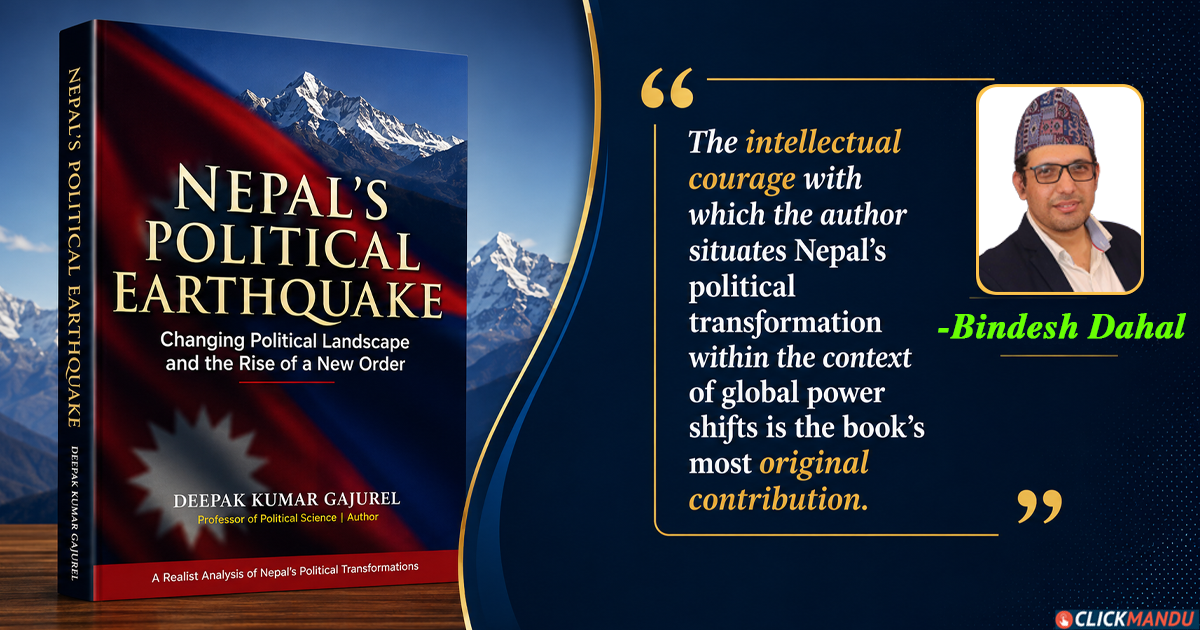

In every sense of the word, March 2026 registered as an earthquake in Nepal’s political history. Rastriya Swatantra Party (RSP), an organization barely four years old, won 182 of 275 seats in the House of Representatives and secured a democratic mandate without precedent in Nepal’s multi-party era.
The book that was needed to understand, analyze, and document this extraordinary political transformation for coming generations has arrived in the form of Prof. Deepak Kumar Gajurel’s Nepal’s Political Earthquake.
This work is not merely an analysis of a single election result. It is an ambitious intellectual undertaking that weaves together three interlocking narratives, thirty-five years of ‘democratic’ governance failure, the electrifying Generation Z uprising of September 2025, and the RSP’s historic landslide win into a single, coherent account.
The Carnegie Endowment for International Peace has described this election outcome as ‘one of the most consequential electoral results in South Asian democratic history,’ and this book is the document that does justice to that significance.
Prof. Gajurel is a retired Professor of Political Science at Tribhuvan University who has studied and analyzed Nepal’s political life at close quarters for more than thirty-five years. Alongside his academic career, he has written analytical and research-based articles for numerous prestigious national and international publications. This book benefits from both the scholarly analytical depth and the huge amount of hard evidence.
Gajurel’s intellectual credentials carry particular weight because he has observed Nepal’s most pivotal political transitions from the front row: the Jana Andolan of 1990, the decade of Maoist violent insurgency, the Jana Andolan II of 2006, and the proclamation of the republic. Having retired from Tribhuvan University four years ago and more recently serving as Campus Chief of Roopnagar Nandaraj Sangraula Campus in Saptari, Prof. Gajurel brings to this work a scholar’s rigour combined with a profound love for and commitment to his motherland, a quality that shines through on every page.
Comprising thirteen chapters, three appendices, an extensive bibliography and a glossary, this book has succeeded in becoming an indispensable reference work for anyone who wishes to understand Nepal’s politics in its full complexity.
The first chapter establishes the historical backdrop, tracing Nepal’s political journey from unification to republic. The second chapter offers a hard-hitting accounting of thirty-five years of governance, from 1990 to 2025, and constitutes the moral spine of the entire work. The third chapter is the book’s analytical pivot: a detailed reconstruction of the Generation Z uprising of September 2025, covering the social media ban, the viral #NepoBaby campaign, the extraordinary Discord parliament through which an interim prime minister was nominated, and the events that followed.
The fourth chapter documents with painstaking precision the legal, constitutional and administrative machinery of the March 2026 election: voter roll updates, candidate nominations, counting procedures and final results. The fifth chapter addresses the central explanatory question, “Why did this political earthquake happen?”, through the RSP’s digital campaign architecture, the Balen Shah wave, the conversion of youth disillusionment into political energy, and the anatomy of the old parties’ catastrophic collapse.
The sixth chapter tests Nepal against the global power equation, examining the strategic interests of India, China and the United States, the challenge to the petrodollar system, and the direct impact of the Iran-Gulf War on Nepal’s economic stability. The intellectual courage to situate Nepal’s domestic political transformation within global power shifts is perhaps this book’s most original contribution to the genre.
Comprising thirteen chapters, three appendices, an extensive bibliography and a glossary, this book has succeeded in becoming an indispensable reference work for anyone who wishes to understand Nepal’s politics in its full complexity
Chapters seven through eleven analyze the implications of the election, the challenges and opportunities facing the new government, the composition of the new parliament, and the legislative agenda ahead. Chapter twelve, a comparative study of Sri Lanka’s Aragalaya, Bangladesh’s July Revolution, South Korea’s Candlelight Revolution and Taiwan’s democratic resilience, establishes a new standard for political analysis in Nepal. The thirteenth and final chapter, a philosophical reckoning within the triangle of ‘promise, peril and possibility,’ stands as one of the finest conclusions in recent Nepali political writing.
Prof. Gajurel integrates official Election Commission statistics, ANFREL observation reports and IFES analyses with a skill and thoroughness that no other analyst has matched. The province-by-province, party-by-party, and voter-demographic breakdown of the results is portrayed with exceptional granularity.
Table 4.3, presenting the full election results, the RSP’s 47.84 percent proportional vote share, the Nepali Congress’s 19.1 percent, and the CPN-UML’s 13.4 percent, alongside the author’s political interpretation, will serve as a permanent reference point in Nepal’s political literature.
The intellectual courage with which the author situates Nepal’s political transformation within the context of global power shifts is the book’s most original contribution. Drawing on his companion analytical paper, Nepal in the World Power Equation and Geopolitical Clash, Gajurel’s framework connecting Nepal’s five major political transformations to corresponding global power transitions is thought-provoking and genuinely novel.
His analysis of the petrodollar system’s challengers and the direct impact of the 2026 Iran-Gulf War on millions of Nepali remittance workers is the kind of geopolitical writing that is rarely attempted and even more rarely executed with such clarity.
The analysis of the September 2025 uprising is the fulcrum of the entire book. Drawing on international reporting from the Harvard Atrocity Prevention Lab, the Congressional Research Service, Foreign Policy magazine and The New Humanitarian, Gajurel constructs a detailed chronology of those eleven days (September 4 to 15) that will endure as a permanent historical record. From the #NepoBaby campaign to the Discord parliament, from VPN-enabled protest coordination to a bereaved mother going to the polling station because she believed her son’s death should mean something, every dimension is handled with both factual precision and genuine humanity.
‘Revolutionary Elections in South Asia and Beyond’ sets a new standard for political analysis in Nepal. Placing the RSP’s rise alongside Sri Lanka’s Aragalaya, Bangladesh’s July Revolution, South Korea’s impeachment of President Park Guen-Hye and Taiwan’s democratic resilience, and drawing on the global evidence about when anti-establishment parties succeed or fail, this chapter contextualizes Nepal’s transformation in ways that enrich understanding on every page.
Rather than glorifying the RSP’s extraordinary mandate, the book subjects the challenges of governance to equally rigorous analysis: the experience gap of first-time legislators, the expectation trap created by sweeping promises, bureaucratic resistance, fiscal constraints, and the internal dynamics of a party held together by the urgency of a historic moment. This balance is the hallmark of a genuinely authoritative scholar.
Nepal’s political literature has not previously produced a book that simultaneously encompasses historical background, economic analysis, the digital revolution, geopolitics, electoral mechanics, comparative politics, and the challenges that lie ahead, all woven into a single coherent narrative. Earlier works were either too sweeping in scope or too narrow in focus. This book, for the first time, holds Nepal’s politics in its complete complexity.
The depth of province-by-province, party-by-party and voter demographic analysis confirms the author’s unmatched command of electoral data. The Global Reset theory and the framework connecting Nepal’s five political transformations to global power shifts confirm the book’s claim to an original geopolitical contribution. The author’s grasp of social dynamics is demonstrated in his treatment of the Generation Z uprising and of the psychology of the Madheshi voter.
Most importantly, this is not the kind of dry academic treatise that tests the reader’s patience. Its prose is precise and vivid. The tribute paid to the seventy-six young people who died in September 2025, and the author’s honest admission that he felt genuine hope for the first time in many years, lift the book above clinical political analysis into something that can fairly be called a human document. In the words of the conclusion: ‘The voter did not ask which caste the RSP candidate belonged to. They asked: will this person do the job? That question, simple, demanding, and democratic, is the most hopeful thing about this election.’
One of the most compelling sections of the fifth chapter is devoted to the Balen Shah factor, which the book describes as an electoral force multiplier. That a thirty-five-year-old structural engineer and rapper, campaigning on the promise of becoming Nepal’s first Madheshi prime minister, should win 30 of Madhesh Province’s 32 constituencies is a development without precedent in Nepali political history.
Gajurel analyzes the political significance of this achievement as ‘the paradoxical end of decades of Madheshi identity politics,’ for a Madheshi-origin leader of a national party accomplished what regional Madheshi parties had never managed across their entire existence.
The symbolism of defeating KP Sharma Oli in his own home constituency of Jhapa-5, by a margin of nearly seventy thousand votes, the highest individual FPTP total in Nepal’s electoral history, cannot be overlooked by any serious political analysis. Gajurel registers this as a landmark in the democratic record and unpacks its social and cultural meaning with characteristic precision. When Shah declared at a rally in Janakpur that ‘a Madheshi boy is going to become prime minister,’ the statement went viral within hours, and the election result confirmed that it had resonated far beyond partisan sentiment.
The second chapter, the book’s moral spine, contains what is arguably the most unflinching assessment of Nepal’s multi-party governance record yet committed to print. After reading it, the question of why voters brought about this revolutionary transformation answers itself.
The book’s analysis of the RSP’s Citizen Contract, and of the hundred-point Governance Reform Agenda released within twenty-four hours of the Balen government taking office, is among its most praiseworthy sections
The numbers are damning: more than thirty governments in thirty-five years with not a single one completing its full constitutional term; GDP growth averaging 4.5 percent against a target of 7 to 8 percent; half a million labour permits issued annually, sending young Nepalis to Gulf labor camps; a ranking of 107th out of 180 countries on Transparency International’s Corruption Perceptions Index; 43 percent of citizens surveyed by Transparency International Nepal reporting direct experience or witness of bribery in government recruitment. These statistics do not describe episodic failure; they describe a structural collapse of public governance.
What distinguishes this reckoning is its balance. The author presents the history with sympathy as well as unflinching honesty. He acknowledges the real gains achieved across the democratic era, in maternal health, in literacy rates, in poverty reduction, while making clear that the gap between what was promised and what was delivered had become, by 2025, simply intolerable to an entire generation of citizens. That balance is the mark of a mature scholar rather than a partisan polemicist.
The book’s analysis of the RSP’s Citizen Contract, and of the hundred-point Governance Reform Agenda released within twenty-four hours of the Balen government taking office, is among its most praiseworthy sections. Prof. Gajurel describes this agenda as ‘one of the fastest major policy announcements in Nepal’s modern political history’ and subjects its detailed contents to both tabulated documentation and critical evaluation.
The concept of a ‘faceless government’ through e-governance, the investigation of public officeholders’ assets going back to 1990, merit-based judicial appointments, and the abolition of party-affiliated trade unions in public institutions, each of these commitments is assessed for both its transformative potential and its implementation risks. And when Gajurel concludes that ‘the hundred-point agenda is the necessary beginning of transformation, not its sufficient condition,’ the intellectual honesty of the statement rings clear. The author does not allow his evident hope for Nepal’s democratic renewal to outrun his analytical rigour.
Like every ambitious book, this one has limitations that an honest reviewer must acknowledge. First, the book’s ambition occasionally comes at a cost to depth. Across thirteen chapters and 504 pages covering an enormous range of subjects, certain topics, the specific complexities of federalism implementation, or the particular challenges facing Dalit political representation, receive somewhat less granular treatment than the author would doubtless have wished.
Second, the recency of the events being described means that the ultimate performance of the RSP government remains to be assessed. The author is transparent about this constraint, and future editions will have the opportunity to fill that gap as the historical record develops.
Third, while Rabi Lamichhane’s legal difficulties are documented with factual accuracy, the long-term political implications of those proceedings for the RSP’s internal cohesion and its anti-corruption brand could have sustained an even fuller treatment.
None of these observations diminishes the book’s overall achievement. They are the natural limitations of an undertaking of this scale, tackled at this historical moment.
This book is essential reading for four distinct audiences. For political scholars, it will serve as the reference work for research on Nepal’s contemporary democratic politics. For policymakers, it provides a detailed map of the possibilities and challenges of governance reform. For journalists and civil society, it offers an accessible and comprehensive portrait of Nepal’s political economy that is difficult to find elsewhere. And most importantly, for every Nepali citizen who wishes to understand in depth what this historic transformation means and where it may lead.
For international readers, particularly those with an interest in South Asian politics, the book constructs a vital bridge between Nepal’s political transformation and global democratic trends, situating a small Himalayan nation within the broader story of generational politics, digital mobilization, and the worldwide demand for accountable governance.
Nepal’s Political Earthquake is not merely the analysis of a political event; it is evidence of a nation’s capacity for self-correction. It is the record of a democracy that, even after thirty-five years of failure, found the institutional courage to demand something genuinely better through its own constitutional mechanisms. The seventy-six martyrs of September 2025, the nineteen million voters of March 2026, and the dream of transformation that animated both are captured in the book. In the judgment of this reviewer, this book is an honourable contribution to Nepal’s political literature.
Book: Nepal’s Political Earthquake: Changing Political Landscape and the Rise of a New Order
Author: Prof. Deepak Kumar Gajurel, Tribhuvan University
Year of Publication: 2026 (Amazon.com)
Pages: 588
Available in English on Amazon.com:

Comment Here