
Kathmandu: Residents of the Kathmandu Valley, long exhausted by chronic traffic congestion and a disorganized transportation network, finally have a reason for optimism.
The government has officially launched the formal process to realize its ambitious “dream project”—the introduction of a state-of-the-art rail service designed to modernize the capital’s transit landscape.
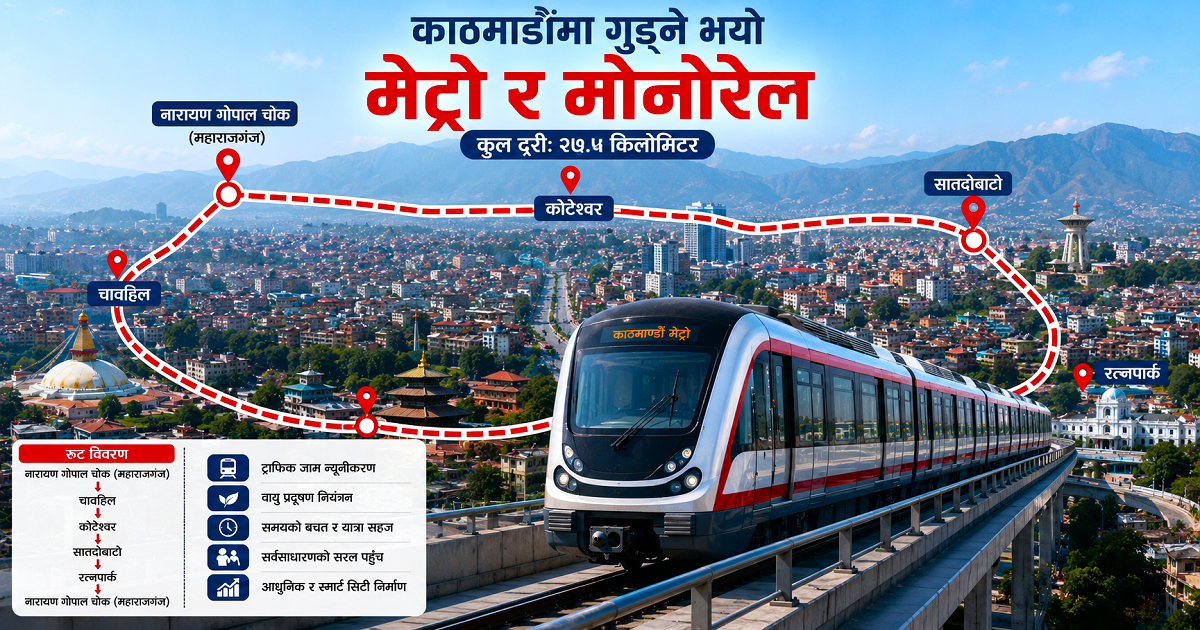
The Railway, Metro Rail, and Monorail Development Project has issued an international call for Expressions of Interest (EOI) to prepare a Detailed Project Report (DPR) for a 27.5-kilometre rail line. This strategic route is intended to link the valley’s primary hubs, and its completion is expected to usher in a new era for Kathmandu’s urban mobility.
As rapid urbanization, narrow infrastructure, and a surging volume of vehicles make daily commuting increasingly arduous, the need for a high-capacity transit system has become critical. Currently, travellers often spend hours stuck in gridlock while trying to reach Narayangopal Chowk or Satdobato from the city centre at Ratnapark. This proposed 27.5-km rail network is envisioned as a permanent solution to these systemic traffic woes.
Beyond simply offering a new way to travel, the project is viewed as a cornerstone in evolving Kathmandu into a sophisticated “Smart City.” Once operational, the rail system will significantly curb fuel consumption, lower air pollution levels, and return thousands of hours of lost time to the general public.
The proposed route is designed to cover the valley’s busiest commercial and administrative corridors. According to the master plan, the railway will operate as a comprehensive loop, starting from Narayangopal Chowk in Maharajgunj and passing through Chabahil, Koteshwor, Satdobato, and Ratnapark before returning to its starting point. By integrating a major portion of the Ring Road with the city’s inner core, the line aims to provide direct transit access to nearly half of the valley’s population.
Recognizing the technical complexity and high stakes of the venture, the government is seeking expertise from the global stage. This ensures that the study and design phases are spearheaded by the world’s leading rail engineering firms. To kickstart this mega-project, a formal public notice was issued on May 14, inviting qualified international companies to submit their credentials.
Addressing potential concerns regarding financing, official documents reveal that the government will utilize its own internal budget to fund the preparation of the DPR. This commitment demonstrates the state’s resolve to move the project forward using domestic resources, ensuring it progresses from a conceptual plan to a tangible reality.
To ensure the highest standards of quality, a transparent and rigorous selection process for consultants has been established. Proposals will be evaluated based on a 100-point merit system, where 50 points are allocated for professional qualifications, 40 points for technical experience, and 10 points for organizational capacity.
Only firms that secure a minimum score of 70 percent will be eligible for shortlisting, ensuring that only the most capable experts map out the city’s future rail infrastructure.
Interested international firms must submit their Expressions of Interest by June 15, 2026. In a move to ensure total transparency and modern administrative standards, the government has mandated that the entire application process be conducted digitally through the national e-GP (electronic Government Procurement) system.

Comment Here