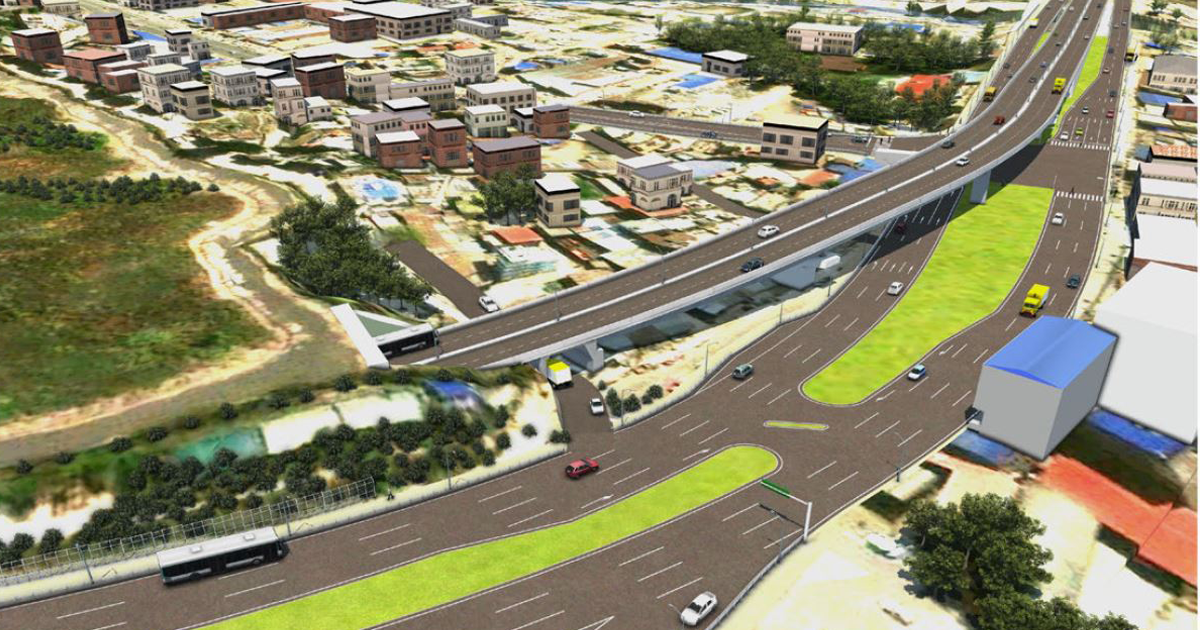

Kathmandu: The Japan International Cooperation Agency (JICA) has prioritised a specialised “Road Improvement Project including Flyover and Underpass” designed to minimise property damage and significantly reduce chronic traffic congestion at Kathmandu’s Koteshwor intersection.
Among the alternatives studied for the Koteshwor-Jadibuti-Tinkune section, JICA has identified the ‘TK-2R’ model as the most viable option due to its technical, social, and environmental advantages. This selection was formalized in the approved Initial Environmental Examination (IEE) report, which confirms that this specific design is the most suitable path forward for the multi-level infrastructure.
A formal loan agreement between the governments of Nepal and Japan was signed on December 2, 2023, to facilitate the construction of this integrated transport system. The signing ceremony took place in the presence of high-ranking officials, where the exchange of notes was finalized by the Finance Secretary and the Japanese Ambassador, while the loan agreement was signed by representatives from the Ministry of Finance and JICA Nepal.
Under this agreement, Japan is providing a soft loan of 34.59 billion Japanese Yen, which is approximately 31.76 billion Nepali Rupees. The loan terms are highly concessional, featuring a 0.2 percent annual interest rate, a 10-year grace period, and a total repayment duration of 30 years.
The TK-2R model was selected over other options like ‘TK-3’ because it strikes a better balance between technical efficiency and social impact. While both designs proposed modern multi-level traffic systems, the TK-2R model was ultimately favoured because it requires significantly less private land acquisition and faces fewer local disputes. The vision presented in the IEE report is to transform the Koteshwor-Tinkune area into Nepal’s first “grade-separated smart traffic corridor,” addressing the urgent need to eliminate hours of daily traffic jams, reduce excessive fuel consumption, and curb rising air pollution levels.
Technically, the project involves a 1.8-kilometre stretch of integrated multi-level road structures. This includes a 440-metre flyover in the Jadibuti area, followed by a 640-metre underpass tunnel built beneath the premises of Tribhuvan International Airport, and finally, another 400-meter flyover in the Tinkune area. This combined system of flyovers and underground tunnels will be the first of its kind in Nepal. The proposed road width is set at a minimum of 15 meters, with some sections potentially being wider following the final detailed design.
The primary goal of the TK-2R design is to create a “signal-free” traffic flow, allowing vehicles arriving from the Manohara Bridge to travel directly toward Tinkune via elevated or underground routes without stopping at Koteshwor Chowk. By utilizing government land on the airport side for the underpass, the project avoids encroaching on the dense commercial settlements on the western side of Koteshwor. The plan aims to limit private land acquisition to approximately 2,503 square metres, mostly in the Jadibuti area, affecting roughly 18 private structures such as hotels, workshops, and retail shops.
The alternative TK-3 model was considered technically robust by the Department of Roads, but it was set aside due to potential social unrest. That design would have required more land in the Tinkune area, which is already embroiled in long-standing legal and compensation disputes regarding previous road expansions. To avoid further legal delays and social tension, the TK-2R model was deemed a much safer and more practical choice. JICA’s geotechnical studies have already confirmed that constructing a tunnel under the airport is feasible, providing confidence in the project’s implementation.
The project is expected to yield massive economic and environmental benefits for the state. By eliminating idling in traffic, the project will drastically reduce fuel imports and save valuable time, thereby boosting national productivity. Environmental assessments suggest that the project will reduce carbon dioxide emissions by about 1,139 tons annually, supporting Nepal’s climate goals. The modern infrastructure will also include advanced ventilation in the tunnel, scientific drainage systems, safety monitoring, and high-tech traffic signals.
For the general public, the completion of this project promises a transformation in daily commuting. It will ensure that public transport is more regular and faster, while also providing safe, dedicated walkways for pedestrians and reducing the risk of accidents. Beyond the convenience, the reduction in noise and air pollution will contribute to better public health. Experts believe that the successful execution of this project will serve as a blueprint for modernizing other complex intersections across the Kathmandu Valley in the future.

Comment Here