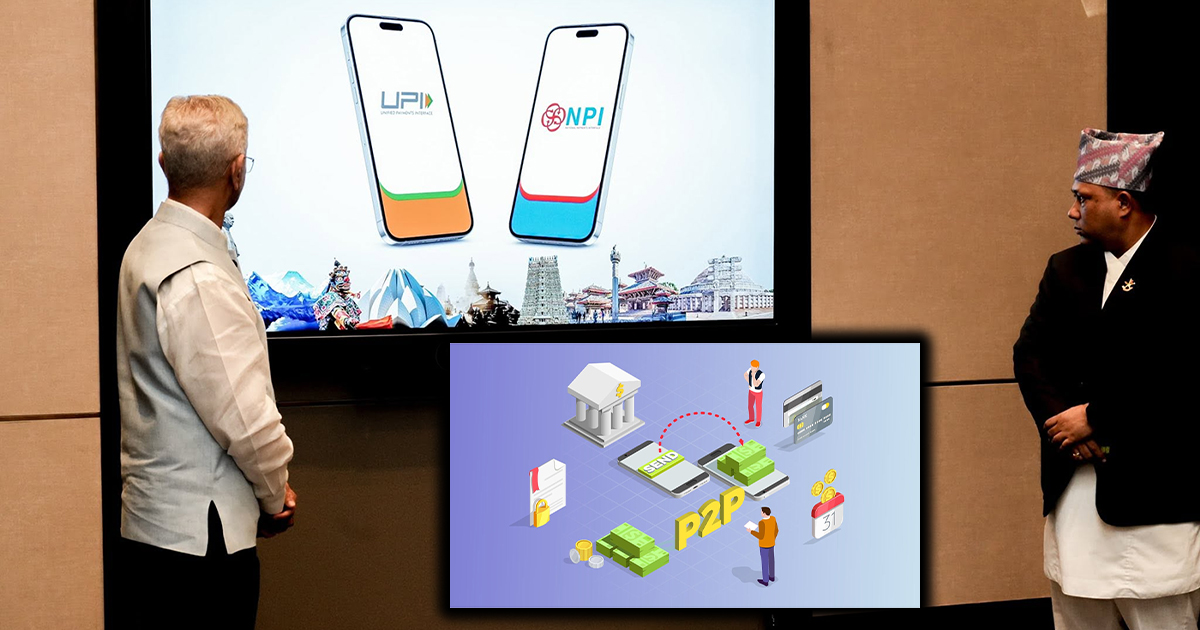

Kathmandu: Nepali citizens working in India and Indian nationals employed in Nepal can now send remittances across the border through digital channels.
This significant development was jointly announced following a meeting between Nepal’s Foreign Minister Shishir Khanal and his Indian counterpart, Dr. S. Jaishankar, during Khanal’s official visit to India. While the groundwork for cross-border digital payments was initially laid in 2023, this move officially operationalizes person-to-person (P2P) transfers between the two neighbours.
The initiative is the direct result of a 2023 agreement between the Nepal Clearing House (NCHL) and the National Payments Corporation of India (NPCI). According to Nilesh Man Pradhan, Chief Executive Officer of NCHL, the P2P system is now active, allowing for real-time fund transfers. Under this arrangement, Indian citizens in Nepal can remit money home based on the terms and limits set by the Nepal Rastra Bank, while Nepalis in India can instantly transfer funds directly into bank accounts in Nepal via digital platforms.
This official integration effectively links Nepal’s National Payment Interface (NPI) with India’s Unified Payments Interface (UPI). The Nepal Clearing House emphasized that this collaboration marks a new era in formalizing and securing cross-border financial flows. This follows a policy shift by the Nepal Rastra Bank in March 2024, which amended foreign exchange directives to facilitate digital cross-border transactions. While merchant-based payments for tourists had already begun through networks like PhonePe, this new phase focuses specifically on individual-to-individual digital remittances.
Regarding specific transaction caps, Indian nationals working in Nepal are permitted to exchange and remit their salaries through commercial and national-level development banks. Using mobile banking or QR codes via the National Payment Switch, they can send up to 15,000 Indian Rupees per day, with a monthly ceiling of 100,000 Indian Rupees. NCHL CEO Pradhan confirmed that these transfers will occur strictly within these established regulatory boundaries to ensure compliance and financial security for the workers.
Conversely, for remittances flowing from India to Nepal, the system utilizes the National Payment Switch to deposit funds directly into individual accounts in Nepali banks. In addition to the existing Indo-Nepal Remittance Facility Scheme, this digital route allows for greater flexibility and speed. The Reserve Bank of India has set a transaction limit of 200,000 Indian Rupees for these transfers. Furthermore, Nepali businesses are also equipped to receive foreign currency payments from international tourists through cross-border QR code systems, a sector that reportedly saw a turnover of 710 million Rupees in April 2026.
The launch of this P2P service is expected to drastically simplify the remittance process for hundreds of thousands of migrant workers, providing a secure and instantaneous alternative to traditional, often slower methods. By strengthening economic ties and promoting financial inclusion, the Nepal Clearing House believes this will serve as a cornerstone for future digital cooperation. Looking ahead, the next objective for the clearing house will be to fully implement Person-to-Merchant (P2M) cross-border payments, further integrating the daily financial ecosystems of both nations.

Comment Here