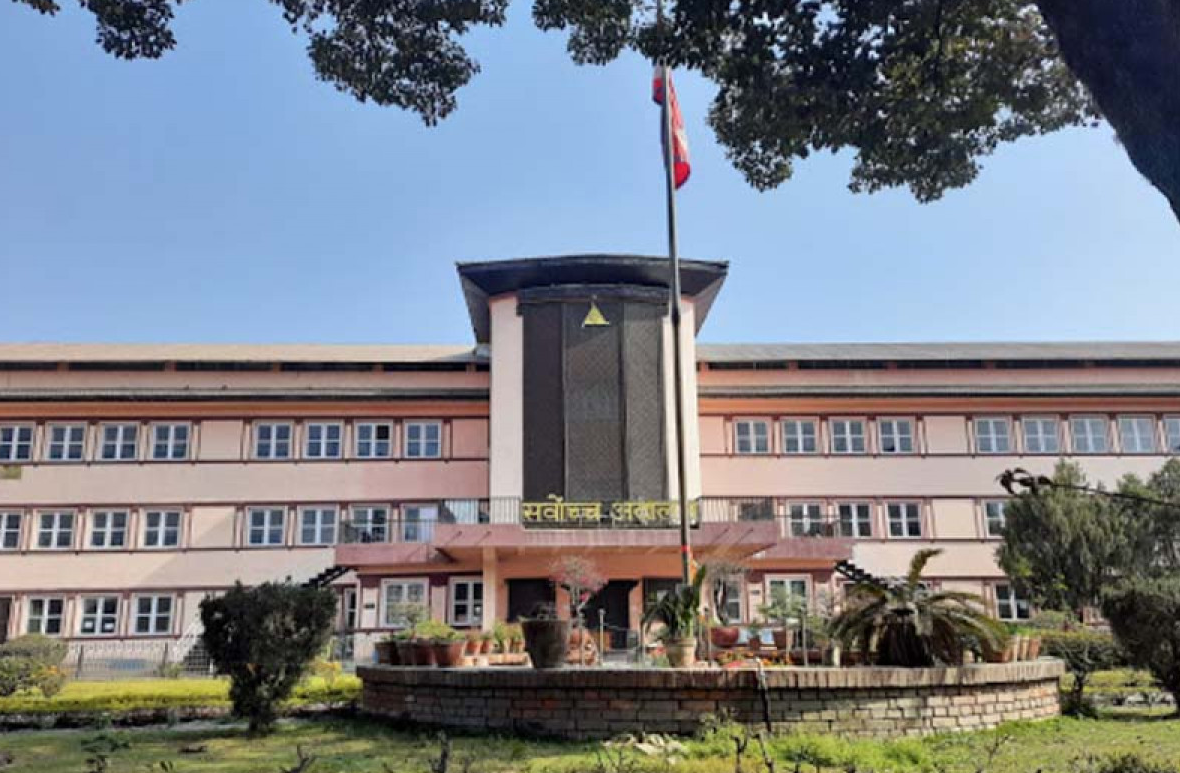

Kathmandu: The Supreme Court of Nepal has ruled that extending an employee’s service period for pension eligibility is a discretionary administrative power of management rather than an inherent legal right of the staff. This clarification was made as the court dismissed a writ petition filed by Bamdev Sigdel, a former Executive Director of the Nepal Rastra Bank (NRB). The court emphasized that such extensions are subject to the judgment of the bank’s leadership and do not constitute an obligatory entitlement for employees.
Under the Nepal Rastra Bank Employee Service Bylaws of 2011, there is a provision stating that employees who have completed at least 15 years of service, have not taken extraordinary leave, and have maintained a performance score of over 75 percent in their last three years may have their service period extended by up to five years. This extension is intended to help employees reach the 20-year service threshold required to qualify for a lifetime pension.
The petitioner, Sigdel, moved the court seeking a writ of mandamus, claiming that he met all necessary criteria and that the bank had unfairly deprived him of his pension by refusing to grant an extension. He argued that the bylaws were designed to protect employees in his position and that the bank was legally bound to recognize his eligibility once the conditions were met.
The specific regulation cited in the case stipulates that for employees who have served between 15 and 18 years, the board may add up to five years of service upon the recommendation of the recruitment committee, regardless of age limits. Sigdel used this clause as the primary foundation for his legal challenge against the central bank’s management.
However, the Supreme Court focused on the specific legal phrasing within the bylaws, particularly the term “may,” interpreting it as a grant of discretionary authority to the board rather than a mandatory requirement. The court noted that it can only issue an order when the law explicitly states a benefit “must” be provided.
Since the authority to grant the extension remains vested in the management based on the recruitment committee’s recommendation, the court found no grounds to compel the bank to act.
A key factor in the ruling was the fact that Sigdel had already accepted a gratuity payment of approximately 2.11 million NPR following his retirement. The court applied the “principle of estoppel,” ruling that once an individual voluntarily accepts a retirement payout, it is legally inconsistent to later claim pension benefits.
The judgment also noted that Sigdel was well aware of the 58-year age limit and the potential shortfall in his total service years at the time he entered his contract with the bank.
In reaching its decision, the Supreme Court also referenced established precedents, including the landmark case of Kedar Mainali vs. Rastriya Banijya Bank. That precedent holds that employees must abide by the terms of service agreed upon at entry unless a policy provides specific, mandatory protection.
The court further validated the bank’s concern that automatically granting such extensions could impose an immense financial burden on the institution and lead to the potential misuse of administrative regulations.

Comment Here