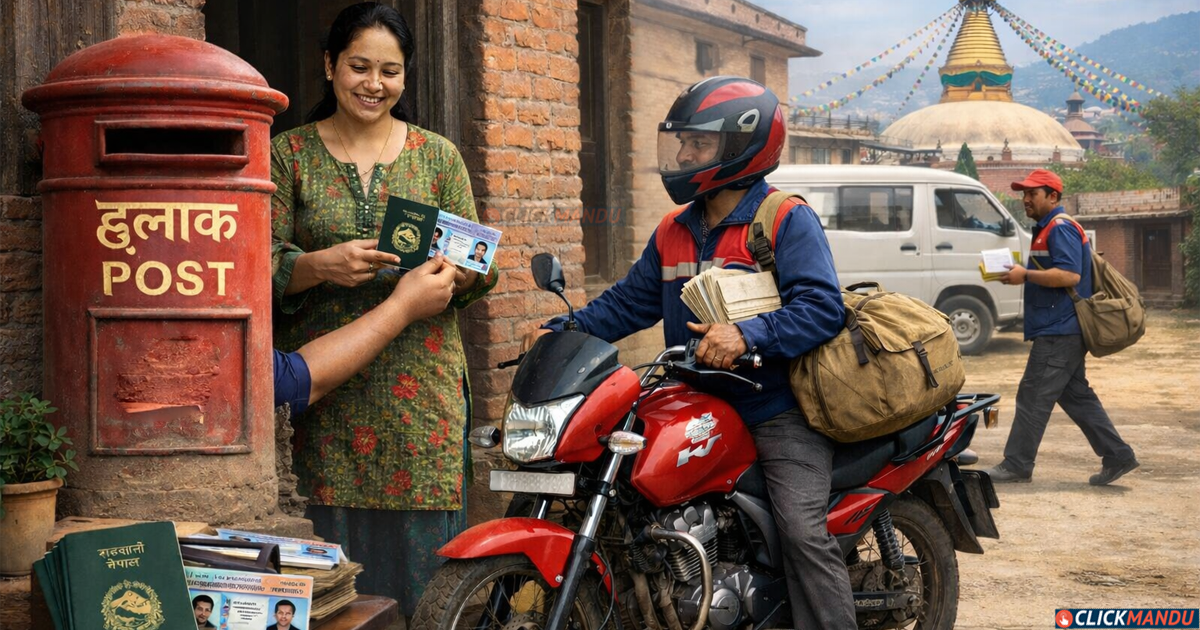

Kathmandu: The “Government Courier Service,” an initiative launched by the Department of Postal Services to bring government services directly to citizens’ doorsteps, has shown remarkable progress. As the department undergoes institutional reforms and embraces modern technology, essential items such as passports, driving licenses, medical supplies, academic certificates, and other official documents are now being delivered directly to people’s homes.
Following the formation of the new government, a 100-point governance reform agenda was introduced, including a mandate to revitalise the postal service and develop it into a dedicated government courier system. Point number 27 of this agenda explicitly stated that arrangements would be made to deliver government documents, including passports, citizenship copies, and driving licenses, directly to the residences of the public.
Manmaya Bhattarai Pangeni, the Director General of the Department of Postal Services, reported significant progress in implementing this reform, noting that several key components of the plan are now in their final stages. Minister for Information and Communications, Dr Bikram Timilsina, has been working tirelessly as the head of the lead ministry to ensure this vision is realized, and the tangible results of these efforts are now becoming evident.
Furthermore, the “Smart Post” concept and the subsequent Government Courier Service were successfully implemented through the continuous guidance of the Office of the Prime Minister and Council of Ministers, as well as seamless coordination with the Ministry of Home Affairs, the Ministry of Land Management, Cooperatives and Poverty Alleviation, and the Ministry of Federal Affairs and General Administration. Notably, this historic transformation is being spearheaded by a leadership team at the Department of Postal Services that includes Director General Pangeni alongside directors Jamuna Mishra and Sapna Kumari Bhattrai, among other female officials.
According to Director General Pangeni, since the formation of the new government up until June 18, 2026, a total of 181,843 passports have been transported via the postal service to respective District Administration Offices. Out of these, the department confirmed that 4,642 passports were delivered directly to the doorsteps of the service seekers.
Similarly, 578,053 driving licenses received from the Department of Transport Management were dispatched to various districts through the General Post Office. Of these, 1,081 licenses have already been distributed directly to homes in districts such as Kaski, Morang, Banke, Parsa, Sunsari, Kalikot, and Bajhang.
Regarding the plan to deliver academic certificates to homes, Director General Pangeni mentioned that discussions are currently underway with Tribhuvan University to finalize a transportation agreement. While the agreement has not yet been formalized due to the current vacancy of university officials, the department noted that the process of transporting 266 academic certificates has already commenced.
Collaborations within the health sector have also been expanded. Following a supplementary agreement with the National Public Health Laboratory, 1,124 laboratory samples have been transported. Additionally, mail transport operations were initiated following an agreement between the National Health Education, Information and Communication Centre and the Department of Postal Services on May 15, 2026. A similar partnership was signed with the Health Insurance Board on June 1, 2026, with medical supply delivery services beginning the very next day.
To enhance the efficiency of mail management, the department has reviewed and updated mail routes by conducting interaction programs across all provinces and applicable districts. These new mail routes were developed through detailed discussions involving representatives from all provincial offices.
A committee comprising representatives from the Ministry of Home Affairs, the Ministry of Federal Affairs and General Administration, the Ministry of Information and Communications, the Survey Department, the National Statistics Office, and the General Post Office approved and implemented these new routes based on recommendations received from the local districts.
In a push for digital transformation, the department has upgraded the Postal Internal Tracking System (PITS) and transitioned the postal code system to a more efficient seven-digit format.
To develop an integrated service between the Department of Passports and the postal system, consultations were held between the Ministry of Information and Communications, the Department of Information Technology, the General Post Office, the Department of Passports, and the Ministry of Foreign Affairs, with a study team already submitting its final report.
To modernize and scientifically organize the postal address system, Nepali scientists Ram and Laxman have proposed a new system to support the department, which they offered to provide free of cost. The department stated that this proposal has been reviewed, and a report has been submitted to the Ministry.
Furthermore, a technical team conducted a “Gap Analysis” to modernize the technologies currently used in the postal service, and the resulting report was forwarded to the Office of the Prime Minister and Council of Ministers via the Ministry of Communications.
Significant progress has also been made in international courier services. In coordination with the Nepali Embassy in Belgium, discussions were held between Netherlands Post and Nepal Post to facilitate the smoother transportation of postal items.
As part of the improvements to foreign postal services, arrangements have been made to ensure that the Foreign Post Customs Office and the National Commerce Bank counter remain operational even on days when the post office is open.
Additionally, a fast-track system has been implemented at Tribhuvan International Airport to speed up the transport of international postal items. The department also noted that the Universal Postal Union provided necessary facilitation after being requested to circulate a notice to all member nations regarding the effective management of international postal fees. According to the department, 143,170 parcels, letters, and EMS items were transported through the post as of June 18, 2026.
To improve the quality of service delivery, refresher training sessions have been conducted across various offices. The department also mentioned that it has been seeking feedback and suggestions from various local levels to make postal services more effective.
In an effort to increase non-tax revenue and ease service delivery, an agreement was made with the Security Printing Centre, resulting in the printing of 3,474,000 postage stamps. Designs for additional stamps have been approved and sent to the Security Printing Centre for production.
Under the plan to gradually transform post offices into “Smart Post Offices” as per the government’s annual policy, program, and budget statement, an evaluation was conducted based on approved criteria. On June 19, 2026, fifty IT-based post offices across the country were selected to be developed into Smart Post Offices.
Meanwhile, drafts for Memorandums of Understanding (MoUs) have been prepared for services including the distribution of Nepal Telecom SIM cards, “Leg-2” facilitation with Qatar Airways, and the doorstep delivery of certificates and documents for students of Nepal Open University. According to the department, these agreements are scheduled to be officially signed on June 22.
By implementing these policies, the government is successfully transitioning the postal service from a traditional letter-exchange medium into a modern “Government Courier Service,” steadily expanding its scope to ensure that passports, licenses, academic certificates, medical supplies, and other vital documents reach citizens at their doorsteps.

Comment Here