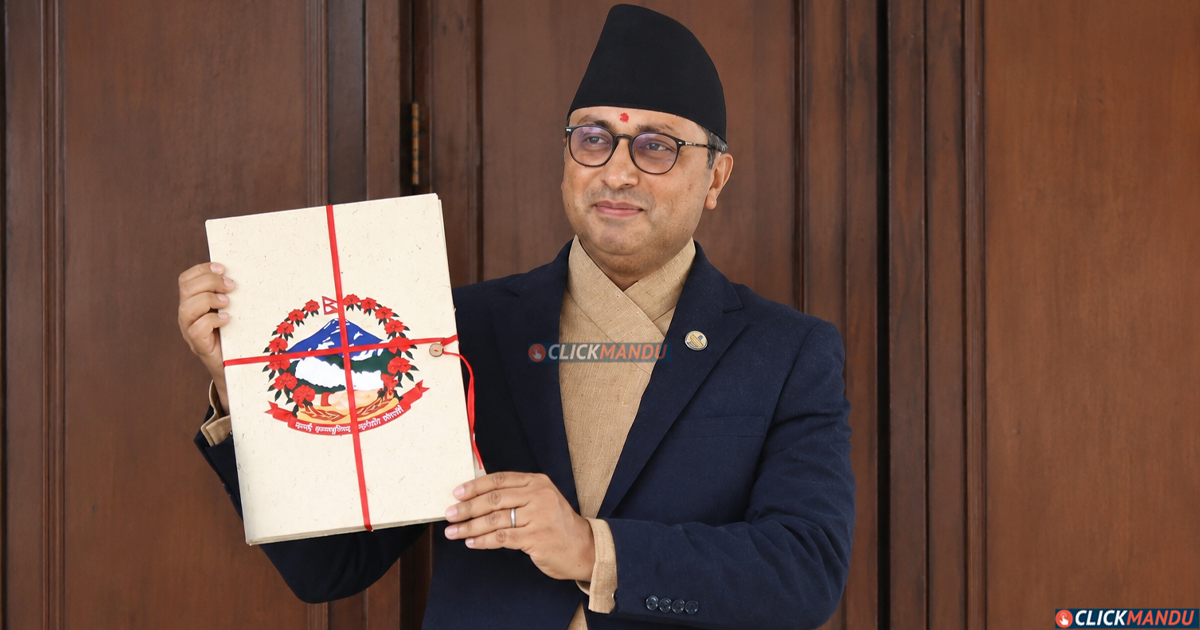

Kathmandu: Many had hoped that Finance Minister Dr Swarnim Wagle would provide a sustainable solution to the long-standing financial crisis plaguing the national health insurance program.
As the state’s liability continues to swell, calls for a complete restructuring of the system have intensified, yet successive governments and ministers have found the issue to be an intractable headache. There was a widespread expectation that the new budget under Wagle’s leadership would unveil a more effective and stable framework for the programme.
While the Rastriya Swatantra Party (RSP) has only recently joined the government, critics argue that the administration should have at least presented a clear, solution-oriented roadmap. Instead, the government is facing intense criticism for narrowing the scope of health insurance and deciding to impose taxes on private hospital treatments. During the parliamentary discussions on the budget for the upcoming fiscal year 2026/27, opposition and even ruling party lawmakers characterized these moves as a “heartless” assault on the fundamental rights of citizens.
In the House of Representatives, RPP leader Gyan Bahadur Shahi accused the government of betraying its promise of free healthcare by taxing medical treatment and cutting off insurance access for millions of poor citizens. He argued that decreasing insurance reach without first upgrading the capacity, equipment, and staffing of government hospitals sends a cruel message that the state is not responsible for the lives of the impoverished.
Shahi further challenged the Finance Minister to experience the gruelling reality of state-run hospitals firsthand before choosing to collect taxes from those battling illnesses. Similarly, lawmakers from the Nepali Congress and CPN-UML, as well as fellow RSP members, questioned the ethics of taxing health and education, noting that over half the population relies on private healthcare.
Responding to the criticism, Finance Minister Wagle admitted that health insurance has become an incredibly thorny issue for both the Finance and Health ministries. He revealed that the financial burden has far exceeded initial projections; while only 10 billion rupees were originally allocated last year, the government has had to inject billions more, with total spending reaching nearly 19 billion rupees and another 5 billion currently being arranged.
Wagle emphasized that the current model, with its unlimited liabilities, is fiscally unsustainable in its present form and must be redesigned according to global insurance principles.
Regarding the future structure, Wagle noted that a study team led by Dr Toshima Karki is currently exploring various models in coordination with the Prime Minister’s Office. He stressed the need for a “Universal Risk Pool,” arguing that the system fails if healthy young people do not pay premiums while the sick and elderly do.
His vision for a contemporary insurance plan involves the state covering premiums for the indigent, while others contribute based on their capacity. He also suggested that revenue from “sin taxes” on tobacco, alcohol, and sugary products could be diverted to support the insurance fund, while maintaining that health insurance cannot be entirely free for everyone.
The debate comes at a critical time, as the government has suspended health insurance services at private hospitals, except for emergencies, since late May. The Health Insurance Board cited a severe financial crisis as the reason for this suspension, as it currently owes approximately 16 billion rupees to service providers. While private hospitals have long complained about delayed payments and procedural hurdles, the public’s frustration has been compounded by the new budget’s announcement of a 3 percent “Equity Fee” on private and community-based health and education services, a move seen by many as an additional tax on essential human needs.

Comment Here